
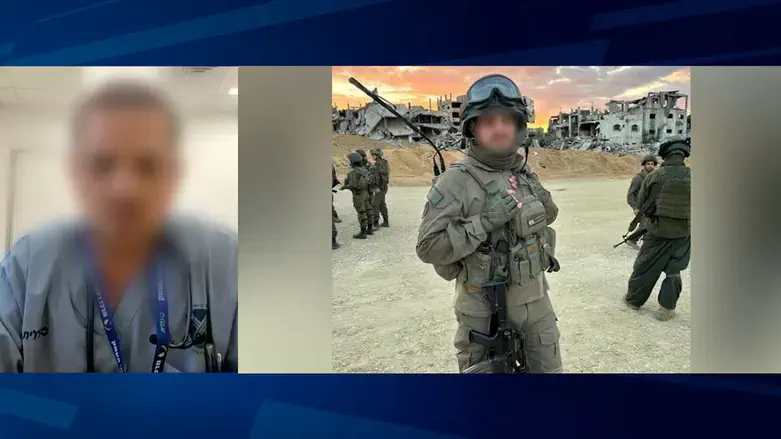
During his military service as a doctor in the IDF, Captain (Res.) Dr. S. completed his medical studies and received his doctorate.
In addition to his role as deputy company commander in a medical unit, Dr. S. was required to balance rigorous academic demands with extended service, which included 320 reserve days across five different operations. Speaking with Israel National News, he recounted the difficult — and moving — moments of the Gaza campaign and explained how an effective medical system was built in the field.
His final year of studies coincided with intense operational activity, as his unit treated hundreds of wounded and fallen soldiers. “Our unit has been preparing for this type of war since Operation Protective Edge. We arrived well-prepared, and my entire role focused on emergency medicine and medical management. I feel everything I’ve done in life led me to this point — making critical decisions in the field,” he said.
Dr. S. emphasized that mistakes are always possible, but proudly stated: “We worked extremely hard — and the system worked. We managed to save many soldiers who had very slim chances.”
He described the stages an injured soldier undergoes — from the moment of injury until reaching the hospital — as requiring full cooperation and high-level skill from all personnel. “It all begins with the wounded soldier’s comrades, who provide initial care and rapid evacuation. From there, the path continues through the battalion, brigade, and the extraction unit, which transfers him to the medical company outside Gaza,” he explained.
Among the most unforgettable cases, he recalled one critically wounded soldier: “We didn’t believe he’d walk again — but now he’s in rehab, engaged, and getting married. We are delighted. Before the war, he wouldn’t have survived. This system saved lives.”
He noted that data supports what was felt on the ground. While mortality rates for wounded soldiers during the Second Lebanon War and in other global conflicts stood at around 15%, in Operation Iron Swords, that figure dropped to 7-7.5%. “It’s impossible to pinpoint a single reason, but the approach — rapid evacuation, sending blood units to the front line, reducing invasive procedures — improved survival chances.”
One of the most powerful messages Dr. S. takes from the operation is a sense of unity: “The bond between fighters from different sectors, religions, and political views — it was moving. The phrase ‘Together we will win’ isn’t just a slogan. It’s a reality we lived.”
He added that despite public disputes, the judicial reform debate did not divide the unit. “Some soldiers were personally affected and spoke to commanders — but on October 7th, we saw near-total turnout. Throughout the war, recruitment rates remained incredible.”
Alongside the fighting, Dr. S. highlighted the extraordinary civilian support. “Every week families come with food, donations, equipment, and treatments for soldiers. People never stop hugging us with love — and it gives us so much strength.”
In closing, he offered thanks to those on the home front. “The families who stay home, wake up at night, send their children to kindergarten alone — they are the true heroes. Without them, we wouldn’t survive a single minute.”