
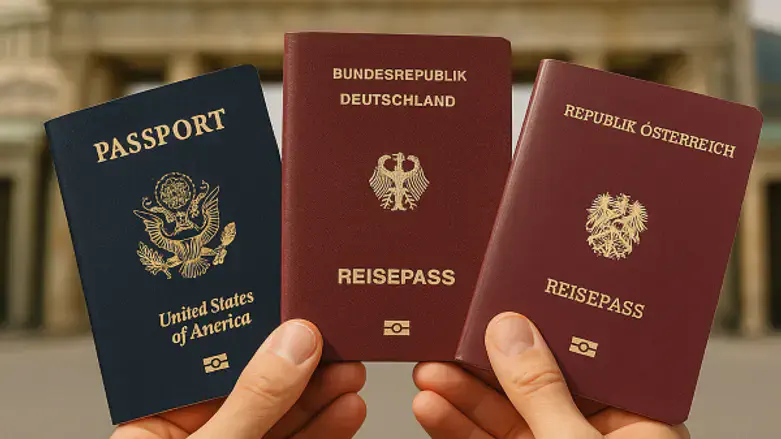
In recent years, Germany and Austria have enacted significant changes to their nationality laws, offering a historic opportunity for American Jews to reclaim citizenship in the countries their ancestors once called home.
Descendants of former citizens and residents who had to flee during the Second World War and had lost their citizenship under the discriminatory laws of the Third Reich can now receive European citizenship and passport.
These legislative reforms are more than symbolic, they provide a practical pathway to European Union (EU) citizenship, allowing eligible individuals to live, work, study, and travel freely across Europe and beyond. Importantly, these changes allow applicants to retain their U.S. citizenship, making dual nationality a viable option for many Americans from Jewish European descent.
Who Qualifies for a European Passport?
The revised laws specifically benefit descendants of German and Austrian citizens who were forced to flee due to Nazi persecution in the 1930s and 1940s. Individuals who can trace their lineage to those who lost their citizenship or were denied it due to racial, political, or religious reasons are now eligible to apply for German Citizenship by Jewish descent or restored Austrian citizenship. This includes children, grandchildren, and even great-grandchildren of Holocaust survivors and other victims of the Nazi regime.
One of the most significant aspects of the reform is that applicants are no longer required to renounce their current nationality. This means that American Jews can hold both U.S. and German or Austrian passports simultaneously. Estimates suggest that as many as 350,000 American Jews may now qualify under these updated laws, opening the door to one of the world’s most powerful passports.
Family Roots Create New Opportunities for American Jews
Jake Weiss, a 43-year-old from Long Island, New York, shared a personal story that reflects the experience of many American Jews. “My grandmother was born in Berlin in 1934. She and her family fled Germany as the Nazis rose to power. For years, my mother wanted to apply for a German passport for us, but the process seemed overwhelming and full of red tape.”
According to Weiss, the recent legal changes transformed what once felt like an impossible task into a straightforward process. “The new law is a form of historic justice. It’s not just about a passport; it’s about reconnecting with our heritage and giving our children access to opportunities in Europe. It’s something we never thought would be possible.”
The reforms have significantly simplified the application process for those seeking German Citizenship by Grandparent . Applicants are no longer required to demonstrate German language proficiency, reside in Germany or Austria, or pay government application fees. These changes remove major barriers that previously discouraged many from pursuing citizenship.
“As soon as we realized we didn’t have to give up our American citizenship and there was no language requirement, we applied for the entire family,” Weiss added. “With recent instability we want to give ourselves and our children more options to choose from. Dual citizenship and a second passport definitely open the door to more possibilities”.
Why a European Passport Is So Valuable
While the U.S. passport is already one of the most powerful in the world, German and Austrian passports offer unique advantages, especially when combined with EU citizenship. Holders of these passports gain automatic residency rights in all 27 EU member states. This means they can live, work, study, invest or retire anywhere in the EU without needing additional visas or permits.
In addition to visa-free access to over 180 countries, EU citizens benefit from subsidized higher education, public healthcare, and housing assistance in many European countries. Citizenship also provides easier immigration pathways to other desirable destinations such as Canada, Australia, and New Zealand.
Another key benefit is that the right to citizenship is inheritable. Once granted, it can be passed down to children and grandchildren, ensuring that future generations can enjoy the same rights and freedoms.
Why Work with a Professional Firm?
Despite the simplified process, applying for German or Austrian citizenship can still be complex. It often involves gathering historical documents, proving lineage, and navigating foreign bureaucracies. Mistakes or missing paperwork can lead to long delays or even rejection.
That’s why many applicants choose to work with professionals who specialize in this field. These experts are fluent in German and experienced in genealogical research. They know how to locate birth certificates, immigration records, and other essential documents from archives in Europe and the U.S.
Professionals also understand the nuances of the application process. They can ensure that forms are filled out correctly, deadlines are met, and communication with government offices is handled efficiently. In many cases, they can expedite the process and increase the likelihood of approval.
Working with a reputable firm also provides peace of mind. Most offer fixed pricing, so applicants know upfront what the costs will be, avoiding unexpected fees or complications down the line.
A Bridge Between Past and Future
For many Americans of Jewish heritages, reclaiming German or Austrian citizenship is more than a legal process, it’s a deeply personal journey. It represents a reconnection with family history, a form of restitution, and a step toward building a future with broader opportunities.
Whether motivated by practical reasons like education and travel or by emotional ones like honouring family legacy, the chance to obtain EU citizenship is both meaningful and empowering.
Article Written by: Attorney Joshua Pex, Co-written by: Maytal Chelst
Decker, Pex, Levi Law Offices
Addresses: 150 Menachem Begin Road, Tel Aviv | 10 Yad Harutzim Street, Jerusalem
Phone: +972-3-3724722 | +972-55-9781688
WhatsApp: +972-55-278-0162
Email: office@lawoffice.org.il