
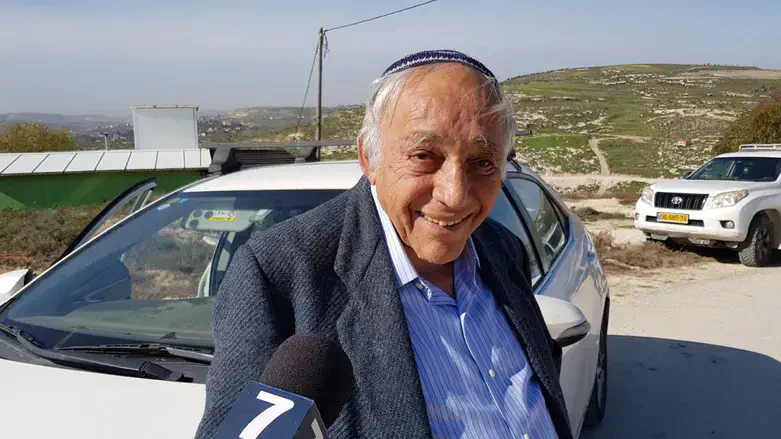
Moshe Zar, a founding figure in the Jewish community movement in Judea and Samaria and one of the original members of Unit 101 and the Paratroopers Brigade, passed away on Friday at the age of 88. His funeral will be held Sunday at 17:00 at Mitzpe Tzva’im near Ramat Gilad.
In a family statement, they said: “The crown of our head has fallen. Woe to us, for we are broken. With broken and aching hearts, we announce the passing of the redeemer of Samaria’s lands and hero of Israel’s wars — our family patriarch, husband, father, grandfather, brother, and brother-in-law, Moshe Zar, of blessed memory. May the clods of the Land of Israel, which he loved with all his soul and for which he gave his life, rest lightly upon him.”
Zar will be buried in the grave he prepared for himself in Ramat Gilad, on the soil of Samaria.

Photography: Moshe Porat
Karnei Shomron Local Council head, Yochanan Koznitz, eulogized Zar: “Moshe Zar was a model figure in the Jewish community in Samaria, driven by deep faith in the right of the Jewish people to return to their land.” Zar was one of the founders of Karnei Shomron and a key figure in land redemption throughout the region. “His home atop the hill became a symbol of steadfastness and Zionist determination. His legacy will continue to guide the path of all who love the land and the pioneers of future generations.”
Shomron Regional Council head, Yossi Dagan, described Zar as a legend: “A hero of Israel, a founder of the Shomron settlement enterprise, a fearless fighter. He symbolized love for the Land of Israel, perseverance, and action. The entire Samaria movement bows its head at the loss of the man whose efforts made settlement in Shomron and many other places in Israel possible. When I visited him recently in the hospital, he had one request: ‘Succeed.’ We will cling even tighter to our land, continue in his path, and succeed — for him and for future generations.”
The Yesha Council issued a statement mourning his passing, calling Zar “the redeemer of lands and a hero of Israel’s wars,” and one of the pillars of the settlement enterprise. They praised his “glorious legacy of pioneering, love for the land, and immense contribution to the settlement of Judea and Samaria.”
After the Yom Kippur War and the founding of the Gush Emunim movement, Zar began purchasing land in the region, becoming a well-known land dealer among both Jewish and Arab residents. He established a Jordanian company to facilitate land registration and, between 1979 and 1982, acquired thousands of dunams across 30 Arab villages.
In 1983, Zar survived an assassination attempt when an Arab landowner attacked him with an axe to the face and neck and shot him, leaving him seriously wounded. After a long hospitalization, Zar recovered. He was also involved in the 1980 bombing that maimed Nablus Mayor Bassam Shaka, as the driver of the Jewish Underground unit that planted the explosive.
Zar and his wife Yael had eight children, all residents of Judea and Samaria and active in the local movement for building Jewish communities in the region. His son Gilad was murdered in a terrorist shooting attack in 2001 while serving as security chief of the Shomron Regional Council. His son, Rabbi Yonadav, teaches at Har Bracha Yeshiva and is married to Atia Zar, daughter of Rabbi Moshe Levinger. His daughter Anat is active in the Jewish community of Hebron, and his daughter Shlomit was also active before moving to a Shomron community. His son-in-law, historian Gershon Bar Kochva, was among the founders of the Hebron seminary.
After Gilad’s murder, Zar purchased the land where Gilad Farm was established. His son Itai and family moved there, and today around 50 families reside in the community.
Following the outbreak of the Swords of Iron War in October last year, Zar visited IDF bases to boost morale among his many descendants serving in combat units, including children, sons-in-law, grandchildren, and even a great-grandchild. On one visit, he encouraged his grandson, Achiya Shilo-Shoham, who was serving in the Nahal Reconnaissance Unit reserves, recalling the Battle of Mitla and declaring: “When the people of Israel are united, no one can defeat them.” He added, “G-d will grant us victory despite the hardships,” quoting, “The Lord gives strength to His people; the Lord blesses His people with peace.”