
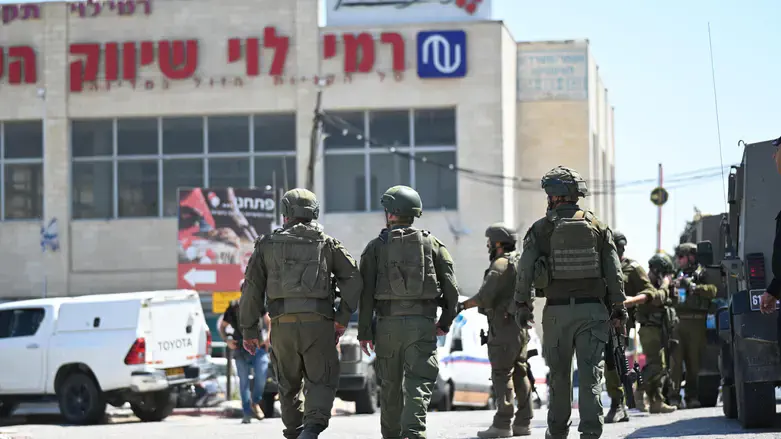
Ten minutes from where I live, a young Israeli man was murdered in cold blood by two Palestinian Arab terrorists. His only crime? Being a Jew in the land of his ancestors.
It’s a headline we’ve read too many times. A family shattered. A community in mourning. Another reminder that the war against us is not theoretical — it is very real, very personal, and very close to home.
And yet, like clockwork, the so-called “experts” and foreign diplomats emerge with their recycled slogans:
“The cycle of violence must end.”
“Both sides need to deescalate.”
“Israel must make concessions.”
They claim this is about the “occupation.” About 1967. About 1948. About settlements, checkpoints, borders, or the very existence of a Jewish state.
But history says otherwise.
If this were truly about borders, then why were Jews being massacred long before the State of Israel even existed?
Why were there riots in Jerusalem in 1920, where Jews were stabbed, beaten, and killed?
Why was there the Hebron massacre in 1929, where 67 Jews were slaughtered by their Arab neighbors — Jews who were not soldiers, not settlers, but civilians, students, and rabbis?
Why did Arab mobs launch the 1936-1939 revolt, murdering hundreds of Jews across the land?
There were no “settlements” then. No IDF. No checkpoints. No State of Israel.
Just Jews — living in their ancestral homeland.
The uncomfortable truth is this:
The violence began long before 1948.
This was never about land. It has always been about our existence.
Today, terrorists are still raised on that same hate. They’re taught that Jews are invaders, that stabbing an Israeli is a sacred act, and that martyrdom is the ultimate goal.
Their families are paid. Their names are celebrated. Their murders are excused.
And we’re still told to negotiate?
No.
You don’t make peace with a society that glorifies murder.
You don’t sign deals with leaders who incite violence.
You don’t pretend that handshakes in European capitals can erase the ideology being pumped into Palestinian Arab classrooms and mosques every single day.
Peace does not come from weakness. It comes from truth.
And the truth is this:
We are not “occupiers.” We are not “colonizers.” We are not guests.
We are the indigenous people of this land.
We returned home — and we are not leaving.
Let the world say what it wants.
We will mourn our dead.
We will comfort the families.
And we will continue to live proudly and unapologetically in our land — because this is not just a homeland. It is our inheritance.
Peace begins when terror ends — and not a moment before.
That truth does not mean we do not feel the pain.
Because in Israel, we all carry the pain
There’s nothing quite like standing in Israel.
Two days ago, we lost five soldiers. One of them was the brother of a friend of mine. And like every loss in this country, it wasn’t just their family’s pain — it became everyone’s pain.
I’m in New York right now. And yes — the Tehillim is being said, the shuls are somber, and there are signs posted about the tragic loss. People are shaken. They care. They really do. But it’s not the same.
Because in Israel, the pain isn’t just felt — it’s lived.
You see it on every face you pass. You hear it in the silence between conversations. You feel it in the air, in the hugs, in the glances between strangers who suddenly become family. The cashier. The cab driver. The rebbe. The woman behind you in line. Everyone’s heart is pierced. Everyone’s voice is softer. Everyone knows.
You don’t need to say much. You just know.
This is a place where your child’s teacher is also a soldier. Where the man you sit next to in shul vanishes for two weeks because he’s commanding a unit deep in Lebanon. And when he returns, you embrace — no words, no explanations. Just presence. Just connection.
Because here in Israel, our soldiers aren’t “them.” They are us.
They’re our brothers, our neighbors, our babysitters, our cousins, our friends, our children and grandchildren. The pain is not distant. It’s close. And when one family mourns, a whole nation mourns.
That’s what it means when we say אחינו כל בית ישראל — our brothers, the entire House of Israel. Not a phrase. A reality. A living, breathing truth.
And while the world debates us from afar, we live this with every fiber of our being. We bury our sons. We cry with strangers. We send food to bases. We teach our kids to feel for people they’ve never met. That’s our strength — our nationhood, our unity, our shared soul.
Last week our collective heart broke seven times. This week, it broke five times. Today it broke again. And yet somehow, it’s still beating — because in Israel, every loss deepens our love and makes our unity burn brighter.
And while I may be thousands of miles away, part of me is still there. Because we don’t just stand in Israel. We stand with Israel.
And no one — no one — stands alone.