

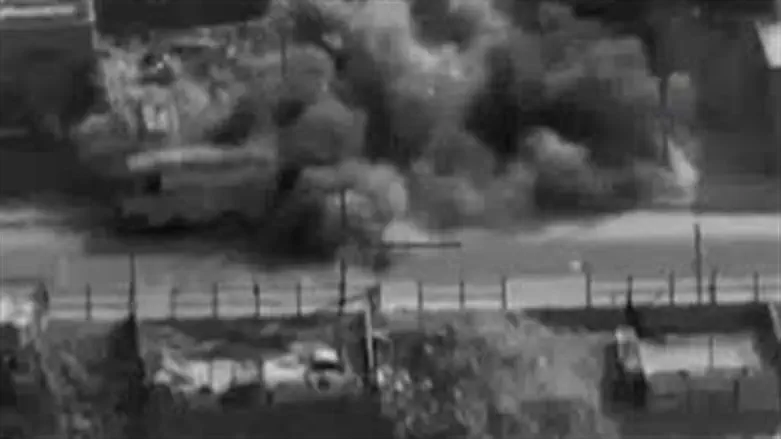
On June 30, the IDF dropped a precision-guided bomb on a seafront café in an area not designated for evacuation or marked as a combat zone, which under IDF protocol typically requires added layers of target verification and civilian risk mitigation.
This was not a concealed weapons depot buried inside civilian infrastructure. It was a visible, crowded entertainment venue in a non-evacuation zone. No warning was issued ( because if the target was specific terrorists, they would have fled), and no last-minute assessment appeared to override the strike. Up-dated reports claim that at least three important key terrorists were eliminated in the strike, but normally, the IDF does not attack when so many uninvolved civilians would be put in danger.
The IDF has a long and documented record of calling off strikes to protect civilians. In May 2023, the IDF canceled a planned hit on a senior Islamic Jihad commander in Gaza after a young girl was seen playing nearby. In 2014, video footage showed drones aborting a mission when children were spotted on a roof and recordings of the abortion orders have been made public. These are not anomalies. They are built into Israel’s ethical code — into its command culture and target protocols.
Therefore, we need to know how many civilians were killed or injured. The IDF has the incident under review and they claim that aerial surveillance was used in advance to assess the risks to civilians. So what happened?
The IDF’s ethical operational standards depend on structure and leadership. Restraint requires leadership. If it turns out that this mission should have been aborted, Al-Baqa may show us what happens when that structure is weakened and that leadership is not effective enough.
Israel had no permanent Shabak chief at the time, just a substitute one.
Since May 2024, Israel’s internal security agency has operated without a permanent director. Previous Director Ronen Bar’s resignation left a vacuum that has yet to be filled.
The appointment process has been stalled by judicial entanglements, especially disputes with the Attorney General who says that Netanyahu has a conflict of interest because of the Qatargate investigation and the High Court (Bagatz)'s involvement in decisions, both of which Prime Minister Netanyahu has openly accused of paralyzing the state’s security apparatus.
Critics dismiss this as a political theatrics. However, the Al-Baqa incident may actually be a demonstration of the cost of the Shabak leadership vacuum.
When an airstrike seems to go so wrong — if a Hamas target did cause so many civilian deaths — something in the system has failed. The IDF’s operational wing may press the trigger, but the decision to designate a target depends on intelligence. And in urban warfare, intelligence is not just about location. It is about timing, civilian presence, proportionality, and the very question of whether a strike should happen at all.
That is Shabak’s job.
Unlike the Mossad, which looks outward, or the IDF, which carries out operations, Shabak is responsible for the sober second look — the vetting, the verification, and the internal challenge process. In theory, it is the last line of defense between a terrorist’s bedroom and the operation we saw last week. In practice, when there is no one at the helm, those lines may blur.
The director's role is not just to approve or deny specific targets; it is to ensure that the organization fosters internal dissent where necessary, empowers subordinates to challenge high-risk decisions, and maintains a culture of operational restraint. In a vacuum of leadership, that interpretive function weakens, and decision-making may become diffuse and dangerously unanchored.
The IDF insists it conducted aerial surveillance before striking Al-Baqa. But surveillance is only one part of the decision chain. It must be interpreted. Civilian risk must be weighed. Alternatives must be considered. And someone must take responsibility for saying “not now,” or “not like this.” Was that person in place?
Netanyahu warned that judicial interference was harming Israel’s security. While the broader debate over the High Court’s role in governance remains complex and polarizing, the Al-Baqa strike may offer a concrete case in which judicial entanglement appears to have delayed critical security appointments — with potentially devastating results. You cannot hobble your security infrastructure and expect flawless performance in wartime. You cannot leave the country’s internal security agency without a permanent head and assume safeguards will stay intact.
To be clear: Hamas is fully responsible for embedding itself in civilian areas. It exploits its own people as human shields and wages a genocidal war from schoolyards and mosques. But that does not relieve Israel of the obligation to attempt to strike with precision. Nor does it erase the difference between lawful, unfortunate civilian death — and an intelligence failure.
The IDF has launched a formal review of the Al-Baqa strike; that is the right move. But an internal military review is insufficient. The government must also ask whether or not the strike would have happened then, there, in that way, if Shabak had a permanent chief.
Would a different leadership structure have flagged the risk, insisted on a different munition, or delayed the operation until civilians had cleared the area? Or would it have found it justified because of things we do not know?
We cannot know yet. But we must ask and we deserve to get answers.
Netanyahu is not wrong to say Bagatz (the High Court) is tying the state’s hands. The question is whether we are willing to call out Bagatz, whatever we think of Bibi, because we cannot afford more preventable failures.
Without leadership, there is no clarity. Without clarity, there is no restraint. The appointment of a Shabak chief cannot wait. Not if we mean what we say about being different from those we fight and we do. Let us hope that today’s compromise decision to appoint the new Shabak head as soon as the Qatargate investigation ends means that this crucial organization will soon be working at full capacity.
Sheri Oz is a freelance writer whose articles appear on major websites and was a member of the Arutz Sheva news staff. She has lived in Israel for over 40 years and blogs at Israel Diaries.