
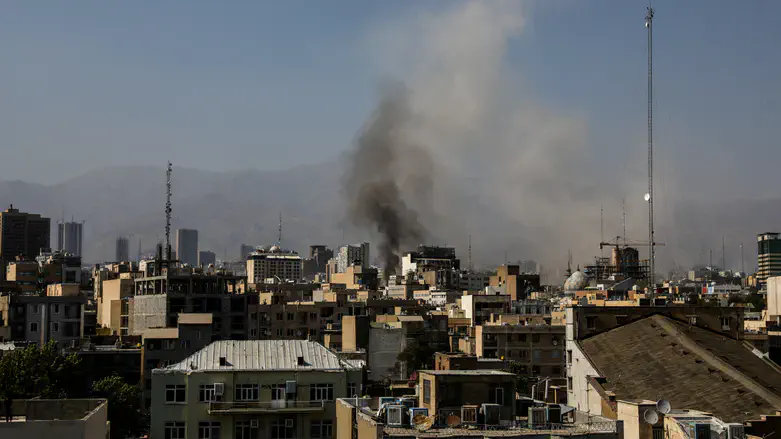
After several days of near-total internet blackout across the country, Iran has partially restored connectivity—but currently, this appears limited primarily to wired networks, and seemingly only those serving government ministries.
For private citizens, particularly mobile users, the internet remains almost entirely inaccessible.
For example, the cellular network IranCell still lacks meaningful access to the global internet, and the same applies to the Mobile Communication Company of Iran.

In contrast, the wired RASANA network has returned to pre-strike levels of data traffic.

Iran is known for its sophisticated censorship system, developed over years alongside a dedicated security apparatus tasked with enforcing control over the online space. This body, known as the "Cyber Police," is based in Tehran. Reports indicate that its website was targeted in a recent Israeli Air Force airstrike.
Beyond basic methods such as domain and website blocking, Iran employs far more advanced tools—such as control over internet routing (BGP), deep content filtering, and even the deliberate disconnection of major access points to the global network.
In parallel, Iran has for years operated a domestic intranet known as NIN—the National Information Network. This is a local, isolated internet that allows users to browse Iranian websites only, including local commerce, government services, and content platforms like Aparat (Iran’s equivalent of YouTube). However, it does not provide access to international websites, making the service limited, slow, and subject to strict Islamic-government oversight.
The latest outage did not follow the usual BGP-based disruption patterns, but appears instead to have involved the physical disconnection of internet providers from the global network—suggesting an attempt at an almost complete digital isolation of Iran. The implication: not just partial censorship, but a full-scale block of the global internet, while maintaining internal communications through Iran’s national intranet.