
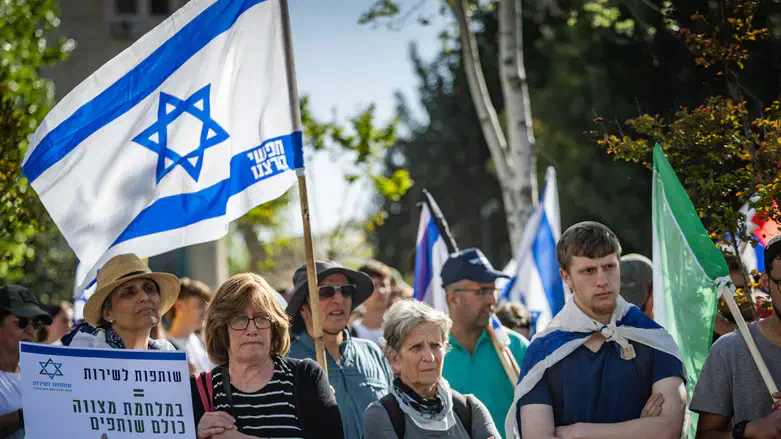
I’m not sure exactly when it became the new normal. My understanding is that protest culture is pervasive not only in Israel but around the world. The recent anti-immigration enforcement riots in Los Angeles are but one violent example. Yet since my family’s aliyah in 2019, we have encountered protests with a frequency that I still cannot accept. My objection relates less to the content of these protests than to the human spectacle of it all. Holding signs, blocking traffic, shouting cliched slogans to anyone who may be listening or not. Who exactly is in favor of this mode of expression, and what minds have ever been changed by it?
For us, it started in 2020 with the black flags of the anti-Bibi protests, which coincided with the social unrest wrought by the Covid pandemic at that time. With the brief ascension of Naftali Bennett to Prime Ministership in 2021, his neighborhood in our shared hometown of Ra’anana became the focus of weekly Saturday night demonstrations complete with blocked traffic and bullhorns. It was hard to keep track of what exactly these protests were for or against.
We all thought the return of Netanyahu to power in 2022 would restore some quiet to the neighborhood, but the subsequent legal reform protests interrupted daily life to an extent that no one had seen before. I remember a trip to a homewares shop in Herziliya cut short by a steady and growing drumbeat outside. My husband and I ran to our car - we had children to pick up from school. But it was too late. The parade had started and streets were blocked. We saw affluent looking men and women in their 60s and 70s strolling down the street with signs and of course, Israeli flags. A taxi driver in front of us was nearly in tears as he argued with police officers to be allowed through. During the time we were forced to wait, we wondered: in the history of mankind, has anyone’s mind been changed by being blocked from picking up their kids from school?
The events of October 7th threw us all into a national funk of mourning and despair. Yet during that time there was one silver lining: the prospect that this terrible tragedy might put an end to the toxic and divisive protests that had been roiling the country until then. Boy were we wrong.
Much has been made about how bravely the leaders of anti-legal reform protests, organizations like “Brothers in Arms,” mobilized to provide support and crucial services in the early days of the war. Less has been noted about how some of the organizers of the Kaplan street anti-judicial reform protests entered the leadership of Hostages and Missing Families Forum, turning what should have been a very pointed advocacy organization into a forum for various anti-government grievances.
We are all desperately concerned about the plight of the hostages in the hands of Hamas and there is great value to raising awareness about their situation all around the world. But why shut down the Tel Aviv highway in concern for their plight? Is the issue that Israelis insufficiently care about the hostages? Do those blocking roads care more than the tired soldier who has been fighting for 400 days in reserves who is waiting, half asleep in his battered car, to get back home to see his family?
One recent Thursday evening I drove my son to a Bar Mitzvah party in the nearby city of Hod Hasharon. Instead of putting us on the highway, Waze routed us through a neighboring moshav, or agricultural settlement, that we occasionally visit for farm-fresh strawberries or flowers. Nestled between cities, it’s not a particularly well-trafficked area, especially at night, yet as we drove in I saw a lone man, as usual in his 60s, standing with a sign. The sign read “there’s no victory until the return of the hostages.”
I mostly agree with this man’s sentiment, though I would frame it a bit differently. Yet what struck me was not the message but the setting. Why stand alone on a quiet roundabout holding a sign to express your convictions? Why not join a larger more organized protest, of which there are plenty, or simply walk to a more populated area nearby?
It occured to me that despite the well-known Israeli passion for meddling in other people’s business, protest culture presents something of the opposite. There’s no obligation to talk when you’re standing there with a sign. No obligation to look in another person’s eyes, explain your position and then listen to theirs. There’s something quite meek, even pathetic, about the man who stands there brandishing a slogan rather than finding a forum to speak his mind. And even if one does find something to admire about a man who stands at an isolated intersection for hours because of his convictions, it’s still quite arguable that this energy might be more productively spent in other ways.
Those invested in normalizing a culture of protest often cite texts about how Judaism is a religion of protests. Avraham famously argued with God against the destruction of Sodom. Moses refused to tolerate the abuse of a Jewish slave by his Egyptian overseer. In Shabbat 54b, the Talmud notes that all who can protest against something wrong that’s being done in one’s family, one’s city, and even the world, and fail to do so are held accountable along with the evildoers. Indeed, there’s no such thing as an innocent bystander in Judaism, we are charged to encourage righteousness and improve the world around us.
Yet what happens if our efforts to improve the world don’t actually make it better? Or more specifically, if in our pursuit of one just goal we overlook some of the basic human decency we expect to find in everyday interactions? When do the ends justify the means and when are we obligated to think twice?
The movement to free Soviet Jewry is often pointed to as an example of the success of mass protest on behalf of a just cause. Some credit the student initiated movement as leading to Gorbachev’s decision in 1987 to free many of the longtime refuseniks as well as other Jews who awaited emigration.
Yet there was one surprising detractor from the movement, the Lubavitcher Rebbe, who himself operated a massive clandestine network supporting the religious life and Jewish education of hundreds of thousands of Jews living in the Soviet Union. It wasn’t that the Rebbe objected to the goals of the international movement for Soviet Jewry, but he believed that the best route toward obtaining these goals was through quiet diplomacy on their behalf. A key to understanding his attitude may be found in an exchange he had with the American law professor Alan Dershowitz on a different topic, an American senator named Jesse Helms who was perceived to be antagonistic to Israel (and who later became a staunch supporter).
The Rebbe’s letter reads as follows (with thanks to Chabad.org):
”My experience with such people has convinced me that politicians are generally motivated more by expediency than by conviction. In other words, their public pronouncements on various issues do not stem from categorical principles or religious imperatives. Hence, most of them, if not all, are subject to change in their positions, depending on time, place, and other factors.
"I believe, therefore, that the proper approach to such persons by Jewish leaders should not be rigid. As a rule, it does no good to engage in a cold war, which may often turn into a hot war; nor does it serve any useful purpose to brand one as an 'enemy' or an 'antisemite,' however tempting it is to do so. It can only be counter-productive. On the contrary, ways and means should be found to persuade such a person to take a favorable stance, at least publicly. We haven't too many friends, and attaching labels, etc. will not gain us any." (source: https://www.chabad.org/therebbe/article_cdo/aid/5992855/jewish/The-Rebbe-on-How-Not-to-Combat-Antisemitism.htm)
The Rebbe’s words here are pragmatic but also profound. People, even craven politicians, are usually multi-faceted. When we reduce them to one category or another, we forfeit our ability to work with them productively on areas of overlapping interest. Obviously even here, there are exceptions. If someone is actively trying to kill you or abet those who are, it is necessary to take up arms and fight back. But in the realm of protests, we are often dealing with something different. We don’t protest against Hamas or other radical Islamists who are actively trying to murder us, we do what we need to do on the battlefield. Protests in Israel are nearly always directed at political actors or specific communities with complex motivations.
Yelling at people that they are prolonging the hostage crisis or destroying the country doesn’t usually convince them that they are. Perhaps those who are yelling might reflect on their own role in prolonging said crisis or taking part in the country’s destruction for that matter.
Most sane people, I think, understand that standing on a street corner holding up a sign is not usually the most effective way of achieving change. Participating in protests can, at best, provide people with a sense of meaning, solidarity and community. At worst they encourage mob-like tendencies, disrupt normal society and enable violence and destruction.
Perhaps the deciding factor as to whether a protest has merit should not be whether it is effective, or a worthy cause (always subject to debate) but relate to the kind of atmosphere it produces. If a protest provides an opportunity to look someone in the eye who disagrees with you and make a calm case for your opinion, then maybe it has value. If a protest takes care to protect other people’s property and respects their time, understanding that the cause of the moment cannot justify making someone else late for a doctor’s appointment or wake up a sleeping newborn, then maybe all is not lost.
And if a protest is for beloved values, rather than against specific people (using “democracy” as a cudgel against Netanyahu does not count), then maybe it has the potential to be something other than a toxic hate-fest of the sort that is inflicted upon us Israelis on a daily basis. Until this becomes the norm, I recommend staying at home on protest days. Or better yet, use some of that energy to try to convince a single person, whether it’s on line at the grocery store or at a family celebration, of the wisdom of your point of view. Maybe it is a little less glamorous than standing alone with a sign in an empty moshav, but I guarantee it is a more direct path to making a positive difference in the world.
For more of Sarah Rindner Blum’s writing you can find her on Substack: https://bookofbooks.substack.com