

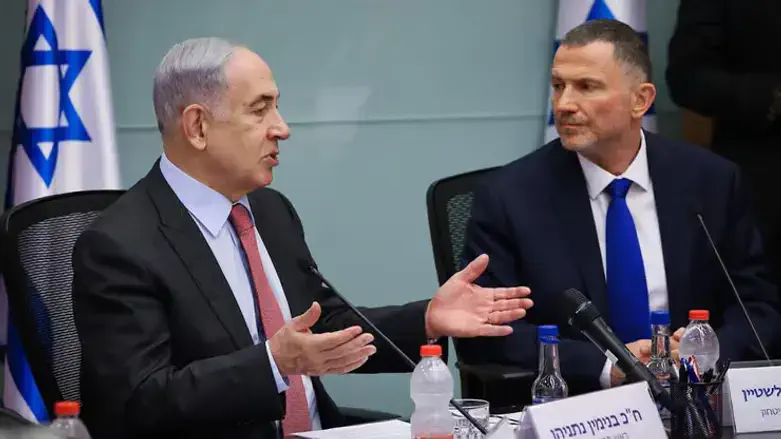
The Prime Minister's Office announced early Friday morning that the meeting between Prime Minister Benjamin Netanyahu, the Chairman of the Foreign Affairs and Defense Committee MK Yuli Edelstein, former Minister Ariel Atias, and Government Secretary Yossi Fuchs regarding the Draft Law had concluded.
The statement said that "significant progress was made. It was decided that an effort will be made to finalize the remaining open issues tomorrow."
Earlier, former Sephardi Chief Rabbi Yitzhak Yosef instructed Atias, who heads the Shas party's negotiation team, to inform Netanyahu that the conditions set by Edelstein for advancing the Draft Law mean "the end of the government's term."
In addition, Rabbi Yosef directed that an open channel be kept with all the parties in the Knesset for potential cooperation after the elections.
Sources in the haredi parties told Kan Reshet Bet on Thursday morning that the meeting convened by the Prime Minister could be decisive for the crisis over the draft law.
The meeting took place after, on Wednesday, haredi leaders refused to meet with Prime Minister Netanyahu on the issue of the Draft Law, citing that "there is no point in further talks."
Previously, Netanyahu met with Edelstein amid Edelstein's insistence on including sweeping sanctions in the law — even in cases where draft targets are nearly met.
A proposed framework involved a tiered system where meeting 90% of the draft targets would result in a 20% reduction in yeshiva funding, and meeting 80% would trigger a 40% cut. However, Edelstein insisted that any achievement below 95% would lead to the total revocation of funding.
The sanctions proposed by Edelstein encompass a wide range of restrictions: revoking tax credits for working women, removing housing subsidies, revoking driver’s licenses, restricting travel abroad, canceling property tax reductions, ending discounted housing programs, and imposing a tax on first-time home purchases.
Additional proposed penalties include denying subsidies for academic studies and daycare subsidies, removal of public transport discounts, and even maintaining a constant risk of arrest, as documented in a list shown to haredi representatives.