
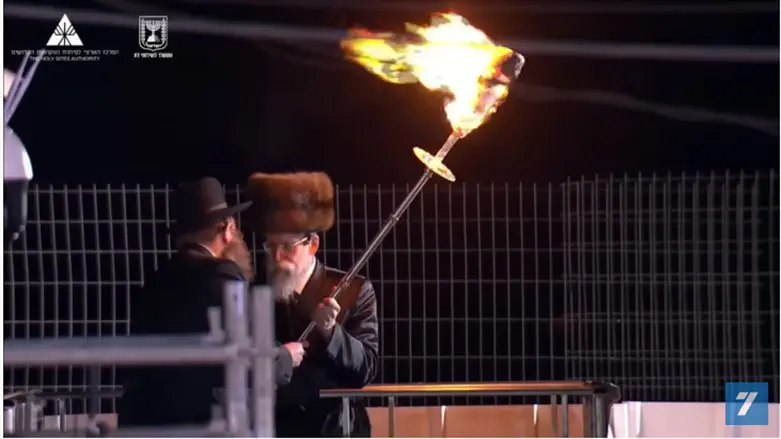
This week, hundreds of thousands of Israelis will journey to Meron on Lag Ba’Omer, the yahrtzeit of Rabbi Shimon Bar Yochai, author of the Holy Zohar. The bonfires of Lag Ba’Omer symbolize the secrets of Torah which Rabbi Shimon Bar Yochai revealed.
The Gaon of Vilna writes: “The Geula (Redemption) will only come about through the learning of Torah, and the main factor of the Geula depends on the learning of the inner secrets” (Even HaShelma, 11:3).
Throughout all of his writings, Rabbi Avraham Yitzhak HaKohen Kook stresses the necessity of learning the secrets of Torah at the time of Israel’s Redemption: “The revelation of the secrets of Torah in the last generation, in order to purify the hearts and to fill the minds with noble thoughts, whose source lies in the secrets of Torah, this is an absolute necessity in the last generation to insure the survival of Judaism” (Orot HaKodesh, Part 1, Pg. 141).
In his book, “Orot,” Rabbi Kook writes: “The secrets of Torah bring Redemption and return Israel to its Land because the Torah of truth in its mighty inner logic demands the complete soul of the Nation. Through this inner Torah the Nation begins to feel the pain of Exile and to realize the absolute impossibility for its character to fulfill its potential as long as it is oppressed on a foreign soul. As long as the light of the supernal Torah is sealed and bound, the inner need to return to Zion will not stir itself with deep faith. The awakening engendered by the circumstantial tribulations and persecutions of the nations is one of external purification. It can energize feeble powers but the foundation of life can only come about through the essential formal quest of the Nation which will increase as the light of the inner Torah, its profound beliefs, and its most secret recesses are lived in their majestic greatness” (Orot, pg.95. Translated by Rabbi Pesach Jaffe).
Elsewhere in “Orot” he writes: “At the time of the revival of the nation in Eretz Yisrael, the Book of the Zohar, which breaches new paths, forging a way in the desert, a road in the wilderness, it and all of its bounty is prepared to open doors of Redemption. ‘Since Israel is destined to taste from the Tree of Life, which is the Book of the Zohar, they will be redeemed from the exile with mercy,’” (Zohar, Naso, 124b. Orot HaTechiyah, 57).
One of the central themes of the Zohar is the absolute unity of the Jewish People, the Torah, and the Land of Israel. Given the centrality of Eretz Yisrael to Jewish life, why are so many Jews still living in foreign lands? Rabbi Chaim Vital, the foremost student of the Arizal, writes in his preface to “Etz HaChaim,” that the prolongation of the exile and its tribulations stem from the sorrowful fact that the secrets of Torah have been neglected from our learning.
In a similar vein, Rabbi Avraham Yitzhak HaCohen Kook writes that due to an alienation from the secrets of Torah, the supreme importance of a Jew’s connection to Eretz Yisrael is not properly understood. In his classic treatise, “Orot,” he bases his deep insights into the renaissance of the Jewish nation in Eretz Yisrael on the esoteric teachings of the Arizal and the holy Zohar, dressing up concepts of Kabbalah in the language of Israel’s gradually developing nationhood and rebirth. He writes:
"By alienating oneself from the secrets of G-d, the highest segulot (treasures) of the deep Divine life become extraneous, secondary matters which do not enter the depths of the soul, and as a result, the most potent force of the individual's and of the nation's soul will be missing; and the exile is found to be pleasant in its own accord. For to someone who only understands the superficial level, nothing basic will be lacking in the absence of the Land of Israel, the Jewish Kingdom, and all of the facets of the nation in its built form."
What is Rabbi Kook saying in this difficult to understand sentence?
He is saying that someone who understands only the superficial level of Judaism will feel nothing lacking if he lives far away from the Land of Israel, in a foreign country, in a Gentile land, under a non-Jewish government. A person like this lives a truncated Judaism that focuses on the individual and private mitzvot that he or she can do. Without a deeper understand of the Torah, which is the national constitution of the Nation of Israel as a whole, he will not feel the need for a Jewish Land, nor for a Jewish country with a Jewish army, nor for any of the other foundations of national Israeli life.
His focus is on Shabbat, Kashrut, and Tefillin. He thinks that in order to perform them, he does not need Eretz Yisrael. He is satisfied with the individual obligations which he feels he can perform just as well in Chutz L'Aretz, and thus the exile finds favor in his eyes. Being estranged from the national component of Torah, but he does not miss having his own Jewish Homeland. The opposite is true – he enjoys the Galut. He enjoys his work, his community, the education he can give to his children, and the opportunity he has to experience the best of both worlds – his Judaism and the Gentile world around him.
If there is an inner need to live in Israel, or to live there because it is the true place of the Torah’s performance, he does not feel it. Therefore, Rabbi Kook explains something will be missing in his yearning for Salvation, for the Temple, the Sanhedrin, for prophecy, for Jewish Kingship, and for all of the aspects of the Jewish nation in its rebuilt form. To his way of thinking, the concept of nationhood has nothing to do with Judaism, or with being "Frum." He fails to understand that the highest worship and sanctification of G-d comes through the life of the nation of Israel in Israel, and not through the deeds of the individual Jew.
One of the great contributions of the Arizal was revealing the relationship between transgression and rectification, known as tikun. For instance, the sin of the Spies in the wilderness fell on the night of Tisha B’Av. Our Sages tell us that their lack of faith in G-d, expressed in their refusing to journey on to Israel, and their rejection of the supreme importance of the Land of Israel to the Jewish People and Torah, planted the seeds for the future national destruction and exile. Because their sin was in despising the cherished Land, the rectification is to love the Land and to make every possible effort to live there.
The Arizal taught that just by eating the fruits of Eretz Yisrael, a person’s fear and reverence for G-d is increased.
In a similar light, the great Torah master, the Chatam Sofer, taught that just saying the words “Eretz Yisrael” increases a person’s holiness.
The Hasidic master, Rebbi Nachman of Breslov, who based much of his teachings on the secrets which Rabbi Shimon Bar Yochai and the Arizal revealed, taught his students that the holiness of Eretz Yisrael is the epitome of holiness, encompassing all other levels of holiness, and that genuine enlightenment and Torah wisdom come only in the Land of Israel. Repeatedly, he stated that only through the special spiritual treasures of Eretz Yisrael can a Jew rise up to the highest levels in the service of G-d. In addition, he said, that true faith and prayer are only possible in Eretz Yisrael, for it is there that prayer ascends to the worlds above (Likutei Etzot, Eretz Yisrael).
In addition to deepening our Torah learning, how can a person increase his love and yearning for the Land of Israel? Rebbi Nachman says: “Pray to G-d to give you desire and yearning for the Land of Israel. Then you will succeed in reaching there.”
True, making Aliyah is a very difficult mitzvah. In addition to the great joy and spiritual elevation that it brings, it is filled with challenges and hardships. The Talmud teaches that it is impossible to come to the Land of Israel without difficulties and suffering. Learning the secrets of Torah is the remedy.
Rebbe Nachman writes: “The power of the inner Torah, which we draw into ourselves through study, enables us to overcome all the obstacles. The more profound a person’s grasp of the Torah, in all of its facets, both the revealed and the secret, the greater his victory will be over all barriers, and he will succeed in reaching the Land of Israel.”
May we all be so worthy soon.
Introduction to the Zohar/ by Rabbi Shimo Bar Yochai
Rabbi Shimon Says:
Woe to the man who says that the Torah comes to teach tales of this world and to speak about ordinary affairs. If that were so, even today, we could create a Torah dealing with ordinary matters that would be far superior. If it comes merely to explain the matters of this world, even the princes of the world have more advanced things to say. If so, we should follow them and compose a Torah from their teachings! But this is not the case. For all the words of the Torah are concerned with exalted matters and celestial secrets.
Come and see, the upper world and the lower world are weighed in an exacting balance. Israel here below is mirrored by the angels above. Of the celestial angels it is said, “Who makest His angels spirits” (Tehillim, 104:4). When they descend down to earth, they dress up in the garments of this world, for if they didn’t dress in the garments of this world, they could not exist in this world, nor could the world endure them.
Now, if this is the case with the angels, how much more must it be with the Torah that created them, and that created all of the worlds and that sustains them all. How much more so the Torah in descending to this world had to dress herself up in the garments of this world so that the world could endure.
Thus, the stories of the Torah are only her worldly garments, and whoever thinks that this worldly attire is the Torah itself, and not something deeper, may his soul be obliterated – he will have no portion in the world to come. For this reason, David said, “Open mine eyes, that I may see the wonders of Your Torah” (Tehillim, 119:18), meaning the things that are beneath the Torah’s worldly garment.
Come and see. There are garments that everyone sees. When fools see a man in smart-looking clothing, they don’t look any deeper (but rather judge the worth of the man according to his clothes). However, the pride of the clothes is the body, and the pride of the body is the soul.
In the very same way, the Torah has a body made up of the commandments of the Torah, which are called the body of the Torah . This body is dressed up in garments that are the stories of this world. The fools of the world only see the garment, the worldly narrations. They do not know anything more, nor do they look beneath this outer garment. Those who understand more, do not look just upon the garment, but on the body that is under the garment. The sages, the servants of the exalted King, those who stood on Mount Sinai, peer down to the soul, which is the principle thing of them all, and this is the real Torah. In the future, they are destined to gaze into the soul of the soul of the Torah.
Behold, in the same way, the upper world has a garment, a body, a soul, and an inner soul. The heavens and their hosts are the outer garment. The Community of Israel is the body which houses the soul, “Tiferet Yisrael.” This soul of “Tiferet Yisrael” is the Torah. And the soul of the soul, this is Ancient Holy One. All of these are attached one with the other. Woe to those sinners who say that the Torah is merely a story, who only see its outer garment and no more. Fortunate are the tzaddikim who gaze properly on the Torah. Wine cannot be contained except in a flask. Likewise, the Torah requires an outer garment. Therefore, one needs to look only upon the things that are under the garment. And therefore, all of these ordinary matters and all of these stories are only exterior garments.