
Every korban in the Beis Hamikdash had to be offered during the day. Why?
Rav Samson Raphael Hirsch answers this question by noting that night is when “the outlines of objects collapse indistinguishably into one another.” Everything “merges into itself and with others and nothing stands apart in its outline.” Lailah (night) is related to lul (a spiral staircase) and lula’os (binding loops). So night is when “things are ‘confusedly mixed up’” and man “sinks back into the realm of things bound by physical forces.”
Without the blessing of electricity – and even with it to some extent – man is timid at night. He sees ghosts and spirits. He huddles inside for fear of the dark. He can’t “conquer the world” because the world is shrouded in darkness. He must tread gingerly lest he fall.
Death, darkness, and the occult constitute the realm of paganism. Rav Hirsch writes that night “brings the heathen mind nearer to his gods.” He “feels the might of the gods which bind him, as it does all other creatures.”
Judaism wishes to cultivate a completely different spirit. Its realm is yom (the day), which is related to kum (arise). “G-d has breathed a tiny spark into [man], and thereby has raised him high above the state of being bound by the merely physical world, and has made him stand upright, in His likeness, as a personality freely mastering the world, in His service for His purposes.”
Rav Hirsch writes further: “The day, in a heathen’s mind, is a battle of mortals against the power of the gods. The day, to the Jew, is the time for accomplishment, in the service of, and to give satisfaction to, his G-d” (emphasis in the original).
Thus, not only were all korbanos brought during the day, but the schedule of the Beis Hamikdash itself began in the morning and ended with the dawn of the next morning (unlike the natural day which starts at night and ends with the arrival of the following night – “vayehi erev, vayehi voker”).
Judaism is for clear-eyed, strong, confident human beings. That’s why Jewish prophets had to be healthy, wealthy, and joyful. That’s why the Jewish new year – Nissan – begins and ends in spring, the most hopeful and cheerful season of the year. And that’s why all the korbanos had to be brought during the day.
“[W]ith a clear mind and with the productive world-forcing power of his upstanding day-life is [man], above all, to stand near to his G-d,” writes Rav Hirsch.
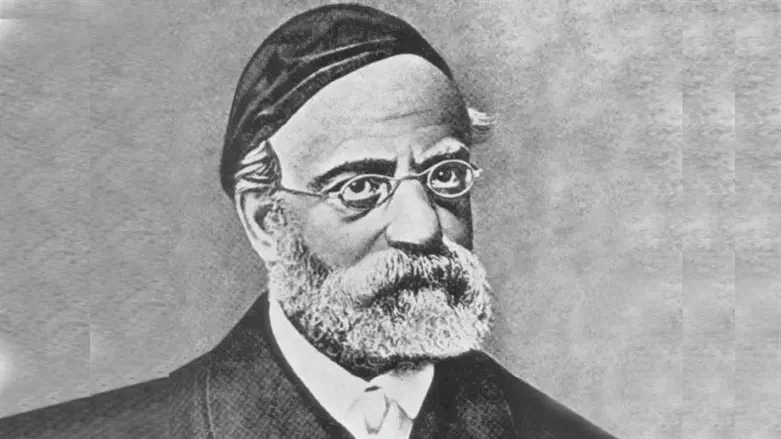
Rav Samson Raphael Hirsch (1808-1888) – head of the Jewish community in Frankfurt, Germany for over 35 years – was a prolific writer whose ideas, passion, and brilliance helped save German Jewry from the onslaught of modernity.
Elliot Resnick, PhD, is the host of “The Elliot Resnick Show” and the editor of “The Rav Samson Raphael Hirsch Dictionary.”