
In 2019, some three weeks before Pesach, Rav Aryeh Stern, Chief Rabbi of Jerusalem, invited synagogue Rabbis and Rabbis of small towns to a convention at the Jerusalem Great Synagogue (Heichal Shlomo). Rav Stern headed the speakers on a program in which he wanted the synagogue Rabbis to impart to their congregants the main messages that Rav Stern felt were important that every Jew hear before Pesach.
Interestingly, I got an emailed formal invitation. At the full day meeting, I met two candidates for the position of Rabbi of my own town, Beit El ( one of them became our town's Rabbi). To this day, I'm convinced that I was invited by some computer glitch; I'm not a practicing Rabbi. In late 2018, I had passed the last of the six tests for the Israeli Rabbinate; and just that spring, I'd had an interview with Chief Rabbi David Lau, who signed my semicha (ordination). To this day, I'm convinced that I was invited to Rav Stern's pre-Pesach meeting, by some sort of computerized mistake.
Thus it was my good luck to hear Rav Stern , Rav Ze'ev Weitman (chief Rabbi of Tenuva, the food manufacturer) and others on that day. Rav Stern's shiur (lesson) was the most thought provoking:
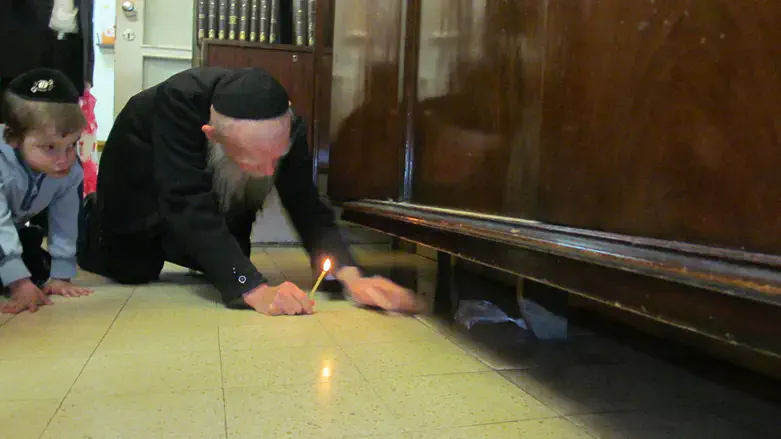
Rashi and Tosafot disagree as to the reasons that we do Bedikat and Bitul Chametz (the Search and the nullification of leaven) during the 24 hours before Pesach. The Gemara (Pesachim 2a) says that we are to search our homes for Chametz 24 hours before the Seder (this year is different, because we cannot walk around the house using a candle to search for bread, etc. on Friday night, the Sabbath). Rashi says the reason for this search ceremony, is so that we not have Chametz on our premises during the Pesach holiday, and thereby violate the biblical injunction of בל ייראה ובל יימצא . This injunction stems from two sentences in the Torah: " For seven days, leaven should not be found in your houses"(Exodus 12, 19); and " No chametz shall be seen in your possession"(Ex.13, 7).
For Rashi, as we will see, the key is the first sentence, stressing "in your house". Thus, the key is שליטה – a word that implies sovereignty, dominion, authority, or domain. It matters not if one owns the Chametz- if a non-Jew deposits his Chametz in the house of a Jew (as he does in the annual "sale of Chametz") , as long as that chametz is in the Jew's house, the Jew must get rid of it, via bedikah (search) and biur( destroy); except that in our annual sale, we sell a particular spot in our house where the chametz is, to the non-Jewish buyer of the chametz (Sh.Aruch, 430,par.1). Therefore, the chametz of the non-Jew stays safely ( no biur) in the non-Jew's premises till it's all bought back after Pesach.
Tosafot seems to stress the second sentence, that we are to have no chametz in our possession. To Tosafot, the reason for the search is so that we not find chametz in our POSSESSION on Pesach, and eat it. The critical factor is ownership, בעלות . In the above case of the non-Jew's chametz in our house, only if the Jew accepts אחריות , responsibility, for the chametz (if stolen, the Jew must pay its value to the non-Jew) is the Jew obligated to destroy that chametz. Responsibility gives the Jew enough בעלות, ownership (of even a weak variety) so that the Jew must destroy that chametz ( see Talmud Pesachim, 5b).
The most interesting part of this dispute is the matter of bitul chametz, the nullification of chametz, which we say the day before Pesach. For Tosafot, the destruction of chametz, the biur, is what the Torah means when it says ) תשביתו tashbitu; Ex. 12,15). This is the ceremony we do on the morning before the Seder, when we burn the chametz. We then say words to "nullify " (bitul) chametz. To Tosafot, this bitul is simple to understand: it’s the common legal practice of making our POSSESSION Hefker (ownerless).
Rashi has a different understanding. He says that "tashbitu" does not mean "destroy" , but rather to nullify the chametz- and specifically, nullify the very existence of the chametz "in one's heart"( see Tosafot, Pesachim 4b, d'h midoreita b'bitul). Fascinatingly, Rambam cites this understanding of Rashi as Halakhah:
"What does the Torah mean by Hashbata (i.e., tashbitu): that one nullifies the chametz in his heart, via considering the chametz as worthless as the dust of the earth- thus determining in one's heart that one has no chametz in his premises …" (Hilchot Chametz u'Matza, 2:2)/
These are the very words that we use today when we do bitul chametz.
And here is where Rav Stern introduces the congregant to the genius of Rashi.
Rav Stern notes that there is simply no legalistic formula like this bitul of Rashi's in all of Halakhah; one can render one's possessions ownerless (hefker)- as Tosafot designates the bitul chametz- but one cannot anywhere in Halakhah think that one's possession has no existence, and poof! Magically, that item doesn't exist; that cannot be done in Halakhah- except here in chametz. Rav Stern calls this a פטנט (pronounced "pah-tent), a novelty, invented by Rashi. Rashi , in his genius.
Please note that I said that I had just finished my semicha, Rabbinic ordination. I learned in the Rav Aharon Soloveichik Semicha Program, taught by Rav Mordechai Goldenhersh. Rav Mordechai taught us only what Rav Aharon taught him; and in Brisker thought, in Basar v'Chalav ( laws of meat with milk) there is one recurrent theme that explains numberless cases: בשר וחלב הוא חידוש , ואיו בו אלא חידושו – the law of meat with milk is a NOVELTY. Once I heard that word from Rav Stern, pah-tent, I recognized Rashi's consistent genius:
Rashi is often considered the simplest commentary on Chumash. However, he is way more than "simple", providing simple "pshat", plain meaning: because the whole section of the Torah that talks of Pesach begins with החדש הזה – literally, this month, but also meaning " this NOVELTY". Rashi explains that the Almighty showed Moses the moon " in its chidush" = its renewal, its NOVELTY.
Thus, the essence of Pesach is this aspect of renewal, novelty- and the genius of Rashi is TO CARRY THIS MESSAGE FROM HIS SIMPLE PSHAT(literal meaning) IN CHUMASH (the Torah) ALL THE WAY THROUGH THE INTRICACIES OF HALAkHAH. The genius is Rashi's consistency through two thousand years of written and oral Torah.
And more: do you walk into your Seder and ask yourself and your child:" What's NEW, NOVEL about you tonight? How have you changed (mah nishtanah) since last Pesach? How do plan to change by next Pesach? What are your aims and goals? How do you plan to reach those goals? What is motivating you to those goals? Can you please express in words( פה שח = the mouth speaks, a pun in Hebrew on the word Pesach) those goals and motivations? What do you perceive as the threats and obstacles to your achieving those goals? And what do you want to be the contents of your Life as you walk the path of Life toward the achievement of those aims and goals?"
Thus, this month, this Nisan, and this Pesach, will become your Aseret Yemei Teshuvah mei'Ahavah (see my article on Israelnationalnews.com, Nissan and Aseret Yemei Teshuvah by Dr. Aryeh Hirsch, April 7, 2008).
May you all have a Chag Kasher v'Sameach.