
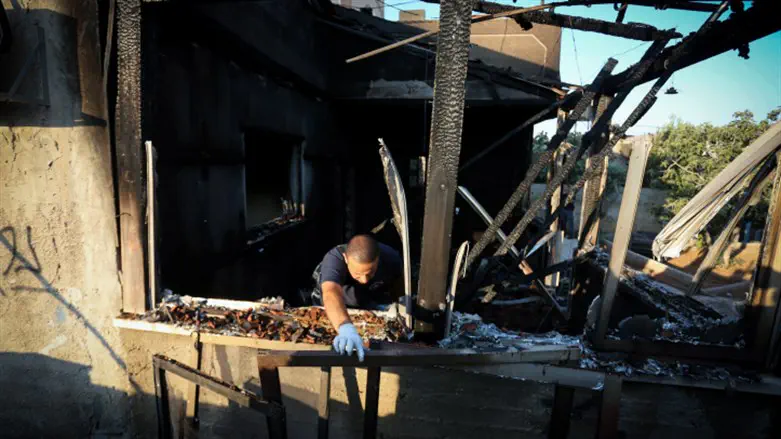
In light of the ongoing headline news of recorded conversations revealing the anti-settler political orientation of the Jewish Division of the Shabak and its flagrantly illegal actions against residents of Jewish communities in Judea and Samaria, as well as the self-imposed suspension of the Jewish Division head, the time has come to review the Duma arson case in which evidence obtained under Shabak torture was admitted for lack of other evidence. It is entirely possible that an objective review of the case would free Amiram Ben Uliel from a life in prison. And if not, Israelis will know that justice has been served.
In July 2015, the home of an Arab family was firebombed in the village of Duma causing the deaths of three family members. Immediately, the Israeli police, along with the Shabak, and the leftist mainstream media in Israel and around the world, claimed that the arson was a “price-tag” attack, carried out by young “extremist settlers” among what is known as the “hilltop youth.” (Note: Now that the anti-Israel bias permeating Wikipedia has been researched and is common knowledge, its definition of the "hilltop youth" can be ignored. These are basically young people who settle barren hills in Judea and Samaria at great personal sacrifice for love of the land and to prevent Arab encroachment - and who unfortunately contain in their midst some radical youth who have been accused of anti-Arab vandalism, ed.)
Amiram Ben Uliel, then age 21, was indicted for murder for three life sentences. Imprisoned and denied the right to counsel for a long period, Ben Uliel confessed to the crime after long interrogation and torture. Later, he declared that he did not commit the arson, and that he confessed only to end the brutal treatment he had received in jail from the Jewish section of the Shabak. Though a district court threw out much of his confession on the grounds that it was illegally forced from him out of duress, part of it was accepted and used to seal the charge of murder.
Speaking to the media after the verdict was read, Shmuel Medad, head of the civil rights organization, “Honenu,” which provides legal aid to Jews charged with crimes against Arabs, criticized the charge of guilt, declaring, “It is a black day for the State of Israel and its citizens when a court of law convicts a person whose innocence screams out to Heaven, when the little and inconclusive evidence against him was garnered through torture, and when the case against him was filled with gaping holes and contradictions. We thought that the days of witch hunts against Jews had ended, but here, in our own country, we were wrong.”
One of Ben Uliel’s attorney’s, Itzhak Bam, shed further light on his client’s ordeal: “After he was arrested, he was kept in isolation 21 days without being allowed visitors or the right to speak with a lawyer. The torture began on the 17th day, around-the-clock, physical, mental, psychological torture, without letting him sleep. Up until then, he denied all involvement in the arson and refused to cooperate with the interrogation. A short time afterward, broken by the torture, he confessed to a crime he didn’t commit. Subsequently, he retracted the confession. Since then he has consistently insisted on his innocence.” (For more details, click here.)
Ben Uliel was confined in isolation in a high-security detention facility for 9 years with a bare minimum of visitor privileges. He is the father of a child who barely knows him. At the end of August 2024, after a storm of public pressure and the appeal of prominent Rabbis, he was transferred to the prison’s religious unit. His wife calls out for a review of his trial which she is confident will lead to his release.
If not now, as the ISA methods aimed against Jews of Judea and Samaria are coming home to roost, when?
Tzvi Fishmanwas awarded the Israel Ministry of Education Prize for Jewish Culture and Creativity. Before making Aliyah to Israel in 1984, he was a successful Hollywood screenwriter. He has co-authored 4 books with Rabbi David Samson, based on the teachings of Rabbis A. Y. Kook and T. Y. Kook.
Rochel Sylvetsky conributed to this article.