
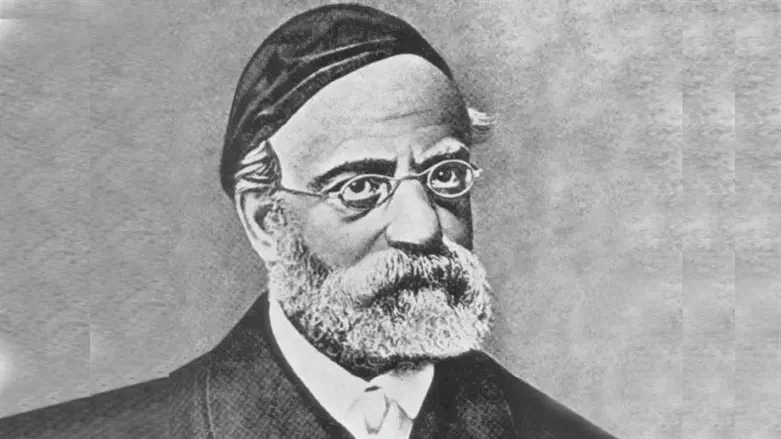
Clothing can deceive. That’s why, according to Rav Samson Raphael Hirsch, the Hebrew word for “garment” (beged) is so similar to the Hebrew word for “betray” (bagad). Hence also the modern Hebrew word bo’ged, which means “traitor.” The person isn’t what he appears to be.
But while a person’s clothes can mislead others, they also can influence the person himself to become what he’s wearing. That’s why the words beged and pakad (to “appoint” or “invest in office”) sound similar. If you want a person to take on certain tasks, you give him clothes (or enclothe him with an environment) that remind him of these tasks. Thus, at the dawn of human history, G-d “gave clothing to man as an eternal reminder of his moral calling when He dismissed him from paradise into the educational school of work and self-sacrifice.”
We know from the parshios of Tetzaveh and Pekudei that the priests in the Mishkan had to wear specific garments. These garments, writes Rav Hirsch, were supposed to “affect the mind of the onlooker” and influence the priests themselves. That’s why nothing could come between their garments and their skin (Zevachim 19a). For “the priest must be entirely at one with his garments.”
In Invitation to Sociology, Peter L. Berger provides a poignant illustration of how clothes (and other external factors) influence a person’s character:
"A man recently commissioned as an officer…will at first be at least slightly embarrassed by the salutes he now receives from the enlisted men he meets on his way. … The new insignia on his uniform are at that point still something that he has merely put on, almost like a disguise. Indeed, the new officer may even tell himself and others that underneath he is still the same person.… This attitude is not likely to last very long. In order to carry out his new role of officer, our man must maintain a certain bearing. This bearing has quite definite implications. …
"Thus, with every salute given and accepted (along, of course, with a hundred other ceremonial acts that enhance his new status) our man is fortified in his new bearing…. He not only acts like an officer, he feels like one. Gone are the embarrassment, the apologetic attitude, the I’m-just-another-guy-really grin. If on some occasion an enlisted man should fail to salute with the appropriate amount of enthusiasm or even commit the unthinkable act of failing to salute at all, our officer is not merely going to punish a violation of military regulations. He will be driven with every fiber of his being to redress an offence against the appointed order of his cosmos."
Berger stresses: “[O]nly very rarely is such a process deliberate or based on reflection. Our man has not sat down and figured out all the things that ought to go into his new role, including the things that he ought to feel and believe. The strength of the process comes precisely from its unconscious, unreflecting character. He has become an officer almost as effortlessly as he grew into a person with blue eyes, brown hair and a height of six feet.”
Never underestimate the power of conduct – or clothes – on a person’s character.
Rav Samson Raphael Hirsch (1808-1888) – head of the Jewish community in Frankfurt, Germany for over 35 years – was a prolific writer whose ideas, passion, and brilliance helped save German Jewry from the onslaught of modernity.
Elliot Resnick, PhD,is the host of “The Elliot Resnick Show” and the editor of “The Rav Samson Raphael Hirsch Dictionary.”
...