
“Whoever does work on [Shabbos] shall be put to death” (Exodus 35:2).
Many non-frum Jews say they understand the command to refrain from working one day a week but ask: In what sense is a simple activity like sewing or boiling an egg “work”?
Rav Samson Raphael Hirsch answers this question by explaining that on Shabbos the Torah forbids not arduous labor but activity that demonstrates “man’s power and mastery over matter.” By “refraining from exercising this power on Shabbos,” man shows his “allegiance to the one only true Master and Creator to whom man, in his mastery over matter and apparently creative powers, is only a leaseholder, a servant.”
Thus, according to strict Torah law, a Jew is not punished if he performs work on Shabbos unintentionally, in a destructive fashion, or kilachar yad, which Rav Hirsch defines as work “not done in the correct skilled manner.” Only meleches machsheves (“work of thoughts”) brings punishment down on a Jew because only such work mirrors the kind of “work” G-d performed during the six days of creation.
One forbidden category of work on Shabbos, however – carrying – doesn’t seem to fit Rav Hirsch’s definition of work since it doesn’t demonstrate “man’s power and mastery over matter.” And, in fact, no less a personage than the prophet Jeremiah clearly considers carrying to be different than all other forbidden Shabbos activities since he tells the Jewish people, “Do not carry a burden out of your houses on Shabbos nor do ye any work” (Jeremiah 17:22). In other words, he doesn’t believe carrying is covered by his exhortation “nor do ye any work.” But if so, why is carrying forbidden?
Rav Hirsch solves this enigma by suggesting that carrying between a private domain and a public domain and within a public domain itself represents social life and activity. In his words:
“The whole idea of social life, of living not isolated, but in a community, in a state, cannot be represented more fully than by the relation of the individual to the community, and the community to the individual, what the individual has to give to the community and what the community gives and does for the individual, what the individual takes out of his own private possessions and pays to the state, and what he gets back for himself, and finally the furthering of public purposes and needs in the public domain.”
Thus, the prohibition of carrying on Shabbos “expresses the idea of man placing his social life, too, under the dictates of the laws of G-d.” So refraining from performing regular Shabbos work is an “acknowledgement of G-d in nature,” and refraining from carrying is an acknowledgement of G-d “in history and human affairs.”
And these two acknowledgments parallel the two reasons we observe Shabbos: to recall the six days of creation and to recall the exodus from Egypt (zecher litzias Mitzrayim). The former concerns mastery of nature; the latter concerns mastery of human affairs.
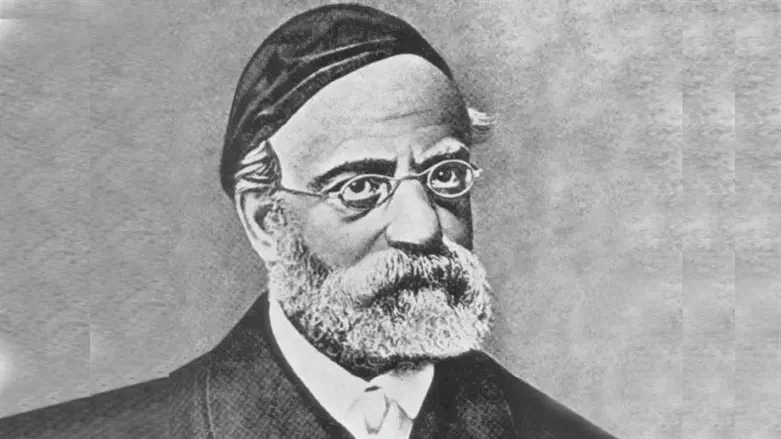
Rav Samson Raphael Hirsch (1808-1888) – head of the Jewish community in Frankfurt, Germany for over 35 years – was a prolific writer whose ideas, passion, and brilliance helped save German Jewry from the onslaught of modernity.
Elliot Resnick, PhD, is the host of “The Elliot Resnick Show” and the editor of “The Rav Samson Raphael Hirsch Dictionary.”
...