
The last eight months haven’t been easy for the Jewish people. But the last 80 years, overall, have arguably been the most philo-Semitic in history. Indeed, according to a 2006 survey that Rabbi Lord Jonathan Sacks cites several times in his writings, Jews are the most widely-respected religious group in America.
Rabbi Sacks himself enjoyed tremendous prestige among non-Jews during his lifetime – the kind of prestige that would have been unimaginable in 18th century Poland or 19th century Russia or virtually any other place.
In Parshas Bechukosai, Hashem says He will remember “brisi Yaakov…brisi Yitzchak…brisi Avraham” (Leviticus 26:42). Most people translate these words as “My covenant with Yaakov…My covenant with Yitzchak…My covenant with Avraham.” But Rav Samson Raphael Hirsch points out that the Torah doesn’t say “My covenant with Yaakov…” The word “im” (with) doesn’t appear. Therefore, according to Rav Hirsch, we should rightfully translate these words as “My covenant ‘Yaakov’…My covenant ‘Yitzchak’…My covenant ‘Avraham.’”
What are these three covenants? Rav Hirsch suggests that they describe Hashem’s relationship with us during three different historical periods corresponding to those of our forefathers. For many centuries following our exile from the Land of Israel, we experienced hardships and travails. Our lives – like Yaakov’s life – resembled the darkness of the night, whose prayer (Maariv) Yaakov composed, according the Gemara.
But Hashem promised us a better future. If we stayed faithful to Him during this initial period, He promised us a better one, one in which we could “begin to breathe freely again and prosper” – as Yitzchak did – “in the lands where hitherto [we] had been so sadly persecuted.” The Gemara tells us that Yitzchak composed Minchah, the prayer of the afternoon, which is neither bright as the morning nor dark as the night. During this “in-between” historical period, we will be wealthy like Yitzchak but also – like him – the subject of envy and rejection.
If we stay faithful to Hashem during this second period of exile, Hashem will usher in a third one – one of light, of morning, whose prayer (Shachris) Avraham composed, says the Gemara. In this period, we will “be honored not despite the fact that [we] are Jews…but because [we] are Jews.” Non-Jews will appreciate “the abundance of all that is true and good” in the Torah Hashem gave us “for the salvation of mankind” and will proclaim – as they did to Avraham – “You are a prince of G-d in our midst!” (Genesis 23:6).
Finally, if remain loyal to Hashem during this last exilic period, we will witness the fulfillment of the last two words of Leviticus 26:42: “v’haaretz ezkor” (and I will remember the land). Hashem promises us the “permanent return to the land of [our] independence.”
Rav Hirsch’s explanation doesn’t perfectly match the last 150 years of Jewish history. For one, the last period of exile and our renewed national existence in the Land of Israel seem to be unfolding concurrently rather than in succession. (Perhaps Hashem saw all our suffering and had mercy on us.) But many non-Jews do, indeed, honor us in the 21st century because we are Jews, just as they once honored Avraham.
May we walk in our forefather Avraham’s ways and thus merit to continue receiving such honor.
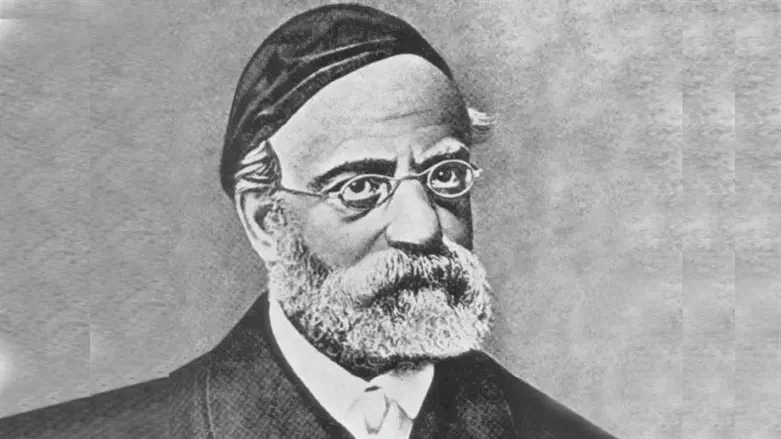
Rav Samson Raphael Hirsch (1808-1888) – head of the Jewish community in Frankfurt, Germany for over 35 years – was a prolific writer whose ideas, passion, and brilliance helped save German Jewry from the onslaught of modernity.
Elliot Resnick, PhD, is the host of “The Elliot Resnick Show” and the editor of an upcoming work on etymological explanations in Rav Samson Raphael Hirsch’s commentary on Chumash.
...