

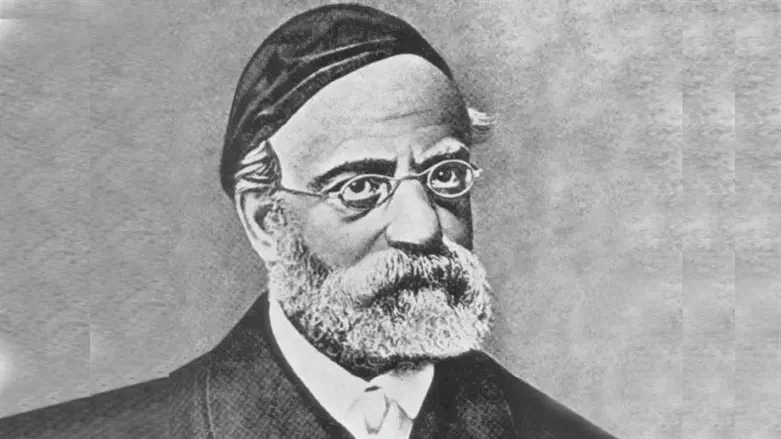
Is tzaraas leprosy? Is a metzorah isolated to prevent transmission of a dangerous disease? No and no, Rav Samson Raphael Hirsch argues forcefully. If tzaraas were leprosy and contagious:
• a person wouldn’t be pronounced pure when tzaraas spreads to his entire body;
• a kohen examining someone for tzaraas would have to inspect every part of him, including the folds of his body;
• tzaraas examinations wouldn’t be suspended on Shabbos and chagim, leaving “infected” people free to mingle among their neighbors;
• a metzorah would have to be expelled from every city, not just those with walls at the time of the conquest of the Land of Israel;
• a kohen wouldn’t order a person to remove his belongings before examining his house for tzaraas as a means of saving them from becoming tamei;
• the tzaraas of non-Jews living in the Land of Israel wouldn’t be ignored;
• halacha would err on the side of caution in cases of doubtful tzaraas. And yet, it does the opposite: kol safek nega’im bat’chilah tahor.
So if tzaraas isn’t leprosy or contagious, what is it? Rav Hirsch (and others) believes the disease is spiritual in nature. The Torah calls it a nega, which means both “plague” and “touch.” A person with tzaraas is “touched by the finger of G-d,” writes Rav Hirsch.
A metzorah must isolate himself, not because he’s contagious, but because he – like Miriam – spoke ill of others (or committed a similar sin). He thereby “forfeited the merit of remaining in the social circle of G-d’s sanctuary,” writes Rav Hirsch.
Why does tzaraas appear on the skin, though, and why is a person in worse shape if it spreads to his skin hair? Rav Hirsch suggests that the answer may lie in skin being “the general sensorium of the body…the means of reception of impressions from the surrounding world.” If a person can speak ill of his fellow man, he clearly is “morally unhealthy in his comprehension” of it; he “failed to absorb the impressions of truth, justice, and goodness of his world” and thus views it through jaundiced eyes.
Hair, meanwhile, “is the protective covering of the skin, protecting against and keeping off injurious contact.” So if tzaraas spreads from a person’s skin to his hair, not only are “good and true impressions…lacking, but…positively bad ones which should be kept away are finding entrance.”
Rav Samson Raphael Hirsch (1808-1888) – head of the Jewish community in Frankfurt, Germany for over 35 years – was a prolific writer whose ideas, passion, and brilliance helped save German Jewry from the onslaught of modernity.
Elliot Resnick, PhD, is the host of “The Elliot Resnick Show” and the editor of an upcoming work on etymological explanations in Rav Samson Raphael Hirsch’s commentary on Chumash.