
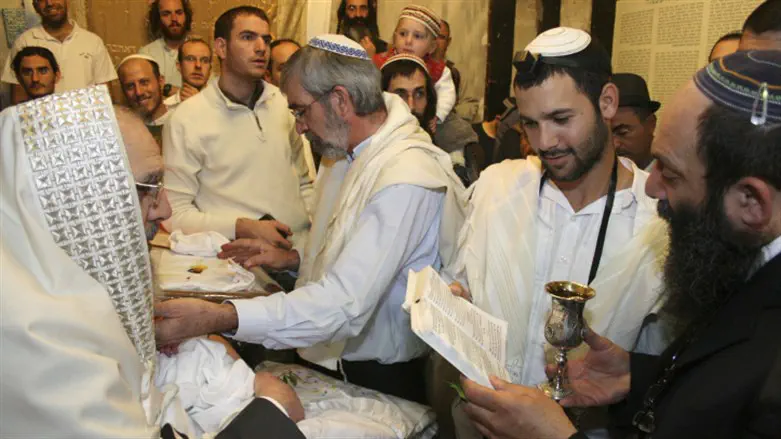
Our first Patriarch, Avraham, intersected with the colossal mitzvah of milah. Avraham was trembling until he realized that upon doing milah (Nedarim 32a) he would be considered complete.
How is it that milah brings completeness?
Turnus Rufus asked (Tanchuma, Tazria 5) Rabbi Akiva why Jews aren’t born circumcised. Rabbi Akiva answered that the mitzvos are given to refine and purify a person and therefore it is up to man to complete himself.
And this rectification is possible if we examine another verse where the notion of orlah is mentioned. The Israelites are commanded (Deuteronomy 10:16), “Circumcise therefore the foreskin of your heart, and be no longer stubborn.” The Ramban explains that this circumcision refers to the uncovering of the heart - to see and accept the truth. The mitzvos can only fully refine us if we’re willing to listen and absorb the realities from the Torah and our sages on how to correctly incorporate them into our beings.
Rabbi Aharon Lopiaמsky uses the menorah to exhibit how we must be complete people, the reason why milah was given. The menorah was carved out of one complete piece and then chiseled into its shape. So too, we must be one complete piece, carving ourselves into full rectification. Only then can we be a vessel to bring forth G-d’s light into the world.
One bad middah terminates completeness, whether it be a grab for power, egoistic movements, laziness in keeping the commandments or weak belief.
Like milah that’s on the eight day, the eighth sefira is hod, glory. In our travels toward completeness and in ultimately capturing it, we bring G-d’s glory to the world.
This in turn exhibits G-d’s completeness and brings peace amongst the nations, as shalom, peace, comes through being shalem, complete.