
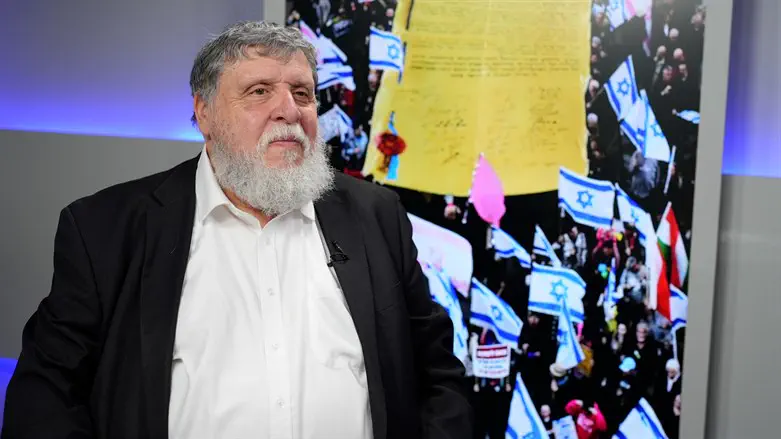
Rabbi Dr. Rafi Feuerstein, President of the Feuerstein Institute and one of the heads of the Tzohar Institute, spoke to Israel National News - Arutz Sheva about the initiative to help the elderly who were evacuated from their homes because of the war.
“Many people, especially the elderly, have been uprooted from their natural environment. Elderly people on the kibbutzim had a daily routine, and suddenly this whole routine, which is the anchor that protects them and us, goes down the drain. All life routines have gone haywire,” explains Rabbi Feuerstein.
He points out that "for younger people this involves many difficulties, but for the elderly it creates greater confusion. We are working in the Royal Hotel at the Dead Sea, where 1,000 elderly people have been evacuated. I asked the director of the center for the elderly how many elderly people are using the services that they provide, and she said that about 40. This shows that life has gone off track. The evacuees feel a strong sense of displacement. One of the evacuees told our caregiver that her biggest dream right now is to make an omelet in her own kitchen. For her, this is the symbol of a normal daily routine."
Dr. Feuerstein claims that the treatment methods offered by the institute for evacuees are different from their usual way of working. "Unlike conventional solutions, we are focusing on cognitive work. We just need to help the elderly maintain clarity and logic, organization, setting goals and a daily routine."
"We must tell their families that it is necessary to visit the elderly as often as possible and talk with them. But it is just as important to ‘work out’ their brain, to activate their thinking processes. We haven’t yet reached the stage of post-trauma; we are still in the midst of the trauma itself. The Feuerstein Institute’s approach is less to focus on treating the emotions themselves and rather build what I call a 'bridge over stormy waters,’ which does not treat the wounds that are currently bleeding, but rather focuses on functioning, setting goals and being able to realize them. The goal is to restore people to function within their family, work and everyday life circles, and from there to deal with emotions. When you return a person to a relatively healthy and normative state of functioning, it's much easier to treat their pain," he concludes.