

Many people’s image of holiness involves an escape from the physical world. Perhaps a monk on a mountaintop or a mystic seeking communion with the divine.
The “Glory of G-d,” however, “wants to have its home primarily on earth, ikar Shechinah b’tachtonim,” writes Rav Samson Raphael Hirsch. We fulfill our divine mission, not by shunning the earthly but by uplifting it. Indeed, “the angels laugh when people piously turn their eyes upwards to heaven and imagine they have to seek G-d up above” (Sefer Chassidim 18, quoted by Rav Hirsch).
According to Rav Hirsch, Yaakov only appreciated this lesson after his famous dream of the ladder reaching heaven. He awoke with the realization that “there is no necessity to go to heaven to look for G-d.” Rather, “where a guiltless man lays down his head, G-d is there!”
And this realization – that “frail man, is to be, should be, the bearer of the Glory of G-d on earth” – frightened Yaakov (“vayira,” Genesis 28:17). For, in a certain sense, retreating behind the walls of the beis medrash is far easier than sanctifying the day-to-day affairs of this physical world.
And yet, that’s our calling, beginning with our family life. We’re supposed to make our home a “beis Elokim” – “a house into which G-d moves” – and, if we do that, it becomes a “shaar hashamayim” – “a gate through which we come to G-d, accordingly, the most consummate union of the earthly with the heavenly.”
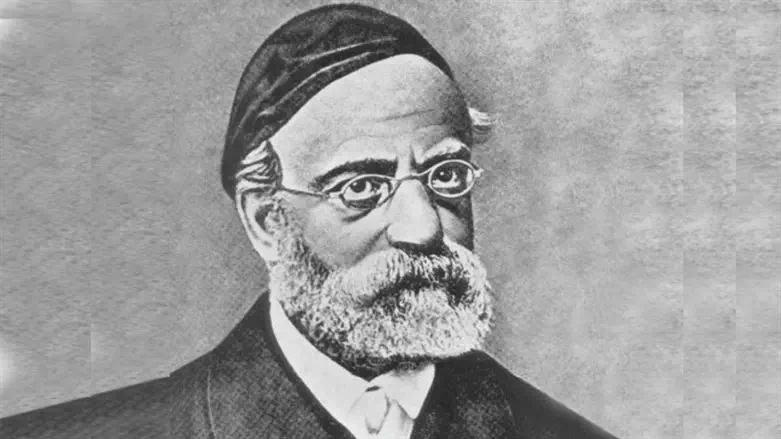
Rav Samson Raphael Hirsch (1808-1888) – head of the Jewish community in Frankfurt, Germany for over 35 years – was a prolific writer whose ideas, passion, and brilliance helped save German Jewry from the onslaught of modernity.
Elliot Resnick, PhD, is the host of “The Elliot Resnick Show” and the editor of an upcoming work on etymological explanations in Rav Samson Raphael Hirsch’s commentary on Chumash.
...