
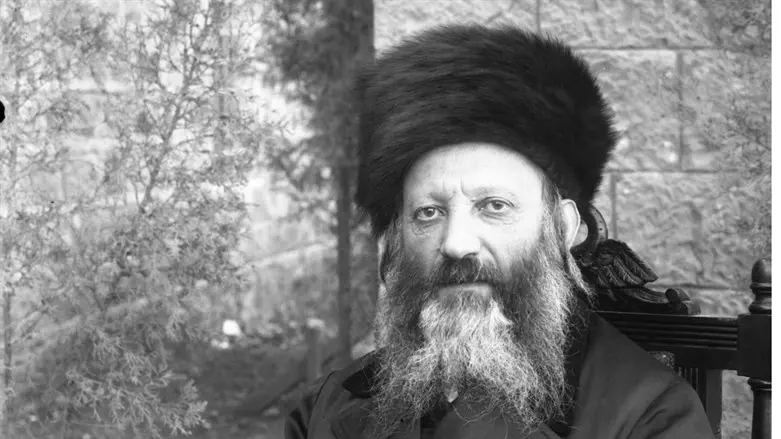
The celebrated first Chief Rabbi of pre-state Israel, Rav Avraham Yitzchak HaCohen Kook (1865-1935) is recognized as being among the most important Jewish thinkers of all time. His writings reflect the mystic's search for underlying unity in all aspects of life and the world, and his unique personality similarly united a rare combination of talents and gifts.He was the undisputed leader of Religious Zionism, defining the Jewish People and the Land of Israel as entities with specific commandments in the Torah of Israel, a construct known as Torat Eretz Yisrael.
Rav Kook was a prominent rabbinical authority and active public leader, but at the same time a deeply religious mystic. He was both Talmudic scholar and poet, original thinker and saintly tzaddik.
The depravity of the inhabitants of Sodom was so monstrous that it was beyond all hope of reformation. God decreed that the city be destroyed. He send angels to save Lot’s family — not in their own merit, but for Abraham’s sake. The rescuers warned Lot and his family not to watch as the city was leveled.
Unfortunately, Lot’s wife did look back, and she was turned into a pillar of salt.
Why did Lot’s wife need to pay such a heavy price for her curiosity? Why were Lot and his family not allowed to witness the city’s destruction?
The Misguided and the Irredeemable
Just as there are varying levels of righteousness, there are also levels of wickedness.
Some unscrupulous individuals are in fact good people who came under the negative influence of unprincipled associates and a milieu of crime and corruption. These misguided individuals are receptive to change. Witnessing the consequences of evil can awaken their innate goodness and encourage them to return to the proper path.
On the other hand, some people are so incorrigibly evil — sociopaths and hardened criminals, for example — that they cannot be redeemed. The only thing restraining their evil excesses is fear of punishment. This was the state of the inhabitants of Sodom, who fully embraced their evil ways and were content with their selfish cruelty.
For the incorrigibly wicked, witnessing the downfall of evil has the opposite effect. It actually reduces the fear that holds their vices in check, since anticipated punishment is more frightening than the real thing. When they observe havoc and devastation, they become less inhibited and pose an even greater threat to society.
Lot’s Wife
Lot’s family did not deserve to be saved. They lacked moral resolve; they were attracted to the malevolent practices of their neighbors. Only fear of Divine retribution kept their immoral inclinations in check.
To maintain their dread of Divine justice, Lot and his family were commanded not to watch the destruction of Sodom. This fear was the only means by which they could escape the corrupting influence of Sodom. When Lot’s wife willfully looked back, she lost some of her fear of judgment. She became like the other residents of Sodom, who were destroyed because they were irredeemably corrupt.
Lot’s wife shared the severe punishment of her fellow Sodomites — “brimstone and salt.” She too was turned into an inert pillar of salt, an apt symbol of her immutable and irreparable state of evil.
(Adapted from Ein Eyah vol. II, p. 250, sent by Rabbi Chanan Morrison, Ravkooktorah.org)