

Is man inherently good or bad?
Traditional Christianity teaches that we are born bad or – at the very least – tainted by the stain of original sin. Rav Samson Raphael Hirsch categorically rejects this view. “Nothing that comes from the hands of G-d is evil,” he writes in his Collected Writings. “The soul of every child is pure.”
How, then, does Rav Hirsch understand Bereishis 8:21, which seems to say that G-d won’t destroy the world again “because (ki) the inclination (yetzer) of the heart of man is evil from his youth”?
Simple. He rejects the common translation of this verse. “Yetzer” doesn’t mean “inclination” and “ki” doesn’t mean “because” (more on this below).
Before delving into the verse’s language, though, Rav Hirsch points out that the familiar translation makes no sense. What is G-d supposedly saying? That He won’t destroy mankind again because of its sinful nature? In other words, that another annihilation would be pointless because, alas, man won’t change? “That would be an extremely unworthy statement for us to ascribe G-d making about Himself and His work,” Rav Hirsch argues.
Furthermore, G-d brought the flood in the first place because “the inclination of the thoughts of [man’s] heart was only evil every day” (common translation of Bereishis 6:5). Does it make sense for “the cause of the punishment” to now be “the cause for the reverse”?
So what then does Bereishis 8:21 mean?
First, Rav Hirsch writes that “yetzer [hara]” is not an evil inclination within man. “Yetzer” actually means “form.” “Our soul,” writes Rav Hirsch, “is a choshev, a weaver” and “all possibilities, good and bad, lie in its hand. The soul has to weave them together to form shapes,” and these shapes “are yetzer, the formations of our weaving soul.”
He continues: “Yezter, the idea, the picture of what we can achieve, certainly does urge, ‘tempt’ us to achieve it, but we ourselves have formed it.”
So G-d is saying in Bereishis 8:21 that even when (“ki” often means “when”) the youth – who are typically far more pure and idealistic than their elders – “aim at evil…as the ideal they have formed in their minds,” He won’t destroy the world.
In normal eras, though, youth represent “hope for the future,” which is why G-d greatly shortened man’s lifespan after the flood. “[A]s long as evil men were able to live for seven or eight centuries, a better youth did not get a chance.” They lived under the shadow and leadership of their elders. Now, though, “G-d can make a generation die out quickly and a better one grow up in its place.”
For man is born good, not bad.
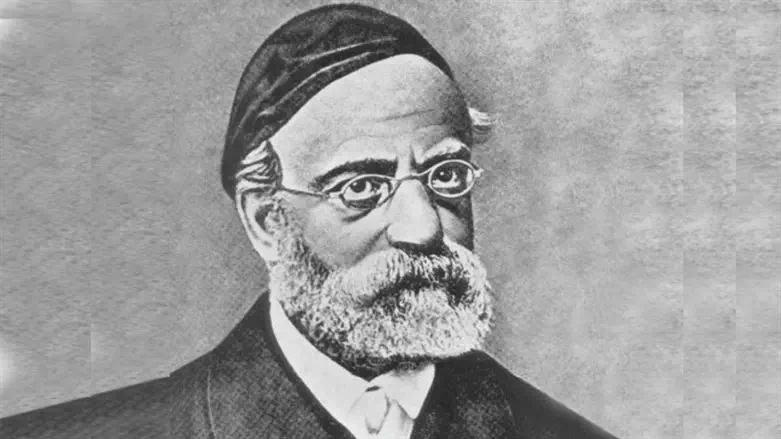
Rav Samson Raphael Hirsch (1808-1888) – head of the Jewish community in Frankfurt, Germany for over 35 years – was a prolific writer whose ideas, passion, and brilliance helped save German Jewry from the onslaught of modernity.
Elliot Resnick, PhD, is the host of “The Elliot Resnick Show” and the editor of an upcoming work on etymological explanations in Rav Samson Raphael Hirsch’s commentary on Chumash.