
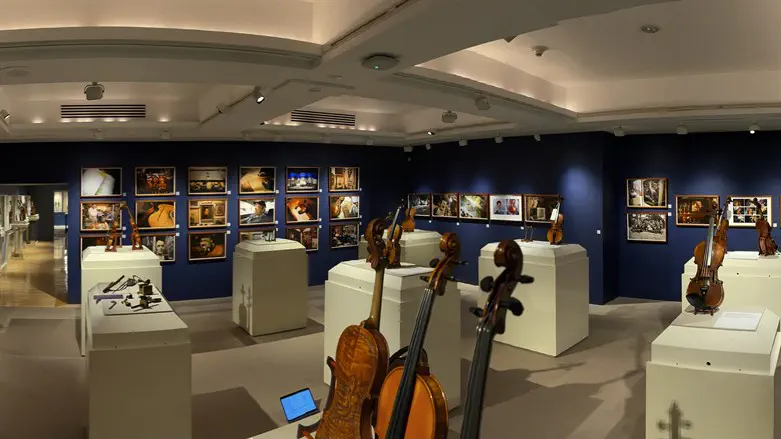
For the first time in New York, the exhibit, TheViolins of Hope: Every Violin Has A Story, will be shown to commemorate the 78th anniversary of the liberation of Auschwitz.
Forty-three photographs by Cleveland, Ohio based fine art photographer and professor, Daniel Levin, at Temple Emanu-El’s Bernard Museum will be on display, along with 36 violins that miraculously survived the Holocaust.
These “Violins of Hope” have been painstakingly restored by Israeli master violin maker and player Amnon Weinstein, and played all around the world so the spirits of people who were murdered in the Holocaust can live on through the music. The exhibition will run from January 31 until March 28.
One of the most memorable concerts was eight years ago on the 70th anniversary of the liberation of Auschwitz, when the violins were played by Hitler’s former orchestra, the Berliner Philharmoniker.
On January 27, 2,500 people, including Holocaust survivors who were guest speakers, attended a performance by the Orchestra of St Luke’s at Temple Emanuel with musicians who played on 10 “Violins of Hope”.
Levin will be making a special appearance at the exhibit on March 2 at 6:30PM to talk about the stories behind the violins, as detailed in his award-winning book, Violins and Hope: From the Holocaust to Symphony Hall.
‘Violins of Hope” have been tossed out of cattle cars, liberated with their owners from concentration camps and secretly carried into a forest where Jewish partisans were hiding. Levin tells Israel National News that they “were so critical in bringing hope to Jews clinging to their lives.”
Levin initially embarked upon this project to find out more about Weinstein. He asks, “Who could have the idea to see violins from the Holocaust as metaphors for transforming such enormous loss into triumph?... Somehow it occurred to Weinstein that by using his luthier mastery to restore them to their ultimate playability, those we lost in the Holocaust could be celebrated in the most beautiful ethereal way imaginable.”
Each violin stands as a testament of Weinstein’s love and transformative work. Levin explains that no one could get close to the violins during the concert, but at the museum exhibit, visitors have the opportunity to see close up the careful restoration process each instrument has been through. “To stand before these half pound instruments that survived the Holocaust is every bit as powerful as listening to them,” Levin says.