
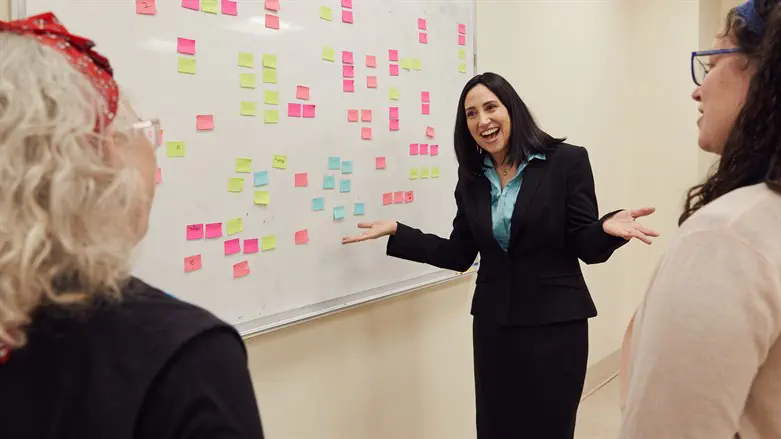
A reality in which Orthodox women receive rabbinical certification was considered science fiction up to a few years ago.
A reality in which a female soldier serves in a combat unit would sound delusional and if we were to present you an Orthodox military Rabbanit, you would think that we have long since lost it. But while in the State of Israel the differences of opinion continue and turn into silent or loud coups, somewhere across the sea, in faraway Australia, the position of military rabbi was indeed filled by a woman.
The historic achievement was recorded by Rabbanit Judith Levitan (47), when she was appointed last June as the first Jewish woman to serve as a Rabbanit in the Australian army. Levitan, who lives in Sydney, is used to breaking glass ceilings, as she is the first woman to be ordained as a Rabbanit in New South Wales, one of the Australian states, and the second woman to be ordained as an Orthodox Rabbanit in Australia as a whole.
Chaplains in the Australian Army are officers whose main role is to provide spiritual and religious support to soldiers and their families when needed.
Due to the variety of religions and sects to which soldiers belong, the army provides access to Christian, Muslim, and Jewish clergy. Rabbis have been a part of the army since World War I, following the recruitment of many Jewish soldiers into the Australian Army, and since the army encourages gender diversity, women also serve as chaplains. Rabbanit Levitan's appointment was not considered unusual, therefore, but it made waves in the Orthodox world.
How were you able to get the position?
"When they approached me and asked if I would be interested in the position, I replied in the affirmative and applied. I passed several tests and interviews and was finally accepted for the position. It is an honor for me to represent the Jewish community in particular and the Australian Army in general, and I am proud to serve in the Australian Army and proud of its efforts to promote diversity and inclusion."
Levitan, whose interview was conducted on Zoom with the careful approval of the Australian Defense Force (A.D.F.), explains that it is her responsibility to provide spiritual-religious support to the members of the military and their families, enable the preservation of their religious customs, advise the, and take care of their well-being.
In addition, Leviatan must conduct religious ceremonies, organize and participate in inter-religious activities and special events, and provide an address for soldiers in need. "As an Orthodox Rabbanit with experience in social work and work in the field of violence against women, I feel that I have a unique perspective that I bring to the position and I hope that I can help the soldiers in their struggles and challenges," she says.
What does the job require of you?
"The job is part-time and more like a 'reserve' service, so the position allows me to continue working at my regular job and to come to the military base every week, for a few hours each time. In addition, the position requires a basic level of fitness, so I started training with a personal trainer. When I took on the With the appointment, I also committed to studies and extensive training that deals with topics such as: trauma, suicide and mental health. I feel that I am only at the beginning of the journey and I have a lot to learn."
Leviatan, married and mother of three, was born in South Africa. Shortly after her birth, the family moved to Australia, where she grew up in a traditional, Sabbath-observant Jewish home. Her parents were very involved in the Jewish community and even volunteered in various Jewish organizations. Under their influence she grew to be a woman imbued with Jewish and religious consciousness. "I have always had a strong affinity for Judaism, I loved to study and I was very interested in the Torah. Over the years I always found time to study and since getting married, I have learned together with my husband."
Over the years, Leviatan took time off to attend women's seminaries for higher education, including Harova and Nishmat in Israel.
She didn't always plan to become a Rabbanit. Levitan says that she dreamed of becoming a lawyer since the age of 12, "because I wanted to change the world and make it a better place." She ended up studying law and social work, worked for over 20 years in the legal-social field, and was one of the founders of the "Jewish Alliance Against Domestic Violence", a voluntary community organization that raises awareness of domestic violence in Sydney's Jewish community.
She currently works at Legal Aid NSW, an organization that provides legal aid to people in social and economic distress, where she designs and builds digital products that aim to make it easier for people to communicate with legal services. She recently completed her studies for rabbinical ordination at the Maharat Yeshiva, an Orthodox seminary in New York that trains women for spiritual leadership (Maharat - halachic, spiritual, Torah leader).
You led a fulfilling role as a lawyer and activist in the Jewish community. What made you suddenly make a change and study to become a Rabbanit?
"I never thought about the possibility that Orthodox women could become rabbis and I certainly did not see rabbinate as an option that could suit me. When I got married and grew older, I became interested in feminism and tried to explore opportunities to actively integrate women into Judaism.
A few years ago, I met Rabbanit Dina Brewer from Britain and when we met at a conference of Orthodox feminist women, she suggested that I study rabbinic ordination. At first I rejected her offer, I told her that I have a family and a job and it would be difficult to leave everything and go to New York, but she insisted and said that online studies were possible.
In the end, I was convinced to apply, and when I was accepted I felt like I had been given an amazing opportunity that I couldn't refuse.
"The certification studies were carried out on Zoom between 4:30 and 7:30 am due to the time difference between the countries. I studied before I went to work, and continued to listen to recordings at night and every free moment I got. I couldn't find the strength to get up early to exercise, but I managed to wake up at 4:30 am to learn Talmud," she says. "It turns out that when something interests you and you really want it, you find the time and energy for it."
In addition to this, every January and June during the three years of her studies, Leviatan attended intensive study sessions in New York. After her last trip in January 2020, she was preparing to return to New York for the final exam in June 2020. "The COVID epidemic disrupted my plans and my final exam took place orally via Zoom when I was in Australia. But finally I received my certificate and the graduation ceremony also took place on Zoom," she continues.
Do you think women should be encouraged to study for rabbinic certification?
"Women should be encouraged to study Torah at advanced levels. If we want Judaism to be a living, vibrant and relevant religion for women and men in the 21st century and beyond, it is essential that women's voices be heard. It is also important to maintain the integrity of the Jewish legal system, which is the Halacha, and therefore women should acquire the necessary knowledge and tools to join the halachic discourse that has been going on for thousands of years."
The social fabric in Australia is characterized by a variety of people, cultures, religions and backgrounds and according to Leviatan, thanks to the democratic system of government and the rule of law, it is a mostly peaceful society, but she nevertheless admits that: "Anti-Semitism does exist and there have been anti-Semitic incidents that have increased in number over the years."
Not everyone accepts the fact that women serve as Rabbaniot in positions of spiritual leadership. What is your opinion on this?
"I think people are concerned mostly because they believe that taking Judaism in this direction will reduce its authenticity, harm, or destroy it. That is why it is important to emphasize the value of women holding leadership roles. Ultimately, Orthodox women in public leadership positions serve as role models for girls and young women and provide opportunities for increasing the connection and involvement of people in Judaism. This is a positive trend that can strengthen Judaism.
"In conversations with older women, they tell me that they lost their connection to Judaism because they did not have someone like me to guide them - an Orthodox Jewish rabbanit who would talk to them at eye level. In conversations with young women asking me questions about Halacha related to relationships, fertility and sexuality, they say that they would never discuss these issues with a male rabbi and are happy to have a female figure that they feel comfortable with..."
When I ask how she manages to be active in so many fields, Leviatan shares that teaching the Torah and strengthening the Jewish community inspires her. "You can always find time or prioritize activities that stimulate you and make you feel good. And I don't do everything. I have help running the house and the children are responsible for household chores. This allows me time to study and teach Torah."