
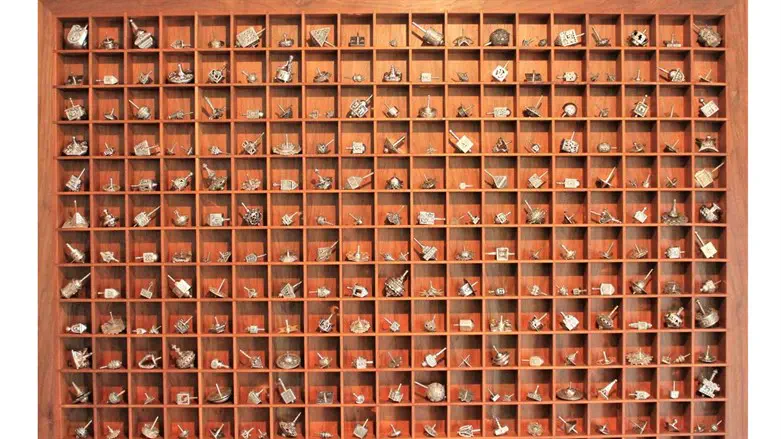
The Collection
About collecting
Many people collect all sort of things without questioning why. The instinct to collect is rooted in the evolution of mankind. In primeval times, hunting and gathering were essential to provide for and ensure the survival of one's own clan. This is no longer the case today. Nevertheless, collections continue worldwide. Various motivations underline this phenomenon:
The passion for collecting serves personal entertainment and a meaningful pastime. It has a stress-reducing and relaxing effect as it offers an escape from every-day life.Ben Zion Jaffa/Tel Aviv
There are countless serious collectors who, over a long period of time, have acquired knowledge in their fields and thus constantly have improved their individual education.
The fact that many collections, which have been assembled over the years, represent considerable investments and often form the basis of museums should also not be underestimated.
The Dreidel
A Dreidel is a four-sided spinning top that Jewish children play with during the eight-day Festival of Lights, Hanukkah. Each side of the spinning top shows a Hebrew letter.
נ (Nun), ג (Gimel), ה (He), ש (Schin). Instead of the letter Schin you also find a פ (Pe) in Israel.
Symbolism of the Dreidel's letters
These letters form the acronym for the following sentences:
Nes gadol haja scham (in the diaspora) - שם היה גדול נס - “A great miracle happened there“, or for Nes gadol haja po (in Israel) - פה היה גדול נס - “A great miracle happened here.“
Various Dreidels
Bier Jerusalem
Griebel London
When the victorious Maccabees reached the Holy Temple, because of the fighting, there was only one jar of consecrated oil left for the seven branched candelabrum in the Holy Temple , which would have lasted only for one day.
An eternal light had been burning in the temple candlestick (menorah) before the occupation.
However, it took eight days to produce new, sacred oil.
Miraculously the light stayed on throughout this period, until new oil became available. This fact justifies the duration of eight days of the Festival of Lights.
The light, called Ner Tamid, still shines continuously in every synagogue as a sign of G`d's presence. Its source is the candelabrum in the Holy Temple.
Various Dreidels II
The miracle described above refers to Hanukkah. The Jewish Festival of Lights is an eight-day lasting annual festival commemorating the rededication of the second Holy Temple in Jerusalem in 164 BC.
It begins on the 25th day of the Jewish month Kislev (November/December).
Back in 164 BCE the Jewish Maccabees ended the foreign rule of the Seleucid empire over Judea and rededicated the temple for the traditional Jewish service.
Caspi Netanya
There are other interpretations by Jewish scholars as to the meaning of the letters on the Dreidel.
One analysis says, that the four letters stand for the four ancient empires Babylon, Persia, Greece and the Roman Empire, which tried to destroy Israel.
Another explanation is based on Gematria. Each Hebrew letter is assigned to a number. The numerical value of the letters on the Dreidel is 358.
This corresponds to the value of the four letters of the word „Moshiach - משיח“ (Messiah).
In this way it creates a spiritual connection between the Dreidel and the „Redeemer“.
Dabbah Jerusalem
Weissman Shapeways USA
Origin of the Dreidel
According to legend, during the reign of Seleucid in Israel in the 2nd century BC, the Jews were forbidden to teach and learn the Torah, the five books of Moses.
Practising the Jewish faith was punishable by imprisonment and death. Despite the ban, the Jews encouraged their children to study religious traditions.
When enemy patrols appeared, the children fooled the occupiers with a game of Dreidels.
Originally, there was probably no connection between the Dreidel, Hanukkah and Judaism.
Although the historical roots of the Dreidel have not been conclusively clarified until today, it has been proven, that a small spinning top made its way to Germany via England and Ireland in the 16th century.
The letters on this spinning top, called Teetotum, were the Latin first letters of the following words: nothing, half, everything and put in.
In Germany, the Teetotum was renamed Trendel. When Yiddish speaking Jews, living in Germany, took over the spinning top game, the Latin letters were transliterated into Hebrew, since Yiddish script is rendered in Hebrew letters.
The word Dreidel comes from the Yiddish word „dreyen - דרייען“, which corresponds to the English word to turn.
Various Dreidels III
The Dreidel Game
The game that according to legend children used to play with the Dreidel is still played today at Hanukkah.
נ Nun = (Yiddish נישט nisht, ‚nothing‘) – You don't win anything, but you don't lose anything either.
ג Gimel = (Yiddish גאץננץ gants, ‚everything‘) – You win the entire contents of the till, after that each player has to put a piece back into the pot.
ה He = (Yiddish ץנאלב ה halb, ‚half‘) – You win half of the pot (rounded up).
ש Schin = (Yiddish אײן שטעל shtel ayn, ‚put in‘) – You have to put a piece in the till. If you can't put anything more in the pot, you are out of the game.
Sometimes it is requested, that if only one piece remains, everyone will have to add one.
The players place the same bet, e.g. chocolate money, raisins, nuts, etc. and turn the Dreidel one after the other. The side facing up indicates the win:
Ghatan Jerusalem
Shevach Jerusalem
Why collect Dreidels?
As a collector with a connection to Judaism and Israel, it is natural to be enthusiastic about Judaica.
These are artistic, ceremonial objects, e.g. candlesticks, Torah pointers, spice boxes, Dreidels, etc., which have served ritual purposes in Judaism for many centuries.
There are various reasons for choosing the Dreidel out of the variety of Judaica as a collector's item.
From a practical point of view, the Dreidel is handy and small, so that a space saving collection is possible, when space is limited.
Furthermore, Dreidels are affordable for many collectors, even in more noble versions, due to their small size compared to other Judaica.
Nadav Jerusalem
Various Dreidel IV
Why silver?
There are Dreidel made of glass, porcelain, wood, plastic, bone, gold, silver and many other materials.
The collection exclusively consists of silver Dreidels. This is based on several reasons.
Silver has been the classic material of craftsmen producing Judaica for centuries.
Dreidel and the nine-armed candlestick are symbolic of Hanukkah. For this reason the spinning top should be valued accordingly.
Considering a religious, philosophical aspect, it is significant, that the Dreidel as a toy gives children direct access to the Jewish religion.
Hence, in every religious community children guarantee for the continued existence of the religious customs and traditions.
The Dreidel ensures that the children are introduced to their Jewish history and culture at an early stage.
In this way the game of Dreidels at Hanukkah contributes to transmission and survival of Jewish traditions.
Netafim Jerusalem
Shmilowitz
Ever since the small spinning top was associated with the Festival of Lights, the Dreidel has stood for liberation from oppression and the victory of Judaism over cultural assimilation until this day.
The use of silver in the manufacture of Jewish spinning tops gives the Dreidel an adequate appreciation.
In this sense:
Lamir veyter dreyen dem Dreydl - לאמיר ווייטער דרייען דעם דריידל - Let's continue to spin the dreidel!
Shoham Jerusalem
Chanukka sameach- חנוכה שמח -Happy Hanukkah!
Dr. Ingo Holtz writes that he is a Dreidel collector for 30 years, living in Germany. Two years ago he wrote a short essay about the collection for the German Internetforum Hagalil. Last week he translated the text into English to reach more people and sent it to Arutz Sheva for the end of the holiday..