
The celebrated first Chief Rabbi of pre-state Israel, Rav Avraham Yitzchak HaCohen Kook (1865-1935) is recognized as being among the most important Jewish thinkers of all time. His writings reflect the mystic's search for underlying unity in all aspects of life and the world, and his unique personality similarly united a rare combination of talents and gifts.He was the undisputed leader of Religious Zionism, defining the Jewish People and the Land of Israel as entities with specific commandments in the Torah of Israel, a construct known as Torat Eretz Yisrael.
Rav Kook was a prominent rabbinical authority and active public leader, but at the same time a deeply religious mystic. He was both Talmudic scholar and poet, original thinker and saintly tzaddik. Here is what he wrote about one aspect of the Sukkot holiday.
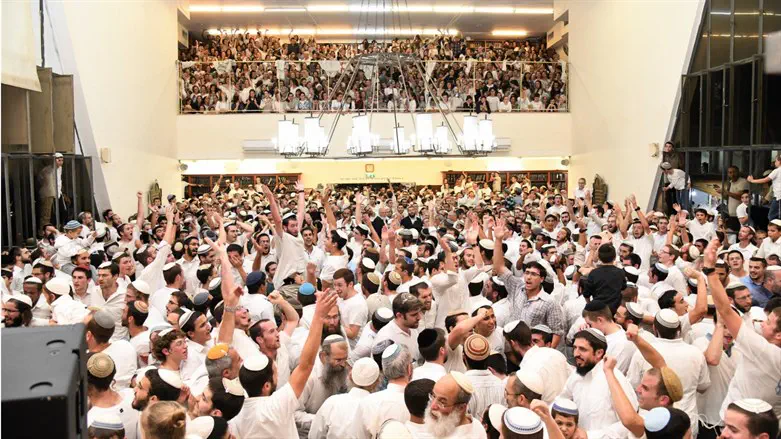
During the evenings of the Sukkot holiday, there was music, dancing, and even juggling in the holy Temple. This joyous activity was called the SimchatBeit-HaSho'eivah, the Water-Drawing Celebration.
While usually wine was used in libation ceremonies, during the holiday of Succoth the kohanim poured water - drawn the previous night from Jerusalem’s Shiloach spring - next to the altar. This water-offering alludes to the Heavenly judgment for rain that takes place on Succoth.
Yet the nature of these evening celebrations is peculiar. They are called SimchatBeit-HaSho'eivah, from the word sho'eivah meaning “to draw water.” This term indicates that the celebrations were not in honor of the actual mitzvah of pouring water on the Temple altar, but rather for the preparatory act of drawing out water from the spring. This appears quite illogical. Why did the people dance and rejoice during the nighttime preparations, and not during the actual Temple service that took place the following day?
Means and Ends
In fact, the Water-Drawing Celebration teaches us an important lesson. Generally speaking, we can divide up life’s activities into two categories: means and ends. We naturally distinguish between their relative importance, and look upon means as merely a prerequisite to attain a desired goal, but lacking any intrinsic value.
This divide between means and ends goes back to the very beginnings of creation. God commanded the earth to produce “fruit trees that make fruit” (Gen. 1:11). Not only were the trees to produce fruit, but they themselves were to be fruit trees - the trees themselves were meant to taste like their fruit. However, the earth failed to bring forth “fruit trees that make fruit”; it only produced “trees that make fruit” - trees that bear fruit, but lack any taste of their own.
Why does it matter that our fruit trees are tasteless?
This Midrash refers to this failure as the “Sin of the Earth,” and it reflects a basic defect in the universe. The original ideal was that even within the means (the ‘tree’) one would be able to sense the same level of purpose and importance as the final goal (the ‘fruit'). Unfortunately, this ideal was beyond the world’s limited reality. The earth could only bring forth trees that bear fruit, but the trees themselves lack the flavor of their fruit.
Elevating the Means
While our current reality makes a sharp distinction between means and ends, nonetheless this original ideal was not completely lost to us. When we sanctify our actions and perform them altruistically, with a pure motive to fulfill God’s will, then even that which only facilitates a mitzvah is elevated to the level of the final goal. At this level of intent, even our preparations have a ‘taste’ of the sweetness and meaningfulness of the mitzvah itself.
So it was with the SimchatBeit-HaSho'eivah celebrations: even in the preparatory act of drawing the water, one could sense the joy and holiness of the actual mitzvah of offering the water on the Temple altar.
(Gold from the Land of Israel (now available in paperback), pp. 21-22. Adapted from Mo'adei HaRe’iyah p. 110. See also Orot HaTeshuvah 6:7, sent by Rabbi Chanan Morrison, ravkooktorah.org)
Ed. Note: You can attend joyous SimchatBeit-HaSho'eivah celebrations all over Jerusalem, in Meah Shearim and yeshivas and neighborhood shuls in memory of the celebration in Temple Times. Check the internet if you are in Israel.