
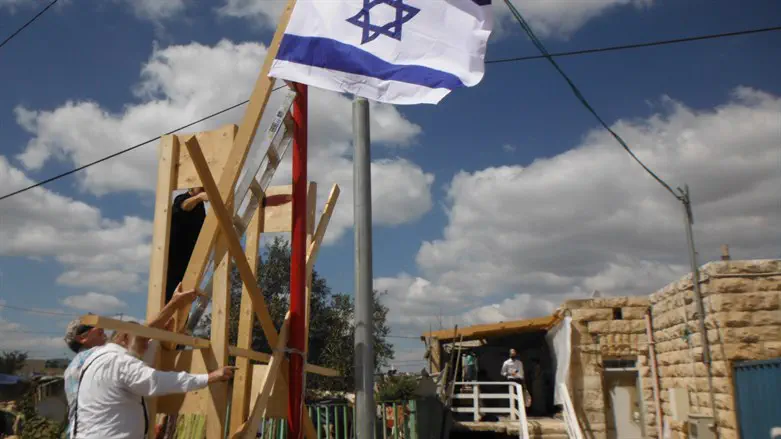
In Israel, he embarked on two interesting projects: opening a wine-making business, and seeking to evict Arab squatters on the property he had recently purchased in the southern Jerusalem neighborhood of Givat HaMatos (Airplane Hill). By refusing to give up this latter battle, despite the legal, financial, bureaucratic and even physical obstacles that faced him, his story – followed closely at the time by Arutz-7/IsraelNationalNews – provided deep inspiration for both writers and readers hoping and actively awaiting the Jewish People's reunion with, and rebuilding of, its holy Land.
In the foreword to his work "My Fight for Justice" (Jerusalem, 2014), it was written: "It is no exaggeration to say that had Yitzchak given up at any point during his 18-year battle to evict an illegal clan of trespassing Arab squatters from his property, a prime piece of holy Jerusalem real estate would have been lost to the Jewish People for generations into the foreseeable future."
The struggle involved:
· Seeking out aerial evidence – annual photos of the site – that proved that the Arab clan had not lived there before 1982.
· Proving that the Arabs' claim that they had purchased the property from the original owner was based on a total forgery. Handwriting experts and "G-d's help in having me find the one person who had a copy of the original owner's handwriting" convinced the courts that the Arab purchase was a forgery.
· 18 months of a legal fight to seize the defendants' sheep in lieu of the back rent they had been ordered to pay.
· Seeking to have the municipality recognize the site and grant it an official street name and address.
Yitzchak also accompanied his legal battle with articles and protests wherever possible against what he saw as the failure of the police over the years to enforce the law against the squatters.
In addition to Yitzchak's direct encounters with the police, he wrote that even before the squatters moved in, they had been illegally grazing their sheep on the site – preventing the Jewish National Fund and Israel Lands Authority from turning the area into a beautiful forest like the one near Mevaseret Zion. He wrote that this was another example of the failure of the police to enforce the law.
Though from the outside, the case looked like a "simple non-political land dispute," most of those closely involved with the case agreed that it was truly so much more. From the foreword: "The Jewish Nation has been fighting a century-long war for the Land of Israel – and [this] was one of its battles fought not by a Jewish army, or a Jewish state, or any Jewish nationalist body. Rather, Yitzchak fought this battle single-handedly and on his own, squaring off against a strong alliance of enemies: A well-funded Arab clan, a bureaucracy whose raison d'etre sometimes appeared to be simply to impede the wheels of justice, and some in the Israeli establishment who feared taking too strong of a stance against a 'minority.'
"If not for his unflagging perseverance, who would have ever known that this property in between Jewish and Arab-populated neighborhoods in Jerusalem rightfully belonged to a Jew?"
Despite all the hardships he faced, Mr. Herskovitz was also known as one who made sure not to let the ends justify all means. His tendency to put himself in the other fellow's shoes and give others the benefit of the doubt, whether they were contractors, tenants, or government officials, was a source of great admiration.
As he lived alone, he was often hosted for Sabbath meals by his neighbors – and many of them related how much they not only enjoyed having him, but also learned much "life wisdom and good traits" from him.
Today, the land he fought for is recognized as an intrinsic part of Jewish Jerusalem, and will be part of a new building project of 2,600 housing units. Politics and our relations with the United States have prevented the project from moving quickly forward, but slow progress is being made.
Yitzchak had a share in building up other parts of the Land of Israel as well. He lived in Kiryat Arba, where he was a well-recognized and admired figure for his perseverance and dedication, and also helped build up a winery in Beit El and Efrat. In February 2014, he was honored by Yeshivat HaRa'yon HaYehudi in Jerusalem, founded by Rabbi Meir Kahane, and was awarded its annual "Gevurah" [Heroism] Award.
For many years, up until the time he was physically unable to do so, he prayed the early-dawn prayers in the Machpelah Cave. He also participated in a weekly prayer at a hilltop near Maaleh Hever in Judea, in memory of two soldiers who were killed there in 2003, Yehuda Ben-Yosef and Yoav Doron Hy"d.
Yitzchak Herskovitz, whose father escaped the Holocaust – unlike most of his siblings – when he moved to the U.S. in 1929, was buried in the hills of Kiryat Arba/Hevron on this past Thursday in the presence of dozens of mourning friends. Shiva will be observed by his children in the U.S.
Hillel Fendel, past senior editor at Israel National News/Arutz 7, is a veteran writer on Jerusalem affairs author and translator.