

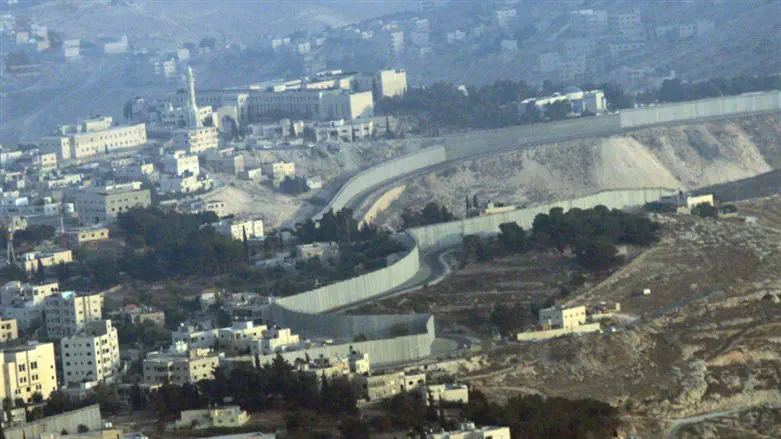
An enclave of 16 dunams on a green hill overlooking the separation fence between Abu Dis and the eastern border of the Jaber Mukaber neighborhood of Jerusalem, appears to be the next battleground in the capital after the Ministry of Justice completed the transfer of land to the temporary ownership of the State of Israel, according to a report in Israel Hayom.
The report states that investigators hired by the General Custodian obtained evidence that the land was purchased by Jews at the beginning of the previous century and recently received the court's consent in the matter.
The story begins in 1924 when property prices dramatically rose in British-occupied Jerusalem, making it increasingly difficult for its Jewish residents, mostly belonging to the lower middle class, to acquire land. This led to the establishment of an investment group by the name of "The Neighbors Committee" whose intention was to purchase land and create a new neighborhood featuring lower-priced homes. The group soon expressed interest in buying about 400 dunams in the Arab town of Abu Dis, neighboring the future capital.
To this end, they established an association by the name of "The Tenants' Association", whose chairman was Yehoshua Avizohar Singlovsky (brother of the founder of the Ort network), and the secretary of the association was Ya'akov Yehoshua Diamond. Among the approximately two hundred members of the group was Rabbi Tzvi Pesach Frank, a great Torah scholar and future chief rabbi of Jerusalem.
In 1927, they completed their purchase of 453 dunams and in 1930, construction of the neighborhood was set to get underway, but was interrupted by the outbreak of WWII, as plans to build a Jewish neighborhood on the site were canceled before getting off the ground.
After the events, the Jewish settlement in the Land of Israel decided to abandon the construction on the territory of all the enclaves, mainly due to difficulties in protecting them, and to build only in a territorial sequence. Due to the outbreak of the "Great Arab Revolt" in April of 1936, and financial issues discovered among group leaders, all activities were ceased in their entirety.
Of the 453 dunams purchased, the association managed to complete the legal registration of land ownership in the mandatory transaction book for only 371 dunams, with the remaining 82 never registered, despite their purchase procedure being completed.
Once the World War II came to an end, the land manager of the Israel National Fund, Yosef Weitz, wrote upon visiting the aforementioned area: "The place is beautiful but very isolated. In a few years it may be possible to begin construction."
In 1948, when Jerusalem was divided following Israel's War of Independence, Abu Dis remained under Jordanian jurisdiction. It expanded and houses sprang up on lands owned by the Tenants' Association, despite them being registered on the "Jordanian Custodian for Enemy Property."
After the completion of the Six Day War, Jerusalem's borders were determined in such a way that a majority of the Jewish-owned lands remained on the Palestinian side.
In 2003, the separation fence was constructed in the area, ensuring that only 60 dunams of the existing 400 remained on the Israeli side. The lands, which were registered with the Jordanian registrar, passed into the hands of the general custodian at the Ministry of Justice in Israel. Over the years, the Ministry has located some of the heirs of the Tenants' Association and transferred the plots of land to them. These were purchased by Irving Moskovitz, and in 2004, 10 Jewish families settled in the area at the behest of the Ateret Kohanim group.
However, the largest area of land on the Israeli side, known as F, was not registered with the Jordanians as Jewish land, and is considered an abandoned property outside the State's jurisdiction.
Over the years, the general custodian assumed that the tenants' association also purchased this area, but despite attempts beginning in 2005, no evidence of this was found. In 2017, Sigal Yacobi was appointed to the position of general guardian, and is currently an acting judge in the Jerusalem District Court. Following her appointment, Yacobi began to promote the issue of a Jewish return to the lands.
In 2021, civilian investigators hired by Yacobi succeeded in finding evidence that Area F had been purchased by Jews. That same year, the evidence was submitted to the District Court in Jerusalem, and as part of a confidential procedure, Judge Tamar Bar-Asher accepted the claims of the Ministry of Justice, and the area was transferred to the temporary ownership of the General Custodian.
The location, an enclave between the separation fence of Abu Dis and the eastern border of the Jabel Mukaber neighborhood named "Swakhara" after the Bedouin tribe found in the are, bears far-reaching political implication since there appear to be a number of lone Arab houses on the property.
These days, the General Custodian, under the leadership of Benzie Feigelson, is busy attempting to locate the heirs of the original purchasing group and Feigelson has mandated additional research regarding other lands in the area with the hopes that they will be returned to their rightful owners.