
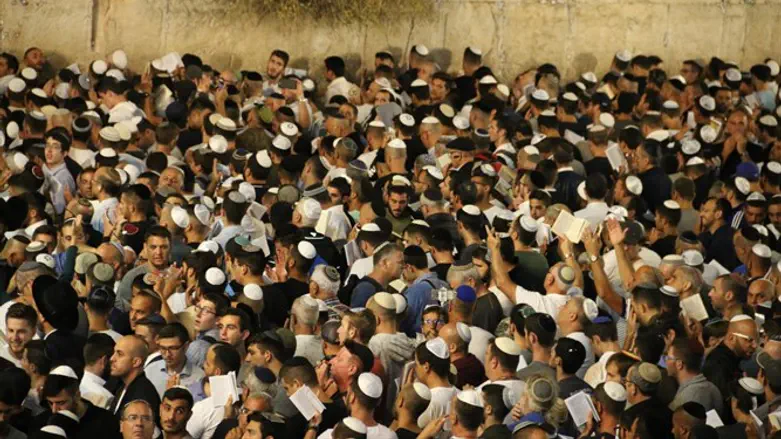
Chief Rabbi Avraham Elkana Cahana Shapira's zts"l's 11th yahrzeit was marked by an evening of Torah lectures in Yeshivat Merkaz HaRav where he served as Rosh Yeshiva for many years. Arutz Sheva is honored to have received the first translationss of several of his Torah essays from the yeshiva.
Strong Tefillah
The Selichos of the Thirteen Attributes, recited before Yom Kippur, opens with the poem of our ancestors, Am Hashem chizku v’nischazek v’kir’u el Elokim b’chozkah – “Nation of Hashem, be strong, and strengthen yourselves, and call out to Hashem with strength.” ‘Call out to Hashem with strength’ refers to Tefillah and Teshuva, prayer and repentance. There is a need to strengthen ourselves in both Teshuva and Tefillah, and this is the awakening we are called upon to perform with the beginning of the Selichos.
What is “strong Tefillah”? The Rambam writes that, “The way of Teshuva is for the one repenting to constantly cry out to Hashem with sobs and supplications.” During the Asseres Y’mei Teshuva, Ten Days of Repentance, there is an additional requirement to cry out to Hashem, for during this time the individual has the strength of the entire community. The Gemara says, “And the individual, when? During the Asseres Y’mei Teshuva.”
This basic principle of Tefillah being said out loud is brought by the Ramban as well. He says, “G-d does not desire supplications, only that man will know and acknowledge his G-d, his Creator. This is the intention of raising one’s voice in Tefillah, and having shuls and Tefillah in congregation, so people will have a place to gather and thank their G-d who created them and gives them life, to publicize this, and say before Him, ‘We are your creations.’ This is the intention of the Midrash which says, ‘They called out to G-d strongly.’ From here you learn that Tefillah must be out loud.” Therefore, the passuk from Yonah, the source for the poem mentioned earlier, “And they called out to G-d strongly,” teaches us about Tefillah being said out loud, i.e. strongly. Since the prayers of the people of Ninveh took place at a time of distress, and as part of the process of Teshuva, they were said strongly.
It is especially important to pray out loud during the Yamim Nora’im, since the prayers of these days are not ordinary prayers; rather, they are considered prayers said in times of distress. In times of distress, there is an emphasis on “strong Tefillah.” The Ba’al Halachos Gedolos brings a source for this from the Tefillah of Moshe Rabbeinu, Vayechal Moshe es pnei Hashem – “Moshe pleaded before Hashem, his G-d.”
The Rambam, in his work, Sefer Hamitzvos, disagrees with the Ba’al Halachos Gedolos, and says that we don’t learn from something that was not established for generations, and Moshe’s Tefillah was not set for generations. In the words of the Rambam: “The Ba’al Halachos Gedolos writes that there is a parsha of supplications, and that is the parsha of “Moshe pleaded,” Moshe’s supplication before Hashem regarding the sin of the Golden Calf.
According to the Ba’al Halachos Gedolos, this parsha is for the public, one from which we shall learn supplications in times of distress. As it says in the Gemara, “Va’ya’avor Hashem al panav, Vayikra – ‘Hashem passed before him and proclaimed,’ teaches us that Hashem wrapped Himself as a Shaliach Tzibbur, appeared to Moshe and said to him, ‘Any time Bnei Yisrael sin, perform this ritual before Me and I will forgive them.’”
In any case, the cries and shouts in times of distress are an integral part of the process of Teshuva, and not just for the purpose of requesting one’s personal needs. From here we can understand the Halakha that on Rosh Hashana it is customary to pray out loud. Because the Tefillah of the days of Teshuva is part of the process of Teshuva, to repent and cry out before Hashem, this is the format of Tefillah, and so it is permitted to pray out loud.
Strong Teshuva
Just as the words of the poem “Call out to Hashem with strength” refer to Tefillah, they also refer to strengthening oneself to do Teshuva, a “strong Teshuva.” Teshuva, as well, is considered calling out to Hashem. Teshuva has many benefits, from its most basic level to the highest of heights. The Gemara mentions that even a thought of Teshuva has a great effect: “A man who gets engaged to a woman ‘On condition that I am a tzaddik,’ even if he is a complete rasha, has indeed become engaged, for perhaps he had thoughts of Teshuva in his mind.” In truth, even if he had only a hint of a thought of Teshuva, it is considered as if he has begun the process of Teshuva, for that hint of a thought is the beginning of the process of coming closer to Hashem.
This is the lowest of the levels of Teshuva, and from here the power of Teshuva ascends until it reaches the level of “Return, Israel, up to Hashem your G-d,” up to the throne of glory.
Many examples can be found regarding the various benefits of Teshuva. First, by Adam Harishon in Breishis. After he sinned, Hashem said to him, “Ayekah” – “Where are you?” Just one word, and this was the beginning of Teshuva. What exactly did Hashem ask of Adam in that question, “Ayekah?” – Where are you, what is with you. A person is asked – Where do you stand. This question is the basis of Teshuva for generations. The question, “Where are you?” applies to every person. It begins the process of personal introspection, and is one of the easier steps in the process of Teshuva, making it a good place to begin.
With Kain, also in Breishis, we see a higher level of Teshuva. Hashem says to Kain, “Surely, if you improve [you will be forgiven].” The Sforno explains, “‘Surely if you improve’ yourself and try to make yourself wanted [in the eyes of Hashem], ‘you will be exalted,’ the highest, most exalted levels are before you, waiting for you to attain.” If you do Teshuva, you will be elevated. The ability to elevate and exalt oneself is one of the greatest effects of Teshuva.
Another level of agreeing and deciding to do Teshuva can be found in the commentary of the Yerushalmi on Melachim Alef, regarding Bnei Yisrael’s Teshuva in the story of Eliyahu the Navi on Mt. Carmel. This Teshuva contained only the words, “The proposal is good!” The people had not yet fully returned to Hashem. Because they had begun to doubt their avodah zara, however, they had already reached a certain level of Teshuva. This was still a low level of Teshuva, but the merit of Teshuva had been gained nevertheless. Due to this spark of Teshuva, a miracle was performed for them.
Teshuva can reach up to the throne of glory, up to the highest, most exalted levels. Personal introspection has the ability to properly connect a person with his Creator. The Ramban, in his commentary on the passuk in Koheles, “Remember your Creator,” explains that as a result of this remembrance, we will call out, “We are your creations.” Personal introspection on all levels brings a person to, “Remember your Creator.” Remember the Creator of the world, this is a great level of introspection.
Torah and Teshuva
At times when pronounced Torah scholars would do Teshuva with great strength, a renewal of Teshuva would come about, and the full extent of the power of Teshuva would be revealed. The Gemara says, “And Rabbi Yehoshua the son of Levi said: ‘The Jewish people made the Golden Calf only in order to give an “opening of the mouth” (i.e. encouragement) for penitents…’
And this same idea is that which R’ Yochanan said in the name of Rabbi Shimon the son of Yochai: ‘King David was not suited to perform that deed (with Batsheva), and Bnei Yisrael was not suited to perform that deed (with the Golden Calf)…’ If so, why did they act in this manner? In order to teach you that if an individual sins, we tell him, ‘Go, reflect about another individual (i.e. King David) who committed a sin and repented, and his repentance was accepted.’ And if a community sins, we tell them, ‘Go, reflect about another community, (i.e. the Jews who worshipped the Golden Calf and then repented,) and their repentance was accepted.’”
What is the meaning of the Gemara’s words, “they only [sinned]… they were not suited…” For in reality, they sinned because the evil inclination overcame them! The explanation of the Gemara is that every day the evil inclination works to overcome a person’s judgment, but we receive special Divine assistance to overcome it. Here, the Gemara teaches us, that at the time of these sins, there had been no Divine assistance, and this is what is meant by the Gemara’s words, “they only [sinned]… they were not suited…” signifying an absence of Divine assistance. This occurred, “In order to provide an ‘opening of the mouth’ (i.e. encouragement) for penitents.”
We need to understand the deeper meaning of this lesson of Teshuva, both for the individual and for the community, for Teshuva preceded the world, and was present at the very beginning of creation, by both Adam Harishon and Kain who did Teshuva. Therefore, it is clear that the Gemara isn’t coming to show the existence of Teshuva. Rather, the Gemara is coming to teach us an entirely new concept: it is not enough to simply know that Teshuva exists; there is an entire theory of how exactly to do Teshuva, and how to atone for sin.
In the process of forgiveness for the sin of the Golden Calf, the incredible tool of recalling the Thirteen Attributes of Mercy was created, and amazing forces of atonement were initiated. The forgiveness of the sin of King David as well, led to the composition of the Book of Tehillim, a book entirely relating to Teshuva and the laws of Teshuva, for every individual and for every deed and action. This is the intention of the Gemara: since Teshuva is so intricate and complex, there is an entire theory, expansive, wide, and all-inclusive, for every detail of the Teshuva process.
The Teshuva of King David
King David created a path for Teshuva, and in the course of his Teshuva, an entire theory was revealed including the fine details for the individual performing Teshuva. King David is not an individual whose life was personal. Rather, he was the king of Israel, a person whose life was collective, for the people. As the Rambam defines it, “His heart is the heart of the entire congregation of Israel.” His actions are not his own personal actions, and also his Teshuva, forgiveness and atonement are affected by and have an effect on the entire Jewish people for generations. In Tehillim, David requests forgiveness, asking, “Let me hear the sounds of happiness and joy.” Rashi comments on this passuk, saying, “‘Happiness and joy’ – forgiveness from sin.” Forgiveness returns a person’s happiness and joy.
On Rosh Hashana we do not say Hallel, as the Rambam writes, “But Rosh Hashana and Yom Kippur do not have Hallel, for they are days of Teshuva, fear and awe, not days of extra happiness…” When the books of life and death are open before us, and the forgiveness of our sins has not yet been assured, the happiness is missing, and we continue to request, as it says in Tehillim, “Return to me the happiness of your salvation.”
The Zohar brings the question, that man must act and perform mitzvos out of joy, and if he brings a korban out of misery, how can he serve Hashem without joy? The Zohar answers that it is for this reason that when a person comes to bring a korban, he is met by the Kohanim, people of kindness and good deeds, and by the Levi’im, singing and performing on their platform, in order that the service of the korbanos will indeed be performed out of happiness to serve Hashem.
The Tosefta in Kilayim says, “Issi from Bavel says that it is forbidden to ride on a mule. They said to him, ‘Yet it says in the passuk, “And you will place my son Shlomo on my mule, and you will lead him riding down to Gihon.”‘ He said to them, ‘You cannot draw a conclusion from someone who rules on a Halakha for himself.’” Meaning, we cannot bring a proof from King David, who decided matters of Halakha for himself.
Clarification is necessary, as the Tosefta indeed asks, “How can you utter such an expression about King David?” The Rashba explains, “Do not bring a proof from David, for David acted against the wishes of the Sages, and did not align his actions with their rulings, for he ruled for himself in matters of Halakha. Just as he ruled for himself and did not ask the Sages to rule in the matter of Batsheva, here too, he ruled for himself in matters of Halakha against the will of the Sages, despite having a Rabbi in his own city. This is called “Takua.” Even a great person such as King David should have taken counsel with the Sanhedrin in matters of Halakha and not ruled for himself in this new matter.
The Rashba teaches that it is not only in the case of the mule that King David did not take counsel with the Sages, but he also did not take counsel in the story with Batsheva. David’s Teshuva did not only relate to the act of wrongdoing, but to the entire series of events, even for the part where he did not take counsel. For Teshuva includes not only the specific error, but also all of the means that lead to that error, as the Rambam says, “The person [who has sinned] changes his ways for the good and to the straight path.” This principle of Teshuva is learned from King David as well, whose Teshuva shows the way for every individual to repent.
Up to Hashem, Your G-d
One of the greatest initiators of Teshuva is the Navi (prophet) Hoshea, whose prophecy, “Return, O Israel” awakens the Jewish people to do Teshuva on Shabbos Shuva. As it says in Hoshea, Shuva yisrael ad Hashem Elokecha, ki kishalta ba’avonecha – “Return, O Israel, to Hashem, your G-d, for you have stumbled in your sins.” Teshuva must be “up to Hashem, your G-d.” The Gemara explains that Hoshea was the head of the prophets, and he was worthy of having his sefer - book - precede the sefarim of other prophets. (The Gemara resolves this by saying that since his sefer was smaller, there was a concern that it would get lost amongst the other books of Tanach, and so it was included in Trei Asar, together with the other smaller sefarim of Navi.)
What does the Gemara mean when it says that Hoshea was the head of the prophets? There were many prophets from the days of Moshe Rabbeinu until the days of Hoshea. Yet Hoshea’s prophecy brought something new. Although the prophets preceding him spoke about Teshuva constantly, those prophecies were oral. Hoshea’s prophecies were the first to be written down. This is the meaning of the passuk in Hoshea, “The word of Hashem began with Hoshea.” Just as in the generation of the Tannaim, the need for the oral Torah to be written down was a new concept, so too, in the generation of Hoshea, it was a new concept that the prophecies would be written down. The Gemara brings the reason for this, by explaining that in the generation of Hoshea, the merit of our forefathers ceased, and so in that generation the prophecies began to be written down.
In this Haftarah, Hoshea emphasizes the power of Teshuva, that it can bring a person “up to Hashem your G-d.” There are two ways to explain this. One explanation is that even for a sin which, in its severity, has reached the throne of glory, Teshuva still has the power to resolve the situation. No sin exists which Teshuva cannot fix; the door is always open. The other explanation is that through the process of Teshuva, a person can become spiritually elevated – up to the throne of glory. This principle of raising oneself up in the merit of Teshuva is learned from the story of Kain in Breishis, “If you improve, you will be favored,” as we have explained earlier according to the Sforno.
This is the main concept of Teshuva – that a person who repents does not simply fix his previous misdeeds, yet also elevates himself. As it says in Tehillim, “Praiseworthy is he who rises up from iniquity.” The phrase, “he who rises up” comes from the language of exalting oneself, for he has elevated himself from sin, above his transgressions. The power of Teshuva can change such a person into a tzaddik, not just prevent him from being a rasha. Furthermore, Hoshea adds that this elevation can bring a person higher and higher, “up to Hashem, your G-d.”
Personal Introspection and Vidui – Confession
The passuk brought earlier from Hoshea says, “For you have stumbled in your sin.” This is one of the principles of Teshuva, having the knowledge that a stumbling has occurred. Personal introspection includes the awareness that not only did the person refrain from fulfilling mitzvos, and from growing and improving in Torah and Yiras Shamayim, but even more – there was a stumbling and a fall.
The foundation of Teshuva is the knowledge a person has that, “you have stumbled in your sin.” Then, he can once again elevate himself. When he does not cover up his misdeed or try to place blame on others, but takes responsibility for himself, he can then repair things. The requirement to confess is not because it says in the Shulchan Aruch that we must recite the words, Ashamnu, Bagadnu – “We have become guilty, we have betrayed.” Rather, it is in order to acquire full awareness of the fall, and to then acknowledge the desire to begin to elevate oneself again.
The Navi Hoshea continues, “Take words with yourselves, and return to Hashem.” Confession is part of the process of Teshuva. The Rambam, in his enumeration of the mitzvos, does not count Teshuva among them. There is no specific mitzvah to do Teshuva, according to the Rambam, for there is no mitzvah to improve; rather, the effect of each mitzvah is that it brings a person to improve. Therefore, the Rambam is of the opinion that Teshuva is not a positive commandment; a person doesn’t deserve a “shkoyach” (congratulations) if he does it. For it is impossible to say that due to a sin, a person now has acquired a mitzvah.
However, the Rambam does list the mitzvah of confessing before Hashem when a person repents for his sins. In the words of the Rambam, “When a person does Teshuva and repents for his misdeed, he is obligated to confess.” The confession is part of, “You have stumbled in your sin.” When the person says the words out loud, he begins to fully acknowledge his situation: I have transgressed, I have fallen in sin. In this way, the confession completes the personal introspection which stands at the foundation of Teshuva.
Yet, there is another principle regarding confession, an additional aspect of serving Hashem. The confession includes bringing honor to Hashem. In Yehoshua, Yehoshua tells Achan to confess his transgression, and says to him, “Give, I pray you, glory to the Hashem, G-d of Israel, and make confession to Him.” When a person says, “I was wrong, I have transgressed, and Hashem is right,” it brings honor to Hashem. As it says in Tehillim, “One who slaughters a confession-sacrifice honors Me.” From this passuk the Gemara learns, “Rabbi Yehoshua the son of Levi said: whoever slaughters his evil inclination and confesses (the sins he has committed) on its account, Scripture considers it as if he has honored Hashem in both worlds, This World and the World to Come.”
Giving honor to Hashem stands at the foundation of the confession service on Yom Kippur. The main part of the service of Yom Kippur is the Kohen Gadol’s confession. The Kohen Gadol certainly does not participate in the process of Teshuva, for he is a complete tzaddik and has not sinned. Yet, this act contains an aspect of bringing honor to Hashem. In his confession, the Kohen Gadol justifies the judgment, saying, true, the Jewish people have sinned and transgressed, there was a failure. He admits to the truth of Hashem’s judgment being fair and His justice faithful. If we were to say that confession is only an expression of the Teshuva in a person’s heart, then we would not have any way to understand the Kohen Gadol’s confession.
Confession – Part of the Atonement
The entire concept of confession is learned from the korbanos. The Rambam writes that the source for the mitzvah of confession is from the passuk in Bamidbar regarding the korban chatas, “A man or a woman who commits any of man’s sins… they shall confess the sin that they committed.” If we take a close look at the process of the person who brings a korban, we will see that at first, he does Teshuva in his place, and it is there that he is obligated to confess, the moment he repents for his transgression. After some time, which can even be over a year after he has repented, he brings a korban to Yerushalayim. Yet, when he brings the korban, he must again confess, and the question arises, why does he confess again in Yerushalayim, after he has already confessed in his home? It must be that the first confession made in his home is insufficient; in order to fully atone for his sin he must confess again, and this confession has an aspect of, “I pray you, give glory to Hashem.”
The Ramban explains that because suffering brings atonement, any person who experiences suffering should confess. It seems that we can understand the Ramban in the following way: if we learn from the korbanos that every time a person brings a korban for atonement he must confess, then when there is a time for atonement due to suffering, he must also confess. This is an original concept, that every time a person suffers he should confess. And since this is the time required for his confession, it seems that he can even confess on Shabbos if he experiences suffering on Shabbos.
At the end of the wording of the confession, the Rambam writes, “Anyone who adds to the confession, and expands upon it, this action is praiseworthy.” The Gemara discusses whether a person must repeat the confession after he has already confessed, or perhaps he should not confess again. There is an argument in the Gemara as to whether this is comparable to a dog that vomits and then returns to eat it, for it is not necessary for a person to expound upon his sins. Even though we do not rule like this, and we go according to the opinion that it is permissible to confess again, it is still difficult to understand; why one would lengthen his confession from the outset, and what purpose can be served in confessing once he has already confessed? Yet, the basic principle is that the confession brings honor to Hashem. The more a person discusses the process of his Teshuva, the more honor he brings honor to Hashem.
This is the foundation of the confessions of Yom Kippur, which take place five times throughout the holy day, and each one brings honor to Hashem. Our entire service on Yom Kippur is based on the service of the confessions and bringing honor to Hashem. This type of confession is emphasized in the Selichos as well, where we begin by mentioning Hashem’s might, Lecha, Hashem hatzedaka, v’lanu boshes hapanim – “You, Hashem, have all righteousness, and we have embarrassment,” and Meh anu, u’mah chayenu – “What are we, and what is our lives?” and Lema’ancha Elokeinu aseh, v’lo lanu – “Act for Your sake, Hashem, not for ours,” and Re’eh amidaseinu dalim v’reikim – “See our stance as poor and empty people.” This is the purpose of confession, to justify the judgment, to acknowledge and express that Hashem is right.
Thirteen Attributes of Mercy
The service of Hashem that emphasizes His mercy, attributes, and leadership, is based in the Thirteen Attributes of Mercy. The revelation of the Thirteen Attributes of Mercy is part of the covenant that was made with the Jewish people on Yom Kippur, as it says in Shmos, “For according to these words…” It is clear that these p’sukim are a covenant regarding the Oral Torah, which was sealed on Yom Kippur when Moshe Rabbeinu descended from Har Sinai with the second Luchos (Tablets of the Law). Although this covenant also included what had preceded the giving of the second Luchos, on Rosh Chodesh Elul, when Moshe ascended Har Sinai for the third time, he was informed of the attribute of Hashem being “Compassionate and Gracious.” Yet the covenant itself took place on Yom Kippur. “To You, Hashem, is righteousness.” This is the meaning of the passuk in Hoshea, “Take words with yourselves,” to speak about honoring Hashem, and to recall the covenant of the Thirteen Attributes.
As we have mentioned, the first prophecy to speak about Teshuva is “Return, O Israel, to Hashem your G-d.” We read the words of this prophecy in the Haftarah of Shabbos Shuvah. Some congregations add the Thirteen Attributes of Mercy from Michah to the Haftarah as well, “Who is a G-d like You, Who forgives iniquity and passes over the transgression of the remnant of His heritage? ... He desires loving-kindness.”
We have the custom to leave the addition to this Haftarah for Minchah on Yom Kippur, after the Haftarah of Sefer Yonah, and to end there with the Thirteen Attributes of Sefer Michah. But the original custom was to say these p’sukim together with the Haftarah of Shabbos Shuvah.
All Thirteen Attributes are mentioned in Michah, in the passuk “Who is a G-d like you…” The entire service of Selichos is built upon the Thirteen Attributes of Mercy, and as such, there was a custom to say this Haftara containing the Thirteen Attributes of Faith during the Asseres Y’mei Teshuva.
The Ramak wrote the sefer, “Tomer Devorah,” based entirely on the p’sukim of the Thirteen Attributes of Mercy from Michah. In Kelm, they would learn mussar every day in order to awaken the heart, and the learning would bring the students grief and anguish. Yet, on Shabbos, this was a problem, since it is forbidden to feel anguish on Shabbos. However, the Yeshiva students of Kelm studied mussar on Shabbos as well – they studied the sefer “Tomer Devorah,” which discusses Hashem’s greatness, and what spiritual levels a person can attain when he clings to and emulates Hashem’s attributes: “Just as He is merciful, so too, you should be merciful… etc.” From this type of mussar a person does not feel distress; it is a higher level of mussar.
This revival of the attributes of mercy is relevant to the service of the Asseres Y’mei Teshuva. During these days, we search for advice in order to emerge victorious on the Day of Judgment. The simplest way to do so is to do Teshuva, but this requires a large effort. However, there is another way, mentioned in the Gemara, “A person who is lenient with others, [from Heaven] they will be lenient with him in his sins.” This, too, is good advice, to be lenient with others. A person must make efforts to perfect his character traits. Therefore, this is a unique piece of advice for the Asseres Y’mei Teshuva and Yom Kippur to indeed help us emerge victorious on the Day of Judgment. It is a type of atonement which does not quite affect one’s heart like regular mussar. That is why they used to read these attributes in the Haftarah of Shabbos Shuvah, in order to teach a person how to emulate them.
From Heaven may we merit to be signed in the book of good life, in the path of Teshuva and in the path of correcting our character traits, together with all of the Jewish people, Amen.
Translated by Yaffa Chaya Ben-Rachamim from Morasha, the set of books on Torah and Holidays written by Harav Avraham Elakana Cahana Shapira zts"l. The Hebrew text was edited by Rabbi Shamir Shintop and Rabbi Yehonatan Aviv.