
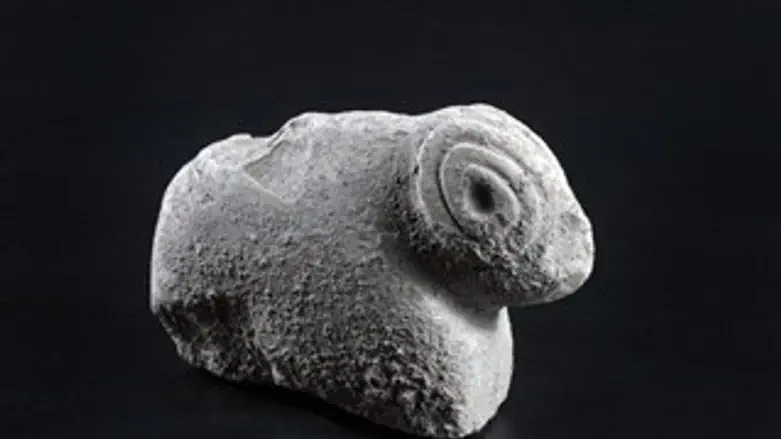
“The nation saw that Moshe was late in coming down from the mountain, and the nation gathered around Aaron and said to him, ‘get up and fashion for us a God that will go before us, for this man, Moshe (Moses), who took us up from the land of Egypt, we do not know what occurred to him.” Exodus 32:1
There are two separate issues which have to be explained:
1. Did Israel really abandon God and turn toward the worship of idolatry?
2. Why do the people of Israel seem so disdainful of Moshe?
One could sense their open disrespect for him. He is not called “our leader” or “our teacher” or “our rescuer,” but rather, “this man Moshe.” It seems that they do not know him at all. Rashi attempts to soften the blow by blaming Satan who showed them the image of a deceased Moshe being carried in the air towards heaven.
That however, makes the problem more difficult. If they really believed that Moshe had died, why was there no expression of regret and no mourning at his loss? There was no sense of gratitude for the man who led them out of Egypt and crossed with them the divided sea and was their source of protection when they received the Ten Commandments.
As a rule, the commentaries do not deal with the issues surrounding Moshe, but rather with the question of their apparent idoloatrous behavior. The Talmud (Sanhedren 63a) clearly states that they desired many Gods. The Kli Yakar is adamant that the fault lies not with Israel, but rather the mixed multitudes (Erev Rav) who accompanied Israel out of Egypt. The Ramban uses their reference to Moshe to demonstrate that they were not really looking for a new God, but rather a guide or leader who would lead them in the wilderness.
All of these solutions do not explain the open text which is not honorific to Moshe. I would like to offer the following interpretation.
The Rambam states:
The general object of the Torah is twofold: 1. The wellbeing of the soul, and 2. The wellbeing of the body. The wellbeing of the soul is promoted by correct opinions (imparted) to the people according to their capacity. . .The wellbeing of the body is established by a proper management of the relations in which we live one to another. This is attained in two ways: First, by removing all violence from our midst, that is to say that we do not do everyone as he pleases, desires, an is able to do; . . . secondly, by teaching such good morals as must produce a good social state. Of these two objects, the one, the wellbeing of the sould, comes unduoutedly first in rank (i.e. importance), but the other, the wellbeing of the body, . . .is anterior in nature and time . . . This second perfection (in time of the soul) certainly does not include any action or good conduct, but only knowledge which is arrived at by speculation or established by research. (Guide to the Perplexed part 3 chapter 27, Friedlander edition).
What the Rambam is saying is that the process of the acquisition of knowledge must occur in a lengthy time frame. The goals are clear and ever present. These include understanding truths about God and man’s relation to him. These truths are of the highest level and are the most important in the development of a human being. They cannot be achieved, however, until all the other aspects of human life are somehow controlled and directed. The best way of doing that is to condition the human being (Jew) from early childhood to fulfill all the mitzvoth which the Torah places upon him. Thus these mitzvoth (those that control our desires) are considered first in time, but are not as important as the higher mitzvoth of the intellect (e.g. davening, studying Torah) which strive to understand the nature of God.
If the Rambam is correct, what level of development had the Children of Israel achieved at the incident of the Golden Calf? It seems that their development occurred in the reverse order. At Sinai, the greatest intellectual truths were revealed to them. But the level of their moral development left them totally unprepared to understand these truths. They were still subordinated to hedonistic needs and selfish lusts. Their desires prevented them from truly understanding God or appreciating who Moshe Rabeinu truly was. As the Rambam indicated, it takes a long time and experience to control the selfishness of the body. It is only after that time frame that the higher good can be best understood. That higher good, is first expressed by consideration for the wellbeing of others and then reaches the level of pure contemplation, which leads to the contemplation of God.
Without allowing for sufficient time which allows for the development of that process, if a crisis occurs, we can expect no other outcome than a what is described in the Torah in the incident of the Golden Calf.