

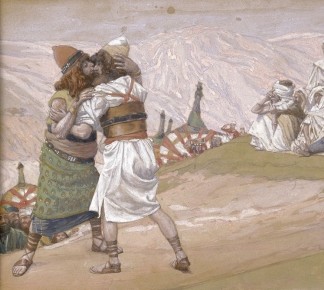
The meeting of Jacob & Esau, by James Tissot
The brothers meet, but whether for reconciliation or confrontation is a matter of dispute amongst the commentaries. On the surface of things, they meet as friends. According to Gen.33:4-5, “Esau ran to greet him (Jacob). He embraced him, he fell on his neck, he kissed him”. The sages wonder about the word which is usually translated “he kissed him”. What, they ask, was Esau’s intention? To kiss him, l’nashek? Or to bite him, l’nashech?
The proponents of the second view explain that Esau’s “embrace” of Jacob was all an act. What he really wanted was to have an excuse to put his mouth to his brother’s neck, to wound him and possibly inject poison into the wound. Others say that each brother was ready for peace after the long and weary years apart. As Rashi says, quoting Rabbi Shimon bar Yochai, their anger turned to love.
The ancient rabbis used the story to refer to the enmity between the Jews and the Romans. The Romans had the might to crush the Jews, but the Jews were not prepared to abandon the struggle, to lie down and die. Would the conflict go on for ever? Could they find it in their hearts to move towards one another in peace and forgiveness?
The analogy has its modern application, not only in terms of religio-political realities but also in the arena of family dynamics. When brothers fall out with one another, when parents and children become estranged, when husband and wife are at loggerheads, which emotion will win out – l’nashek or l’nashech? Either one is possible, but only the first is constructive…
Why did he want a blessing? – Vayyishlach
November 25th, 2012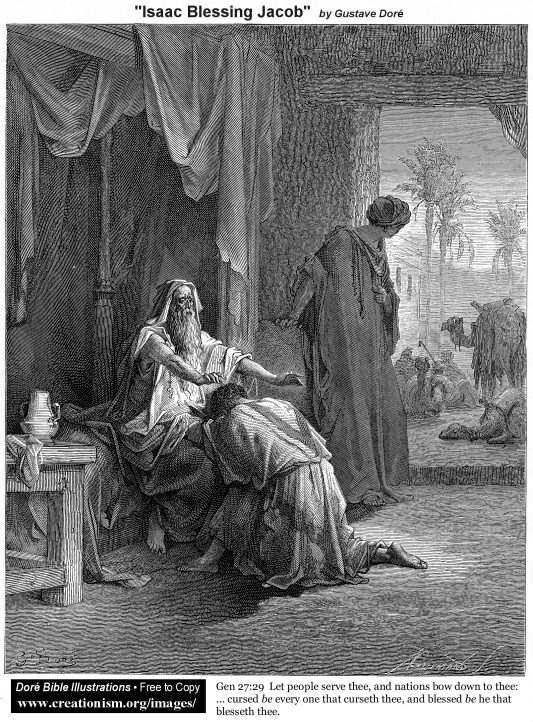
Isaac blessing Jacob, by Gustave Dore
Our forefather Jacob also wanted a blessing, actually two of them, but the ones he wanted were much more substantial. He succeeded in gaining the birthright that was originally his brother’s. He also secured his father Isaac’s blessing, also originally meant for his brother. Then, in this week’s reading, he wrestled all night with an unidentified assailant and said he would not release his opponent unless he blessed him (Gen. 32:26).
We might have thought that the blessing from the assailant was, like the earlier blessings, a worldly advantage, but Rashi (on verse 28) says no. The blessing was a new name, no longer Jacob but Israel. The patriarch no longer bears a name that means “supplanter”, alluding to the fact that he supplanted his brother. Now he is Israel, “the prince of God”, who is a new, wiser human being, who does things more for the glory of God than for himself.