
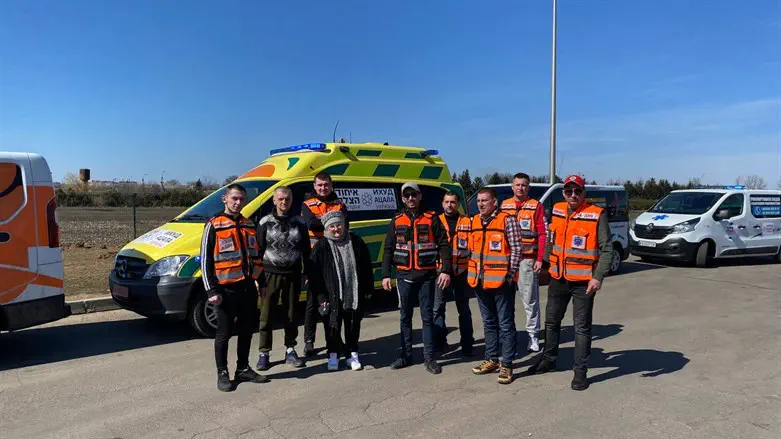
Uzhgorod, Ukraine - Late last week, amid air raid sirens and bombings, we were fortunate enough to rescue three Holocaust survivors from Kyiv and bring them to safety in Poland.
As part of a major rescue operation that spanned two days, I, together with other members of United Hatzalah’s Operation Orange Wings rescue mission, took three ambulances into Kyiv in order to rescue the survivors and bring them across the Polish border to safety.
This isn't my first covert rescue mission inside Ukraine; I've been rescuing people with difficult medical conditions continuously for the past month. My first mission involved rescuing a surrogate baby from a bombed hospital in Kyiv and reuniting it with its intended parents in Romania. Others involved rescuing entire families and bringing them safely across the border and then to Israel.
In this operation, we managed to rescue three Holocaust survivors, two of whom were bedridden and one who was able to walk with great difficulty. They were living in different senior residences and nursing homes and they were in danger as the violence encroached upon their residences, but they were unable to leave on their own.
Utilizing the three ambulances which the organization recently bought for the purpose of these types of rescue missions, we drove from the Moldovan and Polish borders to Kyiv with medical teams on board. Along the way, we delivered much-needed food and medical supplies to hospitals and care centers that had asked for our help in providing these items. The deliveries included medical supplies, bandages, and medications that are in short supply in Ukraine such as insulin and others. It took us three days to make the round trip.
When we arrived in Kyiv each ambulance and medical team gathered up one of the elderly Holocaust survivors and provided them with a thorough medical checkup to make sure that they were healthy and stable enough to make the journey to the border. We then headed out of Kyiv en route to the Polish border.
While on the way, we had to avoid bombings, attacks from snipers, and missile attacks. We heard no shortage of air raid sirens. Another thing that complicated the issue was the mandatory curfew that is in place inside Ukraine during the nighttime hours. At certain points, we had to pay militias or soldiers to allow us to keep going. The going currency in Ukraine isn’t cash, it is medical supplies and fuel. As this wasn’t our first rescue operation, we knew this going in and brought extras of both in order to allow us to continue our travels and get our patients to safety as quickly as we could.
When we arrived at the border, our three patients, all of whom are women, thanked us profusely for rescuing them. They were so happy to be out of a war zone once again and no longer being forced to live in fear of bombings and missile attacks. They said that they felt like they are living life anew and thanked us for saving them.
One of the women is named Svetlana and is 86 years old. She told us all her story and thanked us volunteers who helped her.
Svetlana said, “I have been through two difficult times of war in my life and I was evacuated in both of them. The first war was in 1941. This is now the second war.”
“I was five years old at the time. My dad was taken to the front lines to fight. My mom, my two-year-old brother, and I were taken from our home in Kyiv and put on a truck to Ural. The last memory I have of them, which is forever engraved in my mind, is the picture of us all laying down flat on the floor of the truck. We were like planks, side by side. I had lifted my head to see my mother and she spoke to me calmly saying everything will be okay. We were bombed near Kharkiv while trying to escape. That is the last time I saw my mother or my brother.
“Well, of course, it was terrifying, but I promised myself to get up and to keep living. Now, this is my second war and it is terrifying too. I got back up after the last war, and the same goes for right now, I am continuing life and living anew. Thank G-d for you kind people. Last time, no one was there for me. Thank you for helping us.”
All three of the women have been found a space in a nursing home in Poland where they can live out their lives in peace. I am thankful that I was able to have a small hand in making this happen and in helping to save these women, who deserve to live as peaceful a life as they can. I have been conducting and supervising rescue missions such as these since the war began and our team arrived at the Ukrainian border. But each rescue is different and fraught with its own challenges. Each person we rescue is an entire world unto themselves. I cannot think of anything better to be doing with my time than helping as many people as I can right now and right here. I will stay, and keep doing this, as long as there is a need to do so.