
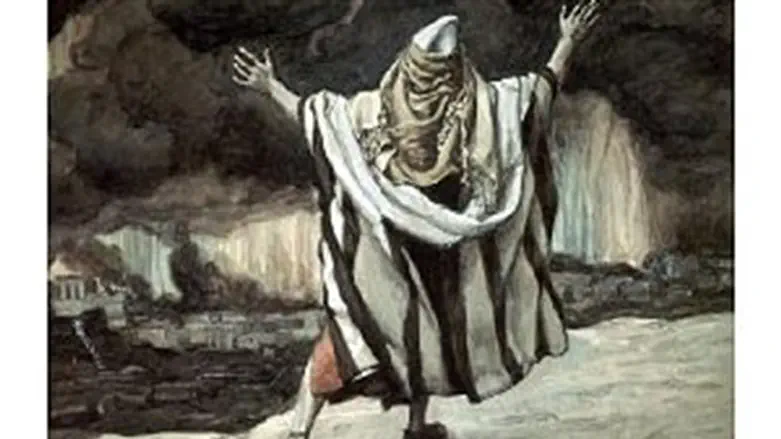
We read in our Parasha (19:29):’And so it was when G-d destroyed the cities of the plain that G-d remembered Avraham; so He sent Lot from amidst the upheaval when He overturned the cities in which Lot had lived’.
Comment our Sages:’And G-d remembered Avraham’: What remembrance did he recall for Lot? That he stayed quiet when Avraham said, in Egypt, that Sarai was his sister- and not his wife, as Lot knew, but did not divulge’.
Lot thereby saved Avraham’s life, as had he revealed the truth, Avraham would likely be killed by Pharoah, who coveted Sarah.
Measure-for-measure, Lot’s life was saved, in the merit of this ‘act’.
Asks Rav Ahron Kotler:’We had earlier read in our Parasha of Lot’s exemplary act of hospitality, at the risk of his life, to the two way-farers; Why was this not sufficient for him to merit to be saved?’
Indeed, the Torah describes the actions of Lot in almost the same words as it uses at the beginning of our Parasha, to describe Avraham’s הכנסת אורחים: hospitality, to the very same ‘way-farers’.
Both Avraham and Lot are seated at ‘the entrance’- Avraham, of his tent, and Lot, of the city.
Both ‘see’ the way-farers, and run towards them, and prostrate themselves before the visitors; both implore the visitors to accept their hospitality, and both feed them- matzot in both cases, as both events occurred in the very same day of Pessach.
Here, the similarity ends: Avraham, despite the pain from his very recent Brit Milah, was sitting at the opening of his tent, in the boiling sun, praying that visitors might grace his home.
To alleviate Avraham’s ‘spiritual’ suffering at the absence of visitors, Hashem felt ‘compelled’ to send three angels, in the guise of way-farers, albeit likely to be seen as Arabs, for Avraham to fulfill his need to do חסד.
Lot, on the other hand, was sitting at the gate of the city, because he had that day, been appointed as a Judge, and that was the seat of judgement.
Further, in his role of Judge, he was sworn to uphold the law of Sodom, which forbade, on penalty of death, inviting outside visitors into one’s home.
Why, then, did Lot act in clear breach of these laws?
Answers the Ktav veHakabala:’He acted out of considerations of HIS OWN honor; he saw that these visitors were of a very high calibre: as alluded to by his words (19:8), when rebuked, ‘but to THESE men do nothing, as they have come under the shelter of my roof’.
‘The law forbidding visitors, was only intended רק למנוע אנשים ריקים פוחזים המטילים עצמם על אחרים: to prevent men ‘of no value’, from imposing themselves on others; however, ‘superior’ people whom one of us wishes to invite, to honor US by his acceptance, the law surely did not wish us to deprive us of this honor.
‘As you have seen fit to appoint me as a judge in your city, do not dishonor me, by disrespecting my home, and my hospitality’.
The Netziv adds:’Lot pleaded with the people of Sodom:(19:8)’But to THESE men do nothing, כי על כן: באו בצל קורתי: inasmuch as they have come under the shelter of my roof’: You must understand, they are great men, and it is only because of this that I permitted them to enter my home, which I don’t permit to any other passer-by’.
Here we also see the vast difference between the acts of Avraham and Lot, despite their superficial similarity.
Lot extended hospitality to these visitors, because he saw it as an honor to him- rather than being concerned with doing חסד for them; Avraham acted with great alacrity and joy, in the thought that the visitors were nomadic Arabs, not eminent men- yet, he still saw it as an act of חסד BY THEM, to accept his offer of hospitality!
Rav Kotler offers a different answer to our query:’I heard from the Saba miKelm, that Lot’s act of hospitality, was only a חיקוי: an imitation of that which he had seen in the house of Avraham, but was not reflective of his ‘true’ nature; a person may perform occasional acts of חסד, but that does not make him an איש חסד.
‘To understand the ‘true’ nature of Lot, we need to look at other incidents in his life, to glean his מהות ועצמיות ‘true’ nature.
‘He parted from Avraham because, say our Sages, ‘he wanted no part of Avraham, or of his G-d’; and this after Avraham had rebuked him for the dishonest acts of his shepherds.
‘How could he choose to live in the company of Sodom, the by-word for wickedness, and the antithesis of חסד, and of all that Avraham had taught him?
‘Even if you say that, as his hospitality to these way-farers showed, he still occasionally did acts of חסד, even in Sodom, of necessity these would have been few and far between, in view if the penalties should he be found out.
‘Apart from the natural concern that he would not be able to withstand the נסיון of living in their midst, clearly by choosing to live there, he severely limited his opportunities for doing חסד’.
Concludes Rav Kotler:’Avraham Avinu teaches us, at the beginning of our Parasha, that a person is only entitled to be called an man of lovingkindness, anאיש חסד, if he sees doing חסד as his main purpose in life, and strives to do so, even in the face of great difficulties.
He feels a ‘lack’ in himself, if he does not do חסד.
Clearly, says Rav Kotler, Lot, despite his meritorious act in our Parasha, did not measure up to this level- and therefore, his singular act of hospitality was not enough, in itself, to spare him from the fate of his chosen neighbors.
Thus, he needed the measure-for-measure reward for ‘saving’ Avraham’s life, to merit his life being spared.
לרפואת נועם עליזה בת זהבה רבקה ונחום אלימלך רפאל בן זהבה רבקה, בתוך שאר חולי עמנו
Danny Ginsbourg is a retired lawyer who made aliya from Australia a decade ago. He has written five volumes of Torah thoughts in Hebrew,and was awarded the Jerusalem Prize.for the two volume Davsha shel Torah to which there are already several sequels. .