
“We never imagined that we would be sent to the United States to help,” IDF Col. Golan Vach told Channel 12 News. “America is not a country that needs to ask others to help out.”
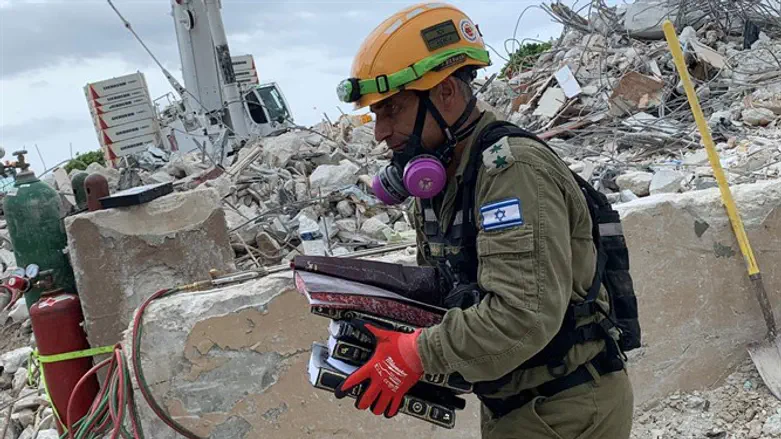
Vach has just returned from Miami after 14 days spent in Surfside, heading an Israeli delegation of IDF soldiers to help in the aftermath of the collapse of Champlain Towers South.
“We realized right away that it was a huge event,” he relates. “At first, no one said anything about us traveling out there, but then, on Saturday evening, we were suddenly told that we were going, and five hours later we were on our way.
“We were there for 14 days, working day and night virtually without breaks even for sleep, continually at the site,” he says, describing “extremely difficult conditions, very hard work, and difficult weather conditions too.”
Given those conditions, what did the Israeli team really think they could achieve?
“We had a very simple plan,” Vach says. “One: There are people trapped here, and we need to rescue them. True, that was rather an ambitious way of looking at things, but that was the way we saw it. And two: to help with the recovery, to do what we can for the families. So that was what we did.”
Vach stresses that, “We were really particular not to refer to the victims as ‘bodies.’ The entire time we were talking about people, about ‘neshamot’ [souls], even though we unfortunately did not succeed in rescuing anyone alive. The truth is that even if we had arrived moments after the building collapsed, I don’t believe we would have succeeded in rescuing anyone alive,” he adds.
According to media reports, the official number of those extracted from the rubble is still less than fifty, but Vach says that the real number is 93 – that is to say, all those buried in the rubble have been extracted.
“We played a role in extracting 87 of those 93 people,” Vach says.
Among them were Itty and Tzvi Ainsworth z”l. “I went to where their children were sitting shivah,” Vach relates, “and I told them about the last moments of their parents’ lives. It was very difficult, but I told them in the most simple and sensitive way I could, and I think that I brought them a measure of comfort.
“One of the Ainsworth children told me that their mother had loved IDF soldiers,” he adds, “and that if she had known that she was rescued by an IDF soldier, she would have been so happy.”
Vach was present in the synagogue when a new granddaughter, born to one of the Ainsworth children, was named after her grandmother, Itta – he was honored with an aliyah to the Torah.
“That was a very touching moment,” he says, “as it was when our delegation left Miami. We were not expecting anything like what happened – firefighters, rescuers lining the street as we walked by, applauding us. We’re not used to something like that, and it’s not what we came for.”
All the same, there certainly is plenty to be grateful for. “They thought at first that it would take a month and a half to extract all the people from the rubble,” Vach says. “We cut that down to just two weeks, a month less.”
That translates into a month less of agonizing waiting on the part of the relatives, a month sooner that they can commence their grieving process and return to normal life.
“It was a long and difficult task,” Vach sums it up, “but extremely rewarding.”