
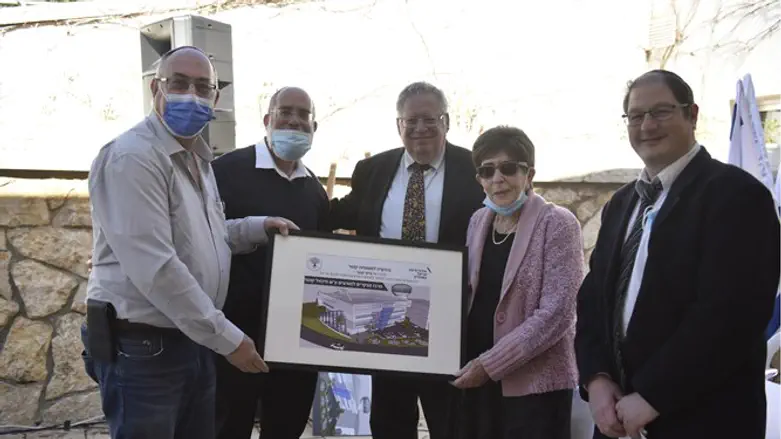
In a special ceremony held on Wednesday, March 17th, Ariel University began the process of establishing the Michael Kanter (z”l) Accelerator Visitors Center.
The funds for the center were kindly donated in memory of Mr. Miki Kanter by his widow, Mrs. Rachel Kanter, and his son, Mr. Eran Kanter. During the ceremony, Mr. Kanter mentioned his father Michael, and described him as a man who combined science and kindness as key factors in his life.
"Opening the visitor's center in his memory is a natural continuation of his path," he said.
The visitors center will be housed in the Schlesinger Family Center for Compact Accelerator Research which has become recognized as a global leader in the field. The center will be the first of several planned visitor centers.
Ariel University Senior Vice President, Mr. Bobby Brown, remarked that the signing of the agreement was "the beginning of a process that Ariel University has started to make the Ariel University campus an interesting and educational attraction for the whole family."
Mr. Adrian Treger, Director of Donor Relations, noted that, "Ariel University's journey to academic excellence shares its success with our family of supporters. We thank the Kantor family for their partnership in the University’s ongoing dynamism and innovation."
The signing ceremony took place in the presence of Ariel University President Prof. Yehuda Danon, who was recently awarded a Jerusalem Prize for his work in education. He thanked Rachel and Eran for their generous donation to develop the visitors' center, stating that, "Michael Kanter worked at Ariel University for 20 years and took part in the founding of the Particle Accelerator Center."
Today, the center has five accelerators and is operated together with faculty members from Tel Aviv and Ben-Gurion Universities, placing Ariel University at the forefront of research in the field.
The new visitors' center will review the history of research and developments made at the particle accelerator in Ariel, which led to the accelerators of the 21st century located at the center today.