

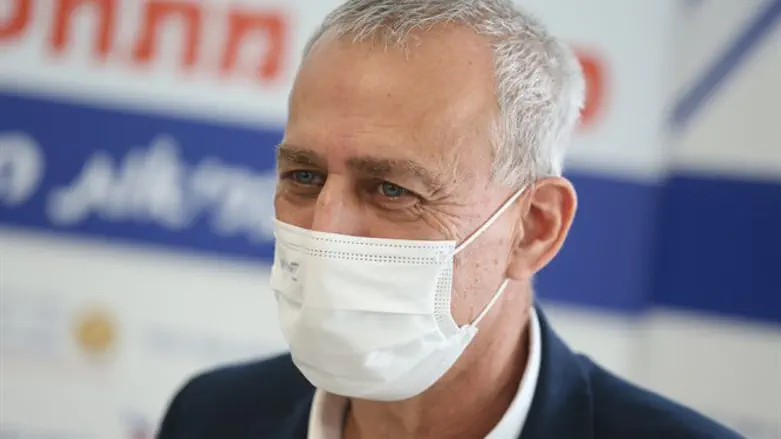
Coronavirus czar Professor Nachman Ash on Thursday told 103 FM Radio that there are three factors influencing Israel's morbidity rates.
"Morbidity is dropping, and we hope that this trend will continue," he told the station. "Obviously with the reopening of the economy, which begins Sunday, we will worriedly follow the morbidity rates, and I hope there won't be another rise."
Adding that the Brazilian variant has not yet been located in Israel, Ash said: "The mutation which has taken over is the British mutation, with about 90%. Regarding the South African [mutation], we have located several dozen cases, but we think there is a much larger outbreak. I can't tell you absolute percentages, but we estimate that there are a few hundred cases of it around the country."
According to Ash, the three factors influencing morbidity are "the British mutation, which is obviously acting to increase morbidity; the reopening of the economy, which may increase infection rates; and vaccines."
"We very much hope that the vaccines will do the job, but it's not certain. We have a special operation with the health funds, and every day we follow the number of people over 50 who are getting vaccinated, and it's moving forward. It's not a simple task to reach each and every person who is over that age, but it's being done."
When asked whether Israel would be back to normal by election day on March 23, Ash said: "I don't think that before the 23 of March we'll be fully back to routine. I think that we have a road ahead. We will need to see if there is a rise in infections due to the reopening of the economy. The question of mutations is also a question of bringing in new mutations, [and] the development of new mutations."
"I'm optimistic, looking forward, and I see the light at the end of the tunnel. But I want us to be realistic, and we're not going to say that this will be behind us in the next few weeks.
Regarding the closure of Ben Gurion International Airport, and the flights which continue to arrive in Israel, Professor Ash explained that the airport cannot remain closed forever, but at the same time, Israel must ensure that coronavirus tests are conducted and that those arriving in Israel are quarantined.
"Right now we have the hotels, but I have to say that it doesn't work well enough. There are a lot of 'exemptions' who are let free, and a great many of them return home. We need to be strict about the tests and the quarantine," he emphasized.
Ash also said that in order to reach herd immunity, children aged 12 and above will need to be included in the vaccination program.
"Children can also develop symptoms and be hospitalized, though it happens at much lower rates," he said. "The concern is that the moment there are a lot of infections among children, it will infect more adults, and we will still have a large number of seriously ill patients. We still have six million who are not vaccinated and who can be infected and become ill, that's a lot. We need to advance with the number of vaccinations, we have a long way to go. Herd immunity is a situation in which there are enough people vaccinated to ensure that the disease doesn't spread like a plague. There will be people ill, like there are with measles every so often, but there won't be large outbreaks and we can return to routine."