
The so-called "Third Wave" of COVID-19 has hit the Israeli population especially hard, many speculate due to the especially contagious variants and mutations. The overworked doctors and nurses can only do so much for the hundreds of patients hospitalized in the corona wards at Sheba Medical Center, and where their duties end, the volunteer work begins.
"Anyone who has experienced corona knows that the suffering from the basic symptoms is compounded by the loneliness and despair caused by the isolation," explained Noa Pakter, community relations coordinator at Sheba who organizes a weekly roster of volunteers from morning till night, including Motzaei Shabbat.
"Our volunteers enter each room and check what's needed. Disabled patients will receive practical, hands-on assistance – with eating, sitting up in bed, and making video calls to their loved ones. We might help a patient lay tefillin, play music and dance with them, or just sit and talk. But beyond the physical help, it's more about the emotional support," she explained.
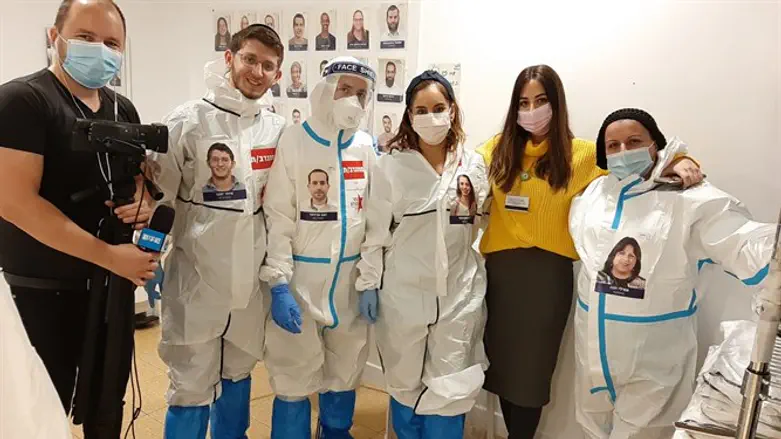
The 35 volunteers are all "corona survivors" who take monthly serology tests to ensure that they have immunity. Those whose numbers fall past a certain index are no longer allowed into the wards, relegated instead to the outer rooms where they help other volunteers and family members of patients "suit up" in the special protective gear.
Pakter described the corps of volunteers as "wonderful people who lead full lives, working, studying and raising families, and who consider it their mission to help COVID patients."
Sheba has five COVID internal wards, as well as a corona ICU, maternity ward, psychiatric ward and a corona ER. Pakter observed that certain volunteers get attached to one particular ward, but she makes it a point to cover all the wards, so that no patient is forgotten.
The volunteers develop a close relationship with the patients, often becoming like a second family, sharing in the elation when the patient is healed, or, tragically, in the grief when the patient passes away.
Pakter recalls the patient who was hospitalized last summer, forced to miss his own daughter's wedding. The volunteer helped him get dressed up and then set up a laptop with Zoom, so that he could feel as if he'd been present at the wedding. The following day, to the father's delight, the bride and groom came to visit him in the ward. By the time the couple celebrated their first month together, the father had recovered and was back at home.
Sadly, some stories end differently. A husband and wife who had been admitted together to the Sheba corona ward were separated when, after a long battle, the husband succumbed. The wife was inconsolable. Chen, a volunteer, arrived just in time to show the widow the funeral on Zoom, while holding her close and crying together with her. "Chen provided the wife with closure and a measure of comfort that no one else could have done at the time," Pakter observed.
"People who weren't there could never understand what it's like," said Tzion, a corona survivor in his early 40s who spent several weeks in the corona ward. After he recovered and felt strong enough, Tzion joined Pakter's group of volunteers. "I try to bring things that will help them feel better, such as their favorite food for Shabbat. But really, it's not so much about the food; it's the smile, the company, the presence. When people come to visit, they literally bring life!"