
Now, if you can't do it yourself, meet me someday and I'll take a walk with you; I'll show you something that could open your eyes just the same as dam, tzefarde'a and kinim (the first three plagues). I'll show you a rose bush. Now, don’t be disappointed when you hear that – I was walking with some boys last week and we stopped by some rose bushes and I said, “Look at the thorns on these roses. The rose is a beautiful flower and as we pass by we might have the urge – perhaps not us, but some other person might have a yetzer hora to pull out the bush and take it with him to plant in his garden.
“But as he would try to take it, he would find that the rose is armed. All the thorns on the rosebush point downwards so when he tries to pull upwards, he finds the welcoming, kabalas panim, committee ready to greet him, just in the right position. He pulls up and the daggers push down into his hand and he changes his mind; he leaves the rose bush alone.”
Now, it could be that many of us pass by rose bushes again and again and not once do we think about the Hand of G-d, etzba Elokim. We won’t stop to notice that the daggers are pointed. It's an interesting thing because in nature nothing happens like that; pointed things don’t happen by accident. If it's pointed, there’s a purpose there. Even the wicked, reshaim, understand that.
They’ll tell you the purpose is to defend the plant. But like Pharaoh they miss the point altogether. We’re expected to think about Who is defending the plant. The plant has no brain, no seichel. It’s Hashem's design! It’s the handiwork of the Designer.
Newton’s Apple Tree
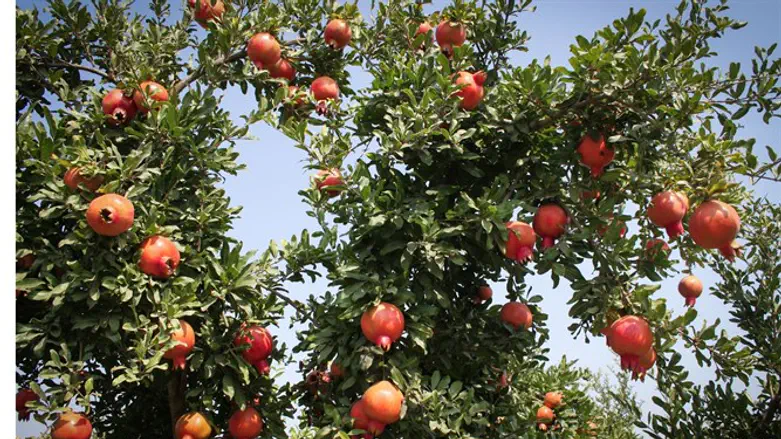
Just to notice the daggers and to marvel at the science without recognizing the Hand of G-d, etzba Elokim? You’re missing out on everything. It’s like what they tell about Newton. When Newton was sitting under the apple tree, an apple fell down on his head. So Newton started saying, “Oh! Why did it fall down – why didn’t it fall up?” That’s a wisdom ,chochma, of a wise goy. He was interested in physics: Why didn’t it fall up? So he discovered the law of gravity. The earth is bigger than the apple, so the earth attracts the apple to itself. Oh! A very great idea.
Only that Newton made an error. He didn’t go far enough! He should have asked, “Why did it fall at all?! It should have remained on the tree!” The branches don’t fall off so why should the apple fall off? And why does it wait until it gets ripe? Why didn’t it fall off when it was still green? It waited until it was ripe and sweet and soft and then it fell off by itself.
Newton should have thought about this miracle. How is it that for months and months, as long as the apple was unripe it held on tightly to the tree and then, as soon as it became ready to eat, it began to fall. It means the apple tree knows you have no wings, that you can’t fly up to it. It means that you see Hashem in the apple tree!
Oh! That discovery would have made Newton a great man. But he wasn’t big enough to do that. To discover the law of gravity, he was capable of but the law of the Hand of G-d, etzba Elokim, he didn’t discover.
Where The Apples Grow
So the boys and I made sure we weren’t going to make that mistake. We stood by the rose bush and we marveled at the creation of Hashem. That's what you’re supposed to do. Don't pass by! Every rose bush you pass by is a glorious opportunity.
Not only roses! Everything! Did you ever see an apple hanging from a branch? When an apple appears on a tree, you should gasp: An apple on the tree?! How did that happen? I was forty years old the first time I saw apples growing on a tree. I was a city boy; I never saw apples hanging on a tree.
For a city boy, apples “grow” in the big bins in front of the store, that’s all. But I was once in a shul, I used to daven in the morning there, and I was the only kohen. I didn’t want to monopolize all the aliyos (A kohen is called up to the Torah first if he is in the synagogue at the time), so before the Torah reading, krias hatorah, I would walk out into the yard, so that I shouldn’t be called up to the Torah.
So I walked out on that first day and I saw a sight! A tree, and red apples were hanging on the tree! I was amazed! I never saw such a thing before! It was the Hand of G-d, etzba Elokim, no less than the Plagues, the makkos. We have to get into our heads that Hashem is speaking to us too from the rose bush and the apple tree as much as the plagues, dam and tzefardei’a, were speaking in Egypt, Mitzrayim.
The Bee and Her Factory
Now, as we were standing there by the rose bush, we saw a bee coming towards us because the bee wanted to draw some nectar from the rose. We watched the bee climb inside that rose to get the nectar. And pollen fell upon herwings as they brushed against the stamen of the rose.
So we saw a marvelous thing. The bee was only thinking about getting nectar to make honey, but while it was doing that, it was bringing pollen from a different rose because a rose cannot pollinate itself – it needs pollen from a different flower. And so, the pollen that the bee brought from elsewhere rubbed off on this flower and the pollen that it took from this rose will be brought to a different place to be rubbed off there. That's how the bee is a messenger, a shaliach, of G-d, Hakodosh Boruch Hu.
And that’s only part of the story. If you look carefully at the legs of the bee, you see she has little baskets on her legs and little brushes. It’s a fact. It has baskets and brushes. Because she needs pollen too. Besides the pollen that she accidentally gathers, she needs it to take home to make pollen cakes for the larva in the beehive. And therefore she has brushes and baskets to collect the pollen. Did it happen by accident that the bee has brushes and baskets? It just happened that way?
Of course she doesn't know her purpose. She's out for honey but actually that little bee is pollinating a 100,000 different species of flowers and fruits. And that little bee is also preparing pollen cakes for the larva. Of course, if you’re not hard hearted yet you’ll see that it’s not a little bee at all – it’s the Hand of G-d, etzba Elokim.
DandelionMiracles
I picked a dandelion for the boys with whom I was walking last week. You know a dandelion has two stages. There's a yellow flower stage and there's a stage when it's in the seed ball; a colorless gray seed ball stage.
I showed them that the seed ball always grows higher than the yellow flower. The yellow flower, after it's pollinated it loses its yellow flower and it becomes a gray seed ball, and then it jumps up much higher than it was when it was a yellow flower.
Why is that? Because when it's a seed ball, the little parachutes in the seed ball have to be blown out to go elsewhere and plant more seeds, more flowers. But if it would grow on the same level as a yellow dandelion, it's too low in the grass so the parachutes would get caught among the surrounding grass. So when it reaches the seed ball stage, it jumps high above the grass and now it has no grass surrounding it. It has a free field on all sides for its parachutes to float.
I picked up a seed ball and puffed on it and 100 parachutes were floating in the air all around us. They were marveling. The yeshiva men were marveling when they saw it. One puff and a hundred parachutes with little seed packages on the bottom were floating in the air, each one perfectly balanced in the wind.
Each one of them was ready for its mission to go off even miles away. They can even float across the ocean; the seeds are protected in a tough jacket that can withstand the salt brine of the sea, and if the ocean would wash them up on the shores of France or England then as soon as it smells the earth, the jacket opens up and it begins to grow. It puts a little root in the ground and a little stem up towards the sun and it begins a new career.
A Different Perspective
Now, once you open your eyes and start looking at these things, your mind opens up too, and you begin to see Hakodosh Boruch Hu in the whole of Creation, briah. You see the handiwork of G-d, ma'aseh yadav shel Hakadosh Baruch Hu, wherever you look.
Now, of course most people when you say all these facts to them, it makes not the slightest impression because they're so deadened by lack of faith, apikorsus. Observant men in black hats and sidelocks, payos, can be apikorsim inside.
They know, they know; they think they know everything. But it’s almost nothing because they don’t think about seeing Hashem around them at all and – it’s the same as how Pharaoh saw everything, in one ear and out the other.
It’s very hard to drive home to them that everything which we call nature is planned as a nisayon, a test, an opportunity for a career of greatness. And it’s a career that is never finished. Because to be convinced once is not enough. It's a job that must go on all our lives.
A Different Perspective
And therefore, if some observant Jew will say to you, “Why spend time studying all these things? If you're convinced, be like all of us and practice everything now and forget about looking for some more convincing.” The answer is that’s not the method, shitah, of the early Sages, the Rishonim. The Rishonim say there's never too much proof! Because it's a mitzvah to see things more and more clearly till your last day.
And just like you will be an old man and you'll still be talking about the plagues, makkos, of Mitzrayim –afilu kulanu zekeinim; even if we are old men, we must sit all night and talk about the makkos – seeing Hakodosh Boruch Hu in the world around us is no different because each time it gets into your bones more and more.
So if you're an old man and tomorrow morning you look and see there's a daisy growing out of a crack in the ground, you won’t harden your heart. A daisy doesn't just appear. Where do daisies come from? You know how a daisy comes? It’s miracles upon miracles. It's too late to start talking about this subject of daisies – maybe a different time. Or maybe you should think about it yourself the next time you see a daisy.
Miracles Forever
Now by listening to this, you're not prepared yet. You have to practice this service of G-d, avodas Hashem. every day and you’ll become adept in this art of recognizing Hakodosh Boruch Hu in the world. You don’t need any books; you don’t need libraries. All you need to do is open your eyes and stop making your heart hard and you’ll be able to discover Hakodosh Boruch Hu.
And for people who have eyes the world is full of such miracles. You don’t need to see rivers turning to blood to be a believer, ma’amin. The plagues, makkos, serve only as a model to open up our eyes and let us know nothing will help for the person who doesn't want to see. But for the person who is eager for the truth, the world holds for him miracles without number! It’s not an exaggeration to say that the miracles that Hakodosh Boruch Hu shows us in the world around us are no less than the miracles of Egypt!
Let’s Get Practical
Every detail in nature is intended to be an eye-opener, a mind-opener, and our opportunities to see Hashem hiding in nature are endless. Every time I pass by a tree or a fruit or a flower or any of the other millions of wonders of the Creator, niflaos ha’Borei. and ignore it, I am “hardening my heart” to the spectacles that Hashem is showing me.
The way to begin softening the heart and to acquire tangible awareness of Hashem is by making use of the opportunities around us. This week, at least once per day I will stop to study one of the demonstrations that Hashem is making for me and practice revealing the secret of Hashem in this world.
Credit for this article goes to Toras Avigdor, an organization dedicated to disseminating the Torah hashkafa of Rav Avigdor Miller ztz"l. Subscribe for our free content by sending an email to ey@torasavigdor.org, or visit our website.
--