


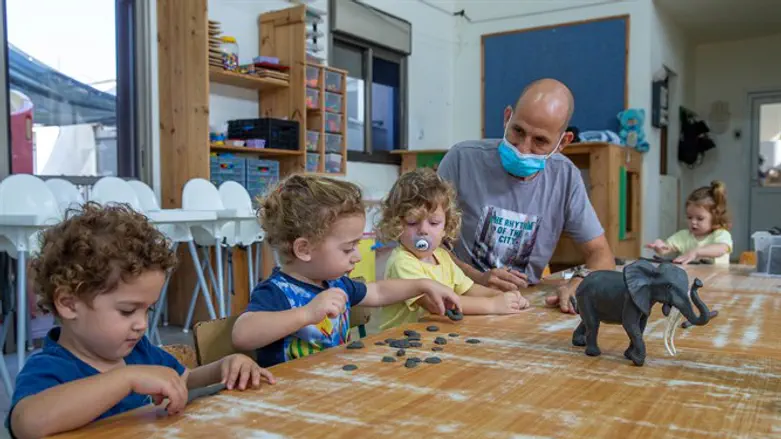
While several companies have successfully tested vaccines for the coronavirus, including Pfizer and Moderna, no company has conducted clinical trials to demonstrate the vaccine's effectiveness for children under the age of 12.
This means that the FDA (US Food and Drug Administration) and Israeli Health Ministry will have difficulty approving the use of the vaccine for children, who are considered a sensitive population. Moderna conducted its research on adults ages 18 and up, while Pfizer conducted its trials on children and adults ages 12 and up. AstraZeneca will conduct trials on children between the ages of five and 12, but has not done so yet.
"We see that no one is testing children under the age of 5, these children are not in the picture at all," Prof. Tzachi Grossman, the incoming chairman of the Association of Pediatricians, said in an interview with Israel Hayom. "I guess later it will be expanded. This may be due to regulatory behavior and the fact that the ethical approvals required for testing children are more complex. But there is also a reflection here of the state of morbidity in children, which is that few children are seriously ill, and most of them get over the disease quite easily. Therefore, it is a population that is less of a priority when it comes to the issue of vaccines."
The Association of Pediatricians called on the Health Ministry to include them in the information teams the new vaccine, in light of their experience in dealing with vaccinating children. Prof. Grossman noted: "I cannot imagine anyone including vaccinating a child population if it has not been studied. No one will approve a vaccine in children based only on adult data."
Prof. Grossman also warned that "there seems to be hesitation and opposition to the vaccine from a significant part of the population. 20% said in the polls that they do not intend to get vaccinated, and there is a lot of bad information on social networks and great concerns within certain sections of the population."
Dr. Tal Brosh, director of the Infectious Diseases Unit at Assuta Ashdod, explained: "In the development of drugs and vaccines, it is common to start with adults and move on to children, who are considered a more sensitive population."
"We will have to decide whether to wait with the children's vaccines until there are research results for the children, or decide that in light of the results in the adults, the vaccine will be given to the children. I cannot yet form an opinion," Dr. Brosh said.