
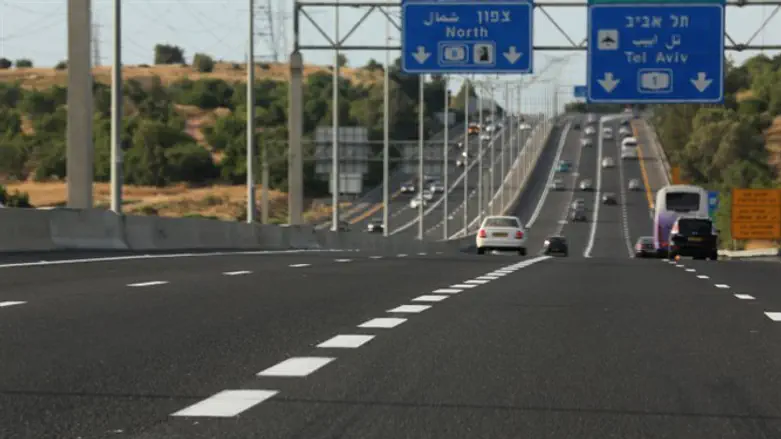
Recently, Wednesday, the Central District Court in Lod heard a petition submitted by the Regavim Movement against the largest illegal industrial center in Israel, situated on some 2800 dunams (over 500 acres) of land zoned for agricultural use adjacent to Kfar Kasem, at the junction of Route 5 and Route 6 (the Trans-Israel Highway).
In its response, the government admitted that the Kfar Kasem Municipal Council had issued hundreds of permits for “agricultural and livestock pens” – but, the chairman of the Regional Planning and Construction Board stated, “in the entire compound, there’s not one single, solitary little sheep to be found.”
Under these fictitious permits, hundreds of massive industrial structures were built, which are being used illegally as warehouses and logistical centers, and as commercial, industrial and leisure facilities. The government’s spokesperson noted that it had put a stop to these fictitious permits, and that since the enactment of Amendment 116 to the Planning and Construction Law (“the Kaminitz Law”), the National Enforcement Unit has shuttered some 50 structures (a mere 10% of the businesses operating in the compound), imposed administrative fines and taken additional law enforcement action.
In opening remarks, Regavim’s representative screened a video clip documenting structures in the compound that are obstructing the national infrastructure corridor, a corridor set aside for the national gas pipeline. The video shows other structures built dangerously close to high-voltage Israel Electric Company power lines, and no less than five illegal access points hacked onto Route 5, an extremely high-volume traffic artery, to create access to the illegal industrial zone. The heavy machinery, slow-moving vehicles and consumer traffic that use these access points endanger thousands of motorists every day.
Tomer Maoz, Deputy Director of the National Enforcement Unit, said: “There is no argument that this is the largest illegal industrial zone in the country, and anyone who travels on Routes 5 or 6 can’t miss it. It is one of the compounds we classify as a “mega issue.” Because of its size, our enforcement policy focuses on construction that disrupts national infrastructure, the electric and gas pipelines. We do a lot, but not enough. We have the enforcement powers and the authority that the law gives us, but we expect that other bodies, such as the Israel Electric Company, the Ministry of Transportation and the Business Licensing Bureau will become more involved and use the enforcement powers the law grants them.”
The state’s counsel, Attorney Sally Gasos, pointed out in her response that “criminal elements are at work in this compound. It is reasonable to assume that if a decision is made to shut one of the illegal [highway access] points with a barrier, these criminals will re-open it by cutting through the barrier. This sort of opening is extremely dangerous for everyone who uses the road, so if an access point is closed it would require police enforcement on the spot to insure that it is not reopened, as well as law enforcement measures against the existing businesses.”
Attorney Avi Segal of Regavim reacted sharply to this statement: “The government makes certain assumptions about what these criminals will do, and doesn’t want to get into a confrontation with them. The Israel Police is also afraid of these criminals, and prefers to work with them and cooperate with them whenever possible. This makes it clear that the State has completely abandoned its duties and shirked its responsibilities because it is afraid of the criminals. Meanwhile, the lives of the law-abiding people who travel on the highway are endangered.”
Attorney Shai Gimelstein, representing the Kfar Kasem Municipality, admitted that the municipality takes in some NIS 10 million in annual revenues from the illegal commercial center, and informed the court that Netivei Yisrael, Israel’s National Transport Infrastructure Company, plans to tunnel below Route 5 to resolve the dangerous situation that presently exists.
Judge Tzvi Dotan pointed out that all parties concerned agree that this massive industrial park is illegal, but in light of the enforcement activity detailed by the government’s representative, he recommended that Regavim focus the petition’s request for specific legal remedies on the traffic-related aspects of the case. “Regarding the transport and traffic elements of the case, the respondents’ answers are insufficient, and this element of the case involves life-threatening issues.”
The judge required the inclusion of Netivei Yisrael as a respondent in the case, and required that the Netivei Yisrael appear at the next hearing, in a few weeks, to report on “the progress of the plans we have been told about.” Regavim will notify the court within one week if it will accept the court’s suggestion.