

Today’s meeting of the government’s “coronavirus cabinet” resulted in a decision to maintain the current level of restrictions on the general public and the economy until next Sunday, November 1, at the very least, Channel 13 reports.
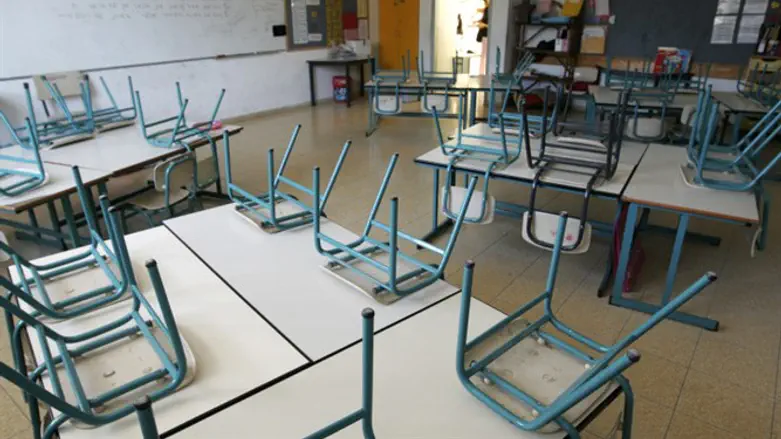
In addition, it was decided to allow educational activities to be held with up to 15 students in the open air, as well as to reopen dormitories for students who do not live with their families. The government has yet to reach a decision on the resumption of studies in elementary grades, or on easing of restrictions on businesses, although the Treasury presented a plan according to which stores would be permitted to reopen.
Under this plan, stores should be permitted to reopen according to the “purple tag” system. Establishments that receive customers should keep each customer separate with seven square meters allotted to each one, with up to five customers permitted at any one time. In open areas, the seven square meter rule would still apply, but up to twenty customers could be accommodated at any one time.
During today’s cabinet discussion, the Prime Minister addressed the reopening of the education system, and clarified that, “We do not have the ability to fund the capsule system for the youngest two grades.” This reflected the position of the Finance Minister, Yisrael Katz (Likud) on the issue, and opened up three possibilities: dividing first and second grade classes into smaller groups that will learn only half a week each; postponing the reopening of elementary schools in order to give teaching staff time to organize the capsules and meanwhile to advance the reopening of businesses instead; or a combination of the first two options.
Speaking at the meeting, Interior Minister Aryeh Deri said: “The cabinet needs to reach a decision regarding children learning in grades one to four this evening already. We can’t push the decision off any longer. What I suggest is for first and second grades to resume learning in their normal format, and for third and fourth grades to open in capsules. Perhaps we can consider making the wearing of face masks obligatory in first and second grades. And regardless of what decision we reach – we must resolve to accept the responsibility for it,” he emphasized.
Health Minister Yuli Edelstein stated: “People want to know if they can go to the cosmetician next week, and if their children can go back to school. They don’t want to see headlines announcing that: ‘Even though the cabinet sat for six hours, they couldn’t reach a decision on anything.’”
Head of the National Security Council Meir Ben Shabbat said: “If we continue to meet our goals as regards the rate of contagion, the next phase of easing the lockdown will begin on the first of November. We’re looking at reopening schools with classes split into smaller units, along with a number of creative solutions that will allow us to open up more sectors. We are already considering a partial reopening of the economy in the coming phase.”
Ben Shabbat added that: “Due to a computer malfunction, the data from the end of last week don’t give us the updated picture. In addition, it’s important to note that easing the restrictions will almost certainly cause a rise in contagion – what we’re seeing now in the data are still the results of the lockdown, and not of the first phase of reopening.”
The figures presented to cabinet members showed that the rate of contagion in the haredi sector continues to decline, and that the percentage of those infected in the Arab-Israeli sector is now higher than in the haredi sector. The number of tests conducted is also declining, to an average of around 30 thousand per day, which was a matter of concern to government officials and experts.
In addition, the data showed that special attention should be given to certain areas whose color-coding in the traffic-light system has not changed officially, but the data suggests that they are heading in the wrong direction.
The government’s coronavirus project manager, Prof. Ronni Gamzu, stressed his concern at the rise in infection in the Arab-Israeli sector. He added that, “In order to assess the impact of the reopening of preschools, we’ll have to wait a bit longer. We want to see a continued decline [in cases] and reach a positivity rate of two percent on average.
“We want to involve local authorities more,” he noted, “and give mayors the authority they need to require testing. In order to get the contagion rate down still more, we need to be doing at least 30,000 tests per day, to cut off the chains of infection. If the current trend in the number of tests being conducted continues, I’m not certain that we’ll reach the next phase. If we drop to 10,000 tests per day, we certainly can’t progress to the next phase, as we won’t be able to assess the situation accurately, and this is particularly important when we’re talking about reopening schools, which has the potential to cause the rate of contagion to rise again.”
Gamzu stressed that: “We need to be extremely cautious when it comes to the schools. We need to split up classes and test the staff. In grades five and above, we will need to implement the capsule system with absolutely no contact between capsules. We also want to make classes in first grade smaller. We compromised with preschools because of the difficulty of dividing them into capsules.”