
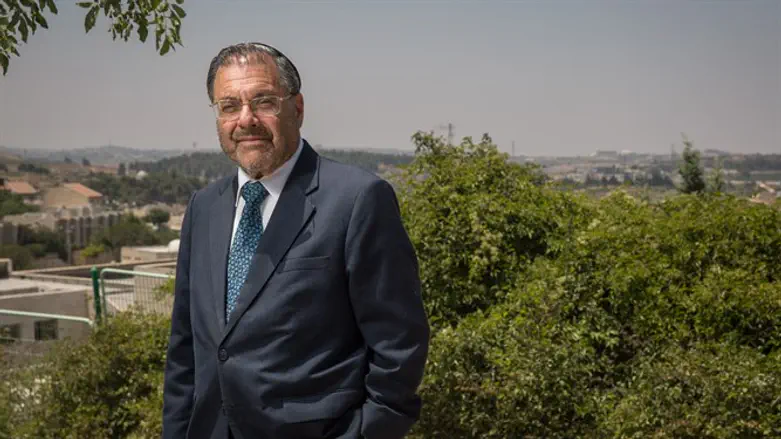
Rabbi Shlomo Riskin, founding Chief Rabbi of Efrat, on Sunday commented on the controversy within the right over the correct attitude toward the Trump administration’s peace plan, saying that as far as he is concerned, there is no reason for the controversy and adding that the gratitude which should be expressed for the Trump plan is clear and obvious.
"This is the first time that one of the great superpowers realizes that we did not take occupied land and we have the right to the entire land of Israel and wants to give us a lot, maybe not all of Judea and Samaria, but thirty percent of Judea and Samaria. We are not receiving everything we need to receive but we are receiving a lot more than we received before and I think we should say thank you," Rabbi Riskin told Arutz Sheva in an interview.
Commenting on the criticism against the plan that is being voiced by the leaders of Judea and Samaria, the fear of a Palestinian state and other troublesome details of the Trump plan, Rabbi Riskin said that is not the case at this time. "In the meantime, we are receiving what we are receiving and the Palestinians did not agree and are not getting anything. If they would agree we would sit with them and negotiate the best deal we could, and I want to believe it would be fairer than this, but as of now they haven’t agreed to anything and will get nothing. They have what they have only in potential."
On the comments of US Ambassador David Friedman, who said that this is an Israeli commitment to the Americans and does not depend on Arab refusal, Rabbi Riskin said that it would be an Israeli commitment "only if they change their ways, teach differently, say publicly that they accept us in the places in which we are, etc. It is not automatic. They have to do a lot of things first."
Asked about the communities that will remain as enclaves as part of the plan, Rabbi Riskin said that these are communities that will only be enclaves if there is a Palestinian state there, and that will not happen due to Arab refusal. "They did not agree to anything. Only if they accept it, will we sit down and talk to them and do the repairs that need to be done together, and then there will be time to do the repairs, but we are not there yet. They did not agree to anything and did not receive anything. Only after they have no terror, military, etc. and they do many things [will they receive anything]. For now, only we are getting anything.”
On the construction freeze included in the Trump plan, Rabbi Riskin said that it would be a period of four years in which there will be no construction but at the same time the Palestinians will not be permitted to do anything. The plan, he added, states that if the Palestinians fail to meet this demand and continue to build and establish facts on the ground, then Israel will no longer be bound to the agreement.
"It will not be worse than it is now. It will be better," said Rabbi Riskin, and of his willingness to discuss the idea of the Palestinian state and the recognition of their rights, he replied, "I am very much in favor of peace. I read in our Torah that eventually Jacob and Esau will live together. It will happen when Esau repents. If Esau does not repent then there is nothing."
On the protest against the plan by most of the heads of the Yesha Council, Rabbi Riskin said, "They got a very good proposal and they shout because they want an excellent proposal. It doesn’t work that way in this world."
"I know that the Land of Israel is ours, and yet Abraham our forefather paid a lot of money for the Cave of the Patriarchs. When we planned to establish Efrat, we did not take any piece of land that the Arabs claimed because we are not yet in the time of the Messiah. I am ready to make compromises for peace and that is very important. I read the Torah and understand that there will be compromises."
Rabbi Riskin made clear that, according to what was written in the Trump plan, the proposal can be lived with and is better than there is now, "much much better" as he put it. On the reality in which it would be impossible to travel on an Israeli road between Efrat and Kiryat Arba, Rabbi Riskin is convinced that these details will be changed. "I think it will be possible. We will see the final maps."
Rabbi Riskin opined that Israel must leave the refusal to the Arab side, say thank you and demand small amendments so that Israelis can travel from one place to another. "I think it can be done," he concluded.