
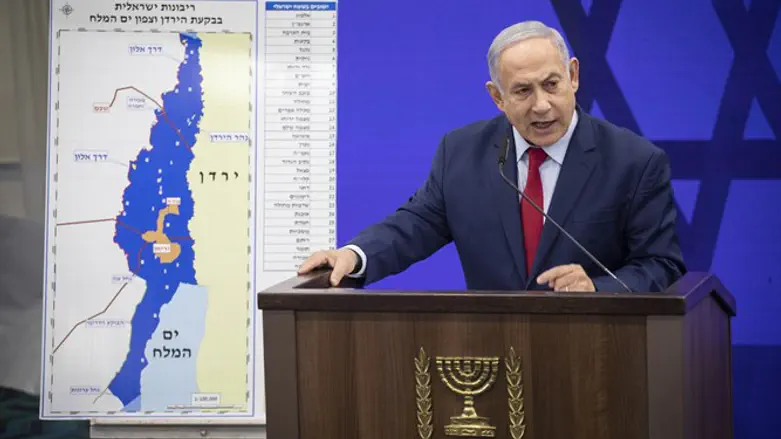
Srugim Hebrew language website reported that a week after meeting settlement leaders opposed to the Trump Plan, PM Netanyahu is slated to meet a number of Yesha mayors who've come out in favor of the move.
Mayor of Ariel Eli Shaviro, Oranit mayor Nir Bartal, Har Adar mayor Haim Mendel Shaked, Givat Ze'ev's Yossi Avrahami, Efrat mayor Oded Ravivi, and mayor of Elkana Assaf Mintzer will participate in the conference scheduled for tonight.
Rift on the Right?
Shaviro was the only settlement leader to be kept out of last week's meeting of Yamina and Yesha Council Head leaders after slamming the door on a previous meeting following disagreement over Trump's plan. He has maintained his silence ever since, insisting, alongside Efrat's Ravivi, that it's still too early to make a final decision regarding the plan.
Elkana's Mintzer said that leaders backing Trump's Plan were arriving at the personal behest of the Prime Minister alongside Defense Minister Gantz, whom he termed a "close friend." "We believe that the offer available to us at the moment won't be the final say on the future borders of the State of Israel and that those advising the Prime Minister on the matter will be able to receive a more favorable offer. We can't allow ourselves to miss the opportunity to apply sovereignty in the coming months. We've been dreaming of sovereignty over the Jordan Valley, Ma'aleh Adumim, and Gush Etzion, and when we're about to receive 30% [of Judea and Samaria} with the rest up for negotiation, we need to grab it with both arms," he asserted.
'Same but better'
Har Adar Mayor Haim Mendel Shaked continued in the same vein, saying: "Judea and Samaria have been under military law for the last 50 years so it's important to see the good instead of the bad. We need to accept what's given to us." "I don’t see the Palestinians giving up on their stated goal of a 'Palestine from River to Sea,' and the right of return and all kinds of other pipe dreams. There are so many things we need to get done that the next administration [may not be willing or capable of achieving]."
Asked if he supports the move because it's good for Elkana, Mintzer stated that the question itself was unreasonable since, "I'm part of the Yesha Council as a whole and, along with my family, have participated in all of its battles from Gush Katif to Amona, and I will continue along the path I've chosen," stated the mayor. Regarding the possibility of Israel losing control over parts of Judea and Samaria, Mintzer remained optimistic saying that, "As far as security arrangements are concerned, the situation will remain the same with the only difference being whether Israel can apply sovereignty over territories outside of the current arrangements or if we are only able to maintain military control. I'm sure the final plan will allow us to connect the main arteries between individual settlement blocs," he concluded.
Price of staying out of the limelight
Mintzer responded to being asked whether the current disagreement could bring about a potential rift on the Right. He said that the majority of Yesha Council members supported the plan "as is" and that "perhaps the media [wasn't] as interested in those who prefer to stay out of the limelight." Mintzer also said he's also opposed to a 'Palestinian State' but that "…it's not even an option at the moment and we haven't agreed to all parts of the plan yet either way."
Mendel Shaked adds to this that, "it's useless to raise concerns with the final outline of the map at this point since it will change a hundred times before we reach a final draft."
Jewish enclaves, 'Palestinian' continuity
Over the past two weeks, opponents of Trump's plan, including Yesha Council Head David Elhayani, Deputy Head of the Council Yigal Dalmoni and others have embarked on a publicity campaign warning of the dangers of Netanyahu's hereto unrevealed sovereignty plan. They maintain the map includes Jewish enclaves within "Palestinian" territories and a territorial succession of "Palestinian" territory, creating, as it were, a "Palestinian state."