
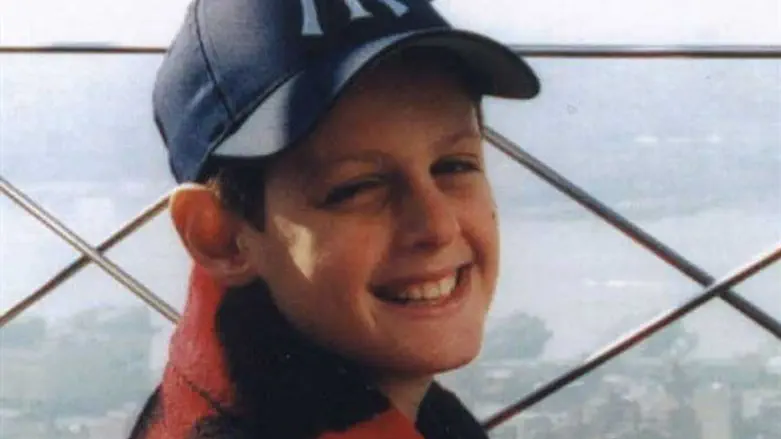
This weekend marks the 19th anniversary of the brutal terror attack that took the lives of 13 year Koby Mandell and his friend Yosef Ish-Ran.
In the aftermath of the tragedy and in the first year of mourning for her son, Sherri Mandell wrote 'The Blessing of a Broken Heart', chronicling her journey through the trauma.
Sherri went on to create 'The Koby Mandell Foundation' and 'Camp Koby', together with her husband, Rabbi Seth Mandell, to help support children and families that have lost an immediate family member to terror or other tragedy.
To commemorate Koby’s memory, we share with you an excerpt from the book, focusing on the first year anniversary:
A Year On
Excerpted from The Blessing of a Broken Heart, by Sherri Mandell
It is Koby and Yosef’s yarzheit. About five hundred of us march through the wadi, some carrying flags, a ribbon of young people and old people, climbing the rugged paths. Wild mustard, garlic, irises, anemones dot the steep slopes. I have not been to the wadi since Koby was killed. I do not know if I will enter the cave. It is too painful for me, the thought of the last hours of Koby’s life, the struggle to fight for life, his dying alone. But suddenly we are in the cleft of the rock; there is an opening in the stone to stoop under. The cave has been cleaned of the boys’ blood. There is the sound of the wind instead of the cry of screams. When I enter the gave it is full of candles, the light seems to magnify and expand, so that I am in a place of beauty and wonder. A large cone-shaped pile of rocks is on the side of the cave. My husband tells me that under these rocks are the blood stained rocks that were used to kill Koby and Yosef. According to religious law, these bloodstained rocks have been buried by the chevra kadisha, the Jewish burial society. All of the blood has been returned to the earth.
My husband turns to me: “This cave now feels holy.”
This year I have learned that everything, even the worst trial, contains sparks of holiness and it is up to us to release those sparks and bring them into the world.
Even the bad, in Jewish thought, deserves blessing. “Just as one utters blessing over the bad, so should he utter blessing over the good,” (Berachot, 54a).
I do not bless the bad. But I understand that light comes from darkness, and that evil exists in the world so that we can choose to do good. Evil exists to the conquered. As the Talmud says: If nothing but good existed it would be like carrying a lamp in broad daylight. It would provide no benefit. Ultimately everything is for the good, even when we can’t see it.
God does his work with that which is broken. We humans can only use vessels if they are unbroken: we can’t put a broken pail into the well and drink. Yet it is when our hearts are broken that God sculpts our souls, prodding open the narrow entrances to the caves of our being. Whenever God takes from you, he has to give you something back. God has given me the blessing of a broken heart.