
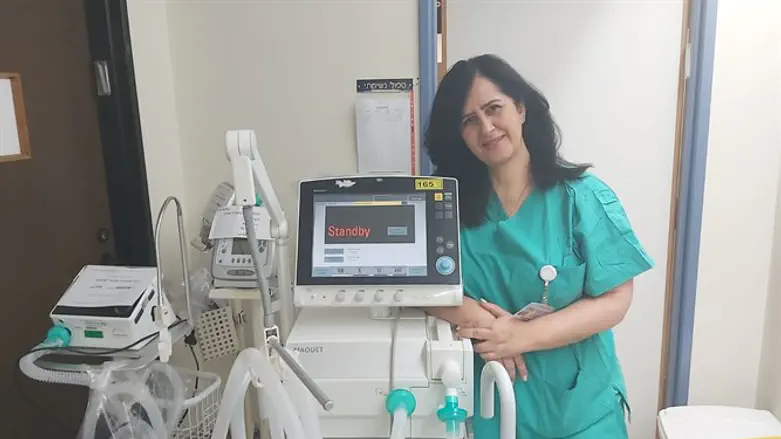
Michal Sheetrit is head of the respiratory technology unit at Shaarei Zedek Medical Center, Jerusalem, where she has been working for the last 29 years. Her unit is currently on the front line in the country’s battle with the coronavirus epidemic. She took a few minutes out of her hyper-busy schedule to speak with Arutz Sheva about the crisis and the specific role of her unit in saving lives.
What was your daily routine like before the coronavirus epidemic?
“The work is always hard here – both physically and emotionally. We’re often called in to the NICU, to put tiny premature babies on ventilators, and we also help older people who are having difficulty breathing. Until seven years ago, all patients needing respiratory support were concentrated in the ICU, which made things a bit simpler, but then things changed and now we are called to help patients from many different departments.”
When did you realize how the current epidemic would affect your department?
“As soon as I heard that this virus starts out with mild symptoms and progresses, in severe cases, to respiratory collapse, I realized that we were likely to find ourselves in the midst of a huge crisis, one that the health system might not be able to deal with. Right away I turned to the Supplies department, and we tripled our stocks of equipment, and managed to acquire additional ventilators. Shaarei Zedek’s administration is aware of the need to invest in our department and they supply us with first-class equipment. I also contacted technicians who used to work here and had since left, and recruited them to return to work here.”
What went through your head when you put on protective clothing for the first time and entered the Keter ward [for coronavirus patients]?
“I wasn’t scared. All of us technicians feel that this is our vocation, that we are agents of healing. We work as a team, with full coordination with the rest of the medical personnel working in Shaarei Zedek. The director, Professor Ofer Marin, is in daily contact with the medical teams working in Keter, and the hospital’s administration is very attentive to our needs.”
Tell us about a case where a person arrives and is diagnosed with coronavirus – what happens next?
“This week, someone was admitted with mild coronavirus symptoms, but he developed difficulty breathing and was immediately given oxygen [via a tube]. After a few hours, there was an additional decline in his condition, and the respiratory team was called in, in order to prevent his condition from deteriorating any further. When we arrived, I saw that he was having trouble breathing. He was sweating, struggling with every breath, and he had tears in his eyes from the effort he was having to make just to breathe. The team placed a non-invasive breathing apparatus on his face, and within half an hour there was significant improvement and his oxygen levels had gone up. The patient had more energy and was already able to sit up and eat. Within a few days we were able to discharge him. Without a respiratory team like ours, this story could have ended very differently.”
Do you think that we might reach a situation where we have to decide who gets a ventilator and who doesn’t?
“Fortunately, I’m not the person making these kinds of decisions. The doctors are the ones who decide on such matters, and the question you’re asking is one that nobody can answer. All the same, I know that hospital staff have gone to great lengths to think of and plan for all kinds of eventualities, precisely to avoid finding ourselves in such a predicament.”
You and your team are on the front line in the battle against coronavirus.
“We’re always on the front line, but right now, we’re in the line of fire. Coronavirus attacks the respiratory system, and we are needed to contribute our technological expertise in order to forestall the need for invasive anesthesia, with all the accompanying dangers. It’s a huge challenge, but I specifically chose to work in this challenging profession, one where my contribution is so obvious. When a person is having trouble breathing, and I manage to help him – there’s nothing more satisfying than that.”
Do you think we can beat the coronavirus?
“I think it’s really important that we maintain the current closure, and it goes without saying that we have to make sure we have enough equipment, and particularly ventilators, as well as professionals who know how to operate them. I personally work with faith and a consciousness of being part of a team dedicated to helping people, and the truth is that we’re all in this together, and each one of us has to play his part. For regular citizens that means abiding by the Health Ministry’s guidelines; for us, it means doing what we can to help our patients. Honestly, I don’t know what the future will hold. I hear all kinds of predictions and forecasts, not all of them good, but at the end of the day, I focus on getting through each day at a time, saving yet another life, doing the best I can.”