
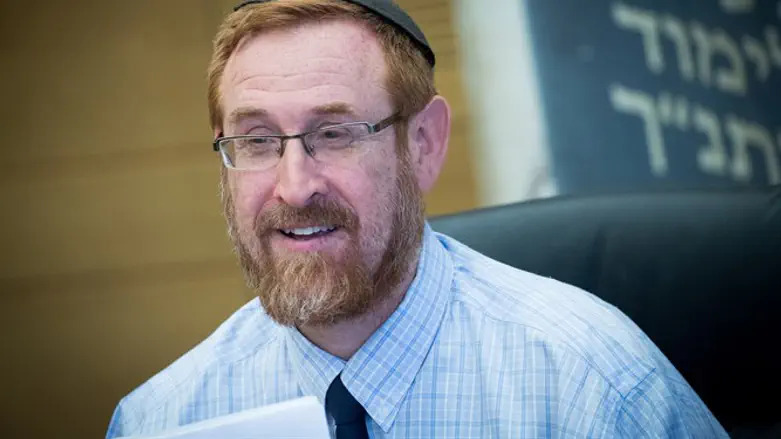
Five years after the attempt on his life, Arutz Sheva spoke with former Knesset Member Yehuda Glick, who recited the blessing thanking G-d for the miracle and later in the day he will visit the place of the assassination attempt to also bless on the place where the miracle took place.
"It's a day for me of great soul-searching. After all, my family members had already been invited to the hospital to say goodbye to me, and today I can tell of G-d's miracles. I ask why G-d saved me. Five years after that, I can look back and realize that G-d has given me errands that I try to fulfill faithfully."
The reason that led the perpetrator to carry out the attempt on Glick's life was his continuous activity to ascend the Temple Mount and pray at the spot. We asked if the multitude of other occupations he got involved in since being elected to the Knesset had slightly lowered the profile of doing for the Temple Mount. Glick rejects the suggestion and says "every Tuesday I go up to the Temple Mount. I set up a 'Peace Jerusalem' association and hundreds of people turn to me every week from around the world to pray for them on the Temple Mount."
Glick notes that "in the month of Tishrei, about 6,000 Jews ascended. A decade ago, less than that ascended in a full year. The dedication and efforts of the Jewish People to the Temple Mount are like a gushing fountainhead. I once knew all the activists of the Temple Mount. Today I already don't. We need thousands of Jews to prove with their feet that the Mount is dear to them."
In this context, we asked if during his years in the Knesset he was able to understand why Jewish prayer on the Mount is forbidden and Glick responds optimistically, stating that in recent years, "we've seen complete revolutions. Four years ago, every Jew who ascended the Temple Mount was a victim of verbal violence and screaming, etc. Minister Erdan and the government outlawed the Marbitun and Marbitat and should be praised. Jews today aren't accompanied by Waqf people, the police are more tolerant, Jews pray, though not with a quorum and no Tanach can be brought up but there are prayers."
Glick mentions: "I submitted to the Supreme Court to allow Knesset Members and ministers to ascend the Temple Mount. As tens of thousands ascend the Mount there will be change here."
Glick tells of his activities in an organization that he also established to connect the non-Jewish world to Jerusalem from the standpoint of "a house of prayer for all nations". "I'm preparing for an international Bible study conference, so Jerusalem will be not only a center for Torah but also for prayer. The messages are global, 'and through you will be blessed all the families of the earth.' The goal is that Zion is the Temple Mount, and we take care to promote peace through the connection to G-d."
And what about the rising resistance often in religious Zionist circles to promote a global agenda that brings together elements such as evangelicals to Jerusalem and the Temple Mount? "I appeal to all peoples and not just to evangelicals. You should know that changes always give rise to a problem," says Glick, who notes that the Zionist movement under Herzl's guidance also raised objections among key figures in the Jewish world.
"The past was dealing with Gentiles who hated us and now we're dealing with Gentiles who love us. The evangelical world has proven itself in recent years in delivering embassies and promoting the struggle against delegitimizing us. We need to fight false attitudes that hurt Israel, but we must encourage connections. We see the prophets talking about the non-Jewish world partnership for the return of Zion. Sometimes we need the gentiles to remind us of our role."
From here we spoke to Yehuda Glick about the day of his assassination and also the first moments when he woke up from his ten day coma, moments that excite him to this day.
"I well remember the moment of the shooting and the few seconds until the loss of consciousness, Shai Malka and Moria Halamish who took care of me. I remember Shai calling me 'Rabbi Yehuda don't leave us, we need you.' I was in a coma for 10 days, but before that was the Begin Center convention, a conference of the Jewish People's return revolution to the Temple Mount," says Glick, who stresses the caregivers who worked together for his well-being, from MDA and Shaare Zedek Hospital and medical personnel as well as rehabilitation and "prayers in Israel and around the world. Everywhere I went. To this day, people see me and ask how I am. I feel it was a moment of Israeli solidarity. We're a nation full of solidarity and love. Too bad we're impressed by the TV screen that says we're divided. If I remember anything, it was the love that enveloped me in the days following the attack. I'll never forget that."
And the moment he woke up from the coma: "The first moment was on Friday night when my son was next to me. He sang me Kabbalat Shabbat. It was very strange to me because I remembered being shot at and thinking only a day passed. It was Wednesday and here it's Kabbalat Shabbat. I didn't know what was going on. Most of the injury was in the lungs and I remember the nights of struggle to breathe and I couldn't speak, but I remember Rabbi Amar who came to visit, Health Minister Yael German, who came to visit, family, I remember the whole hospital attendance. I tear up remembering this moment my son singing beside me Lecha Dodi."
Glick mentions the memory of his late wife, Yafi. "He saw my eyes open and went to call my late wife. Although I survived this incident, my late wife Yaffie suffered a severe post-traumatic illness that she didn't survive and she deserves thousands of thanks for caring for me. The pain is great for her loss after 26 years of marriage. Blessed be G-d for this too, that I married a dedicated woman, Hadas Disin, a great woman, but my first wife, Yaffi, has a big place in my heart for the dedication she gave of herself for me."
And what about the politics bug? "Not at all," Glick replies. "I loved being in the Knesset and I felt a huge privilege to be there, but I really don't miss it. The Knesset was a work tool and today the way for reaching destinations is another tool."