
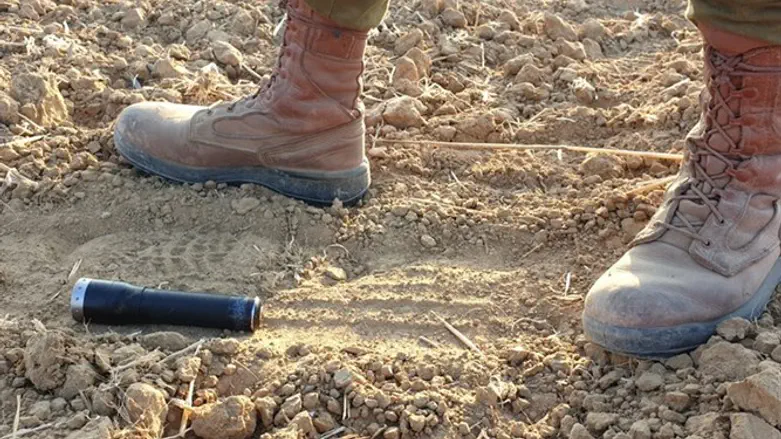
When marching with the Gaza Division Scouts as they train, it is impossible not to try to understand how they never look up from the ground. But after a short time with them, you automatically adopt the habit and do exactly like them, no matter how spectacular the surrounding landscape.
With bright eyes they looked at each leaf and stone, and nodded at the sight of whatever they found. Without words, everyone seemed to understand each other and think exactly the same, as if "the writing was on the ground."
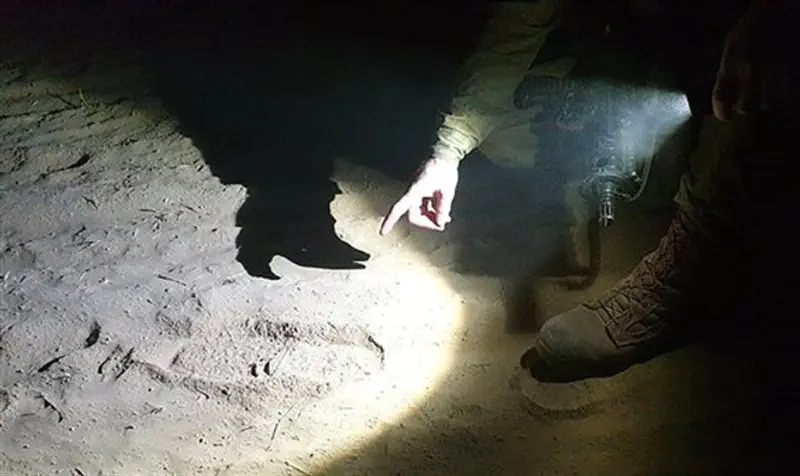
"Here we are," Eid, one of the Scouts, pointing to a footprint that had been partially obscured. "You can clearly see that this is a man's footprint." When I tried to understand for myself how he knew it, he replied innocently that he couldn't explain and just mumbled: "That's just how it is; it's totally obvious."
And indeed, for this group of Bedouin soldiers, this actually was the most obvious thing. From a young age at home, each was somehow connected to nature - some grazed sheep and others ran a farm - and they slowly began to learn something that couldn't be taught anywhere else - a true connection to the land and understanding it fully.
The Scouts go through a four-month course, but according to Captain Muhammad Jouamis, who serves as the Scouts officer in Division's Southern Brigade, the unit bases and develops mainly the experience and knowledge that the soldiers bring from home.
"A footprint is like an identity card for us," he explains. "Anyone can see the tracks on the ground, but only a real tracker understands what they're saying. From the shape I can guess the age of an infiltrator, if he's wounded, if he dragged someone along with him on his back, and where he was heading."
On the ground, the Scouts split into two groups. In actuality, each of them already knows by heart the area of the fence entrusted to him. He walks along with the M16 and flak jacket on him. But the purpose here was a little different and designed to mold the most basic instincts that professional Scouts must have.
The scenario assigned to the Scouts was a situation not unfamiliar to them - infiltration from the Gaza Strip, codenamed "Turkish Horseman". But unlike with any other training, here the situation is a "Black Turkish Horseman," meaning a terrorist infiltration unidentified by any of the sophisticated systems on the fence, and whose successful capture now lays only in the hands of the Scouts.
"Since I arrived," recalls Captain Jouamis, "there were a number of Black Turkish Horsemen we had to trace. The other side exploits weak points in the fence and tries to sneak through the barrier when iot's foggy, without any systems identifying him. That's exactly why we patrol the fence all the time and are responsible for opening and closing the sectors roads. That way we recognize the footprints and warn whoever needs. The enemy may be able to learn the technology - but he won't be able to anticipate us."
The training, which took place on a large area not far from the fence itself, resembled a chase for a terrorist who managed to cross it. The Scouts had to follow the clues and on their own locate the place and identity of the infiltrator.
On the way, the Scouts didn't hesitate to collect any informational item they thought fit, while meticulously screening deceptions that were also placed in the field that aimed to confuse them. Whether in thorny thickets or riverbeds, they marched and changed their path according to what the path showed them.
"Explosive charge!" called out one of the scouts, pointing to a small stone that was visible in the distance. Within seconds, his friends surrounded the area, neutralized the imaginary charge and then used it to re-determine the rest of their path: "The color of the stone doesn't match those existing here in the area," explains the same tracker on his find, "and this isn't the first time we encounter such a thing."
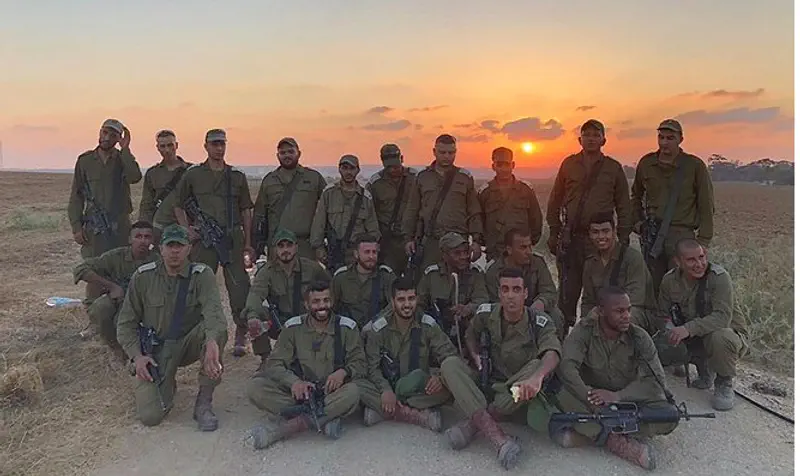
The Gaza terror organizations are already aware of the Scouts' work, and try to mislead them in order to infiltrate into Israel. "There are the classic cases of going over your steps backwards, then choosing a different path," says Division head Oved Gadir, one of the Platoon Commanders. "Some change their shoes midway, walk with a sponge tied under their shoes, or they blur their tracks with a branch. Some even walk on their knees and fists to simulate animal tracks."
Despite all the creative methods, the Scouts' deep familiarity with the sector allows them to identify any suspicious changes or movements on the ground, much by means of the "Blur Path" - the dirt path adjacent to the fence that they "smooth" each day to erase the tracks from the previous day.
"Once I had to clear one of the gates for the forces before cross-fence activity," recalls the commander, "because the enemy knows these gates, he tries to take advantage of it. A moment before the fighters arrived, I found two explosive charges hidden near the gate and neutralized them."
For the Southern Brigade, the last drill was of greater importance than the previous one. In the last round of escalation in May, one of the wounded soldiers was Maj. Sultan Iyadah, who was wounded while carrying out his duties on the fence.
"We breathe this area and we're in it all day long, and therefore more exposed," says Maj. Sultan proudly. "Exactly because of this, training that seems routine is so significant. I wait to come back here and trust my soldiers to continue to do the work in the sharpest and most precise way possible - so that no footprint or overturned stone will slip from under the radar."