
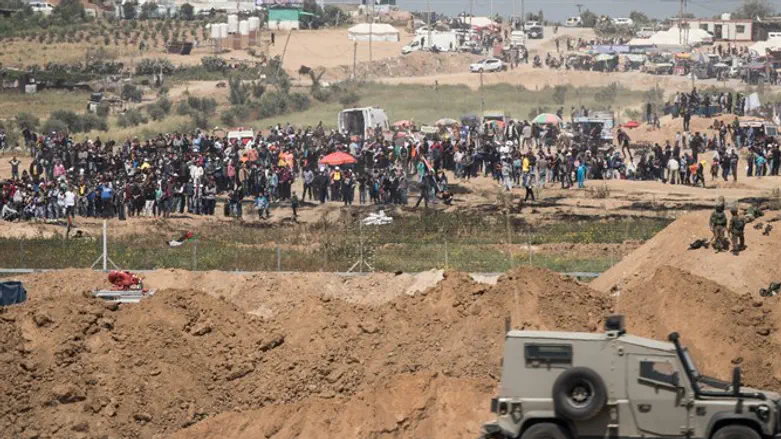
Over the weekend Hamas and Islamic Jihad in Gaza fired more than 200 rockets and mortar shells into Israel while the Israeli air force responded by striking dozens of terror-related targets in the coastal enclave.
Approximately 20 rockets were intercepted by the Iron Dome system while three Israeli citizens were lightly injured by a mortar shell which exploded in the city of Sderot opposite the northern Gaza Strip.
On Saturday night, Israeli media broadcast uncorroborated reports that Egypt together with the United Nations and other unnamed international actors had brokered a ceasefire which was violated by Hamas and Islamic Jihad before it was even implemented.
As a result of the continued rocket fire from Gaza tens of thousands Israelis again had to spend the night in bomb shelters, while Hamas and Islamic Jihad also continued the so-called ‘Kite Jihad’ which has already scorched thousands of acres forest and agricultural fields in southern Israel.
Intelligence minister Yuval Steinitz blamed Iran and Palestinian Authority leader Mahmoud Abbas for the new escalation in southern Israel, stressing that Israel will "not accept any type of terrorism. Not rockets, not tunnels and not arson with balloons and kites.”
“Any violation of our territory, harm to the residents or damage to property, will be answered with great force," Steinitz warned.
The veteran Israeli politician said PA leader Mahmoud Abbas was trying to create a “humanitarian explosion” by withholding salaries of civil servants in Gaza and by undermining water and energy supply to the impoverished enclave which has been ruled by Hamas since 2007.
Other Likud politicians, such as transportation minister Yisrael Katz, blamed defense minister Avigdor Liberman for not implementing his earlier threat to liquidate Hamas and Islamic Jihad leaders which would restore the “balance of power” as he put it.
Katz also indicated Israel would not let Hamas and the Iranian proxy Islamic Jihad dictate the terms of a possible new war.
“We would've done it (going to war) on our own terms. We'll strike whoever we need to whenever we need to and move on," Katz argued.
Education minister Naftali Bennett used similar language but demanded a large-scale military operation in Gaza to restore Israel’s sovereignty and deterrence vis-a-vis the terror organizations in Gaza.
“I don't believe that we should allow Hamas, after 100 days (of Kite Jihad) and over 200 rockets (this weekend), to dictate conditions to us,” according to the leader of the Jewish Home party.
Bennett, who scoffed at the ‘ceasefire,’ repeated his opinion that Israel’s restraint was the root cause of the current escalation.
"Anyone who practices restraint in the face of violation of our sovereignty and prevents a thorough military operation, is essentially decreeing that we will remain in an ongoing war of attrition. We have to allow the IDF to act forcefully, with sophistication - and thoroughly," Bennett said in a statement on Saturday evening.
The education minister later said the latest attempt to reach a ceasefire with Hamas was a “grave error” and, ahead of an emergency meeting of Israel’s security cabinet, vowed the Jewish Home ministers would oppose a ceasefire that would not include a complete halt of the ‘Kite Jihad’ and would prevent Hamas from rearming.
A few hours after Bennett made his remarks a poll was published by the Panels Politics Institute indicating a majority of the Israeli public agrees with Bennett.
The survey showed that 44% of the Israeli public feels Hamas has the upper hand in the current round of violence while only 27 percent disagreed and said Israel came out on top.
This all begs the question why Netanyahu has limited Israel’s response to the escalation in the south to tit for tat operations against Hamas’ and Islamic Jihad’s military infrastructure in Gaza.
Since the majority of Netanyahu’s government seems to agree with Yuval Steinitz that Iran is behind the continuing violence emanating from the Gaza Strip, one should look at the broader picture.
Israel is already engaged in a two-front war with Iran and its proxies, but the danger emanating from the Syrian front is a far more critical threat than Gaza, according to experts - and apparently PM Netanyahu acts according to this line of thinking.
A new war with Hamas and Islamic Jihad will probably bring complete chaos to Gaza and will not bring stability to southern Israel. Such a war will also tie the hands of the IDF at a moment that the Iranian axis is approaching the Israeli border on the Golan Heights.
On Sunday, the Iranian axis captured the village of Mashara in the Quneitra province and is now only 11 km away from the Israeli border, the Syrian Observatory for Human Rights announced.
The move came after the IDF shot down two Syrian or Iranian drones on the Golan Heights last week and after the pro-Assad coalition launched an offensive against Islamic State branch Jaish Khalid Ibn al-Walid, which controls the Yarmuk basin near the southern Golan Heights, at the end of last week.
Russian warplanes are reportedly supporting the offensive with airstrikes against the rebels.
The escalation at the northern front is therefore regarded as a far more urgent security threat to Israel than the ongoing “Kite Jihad” and the barrages of short-range rockets and mortar shells from the Gaza Strip.
As Netanyahu’s third trip in six months to Russian president Vladimir Putin last week made clear, the Israeli government sees the advances of the Russian-Iranian-backed pro-Assad coalition in southwest Syria as a critical threat which must be addressed immediately, while the situation in the Gaza belt is considered to be manageable at the moment.