
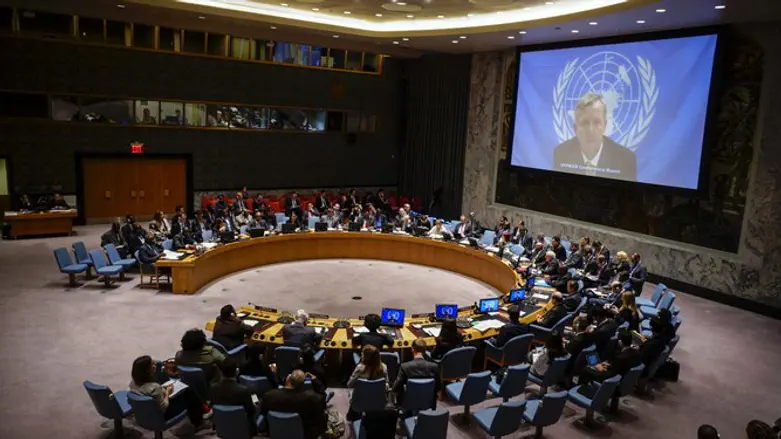
The UN Security Council on Friday blacklisted 27 ships, 21 companies and a businessman for helping North Korea circumvent sanctions, AFP reported.
The sanctions keep the pressure on Pyongyang despite its recent diplomatic opening to talks.
Acting on a request from the United States, a council committee approved the largest-ever package of sanctions designations on North Korea, a council diplomat told AFP on condition of anonymity.
The move is part of a global crackdown on the smuggling of North Korean commodities in violation of UN sanctions resolutions, which were adopted in response to Pyongyang's nuclear and ballistic missile tests.
A total of 13 North Korean oil tankers and cargo vessels were banned from ports worldwide along with 12 other ships for helping Pyongyang smuggle banned commodities or supplying oil and fuel shipments, according to a UN document obtained by AFP.
Two other North Korean vessels were hit with a global assets freeze, but are not banned from port entry.
21 shipping and trading firms were hit by an assets freeze. Three of them are based in Hong Kong including Huaxin Shipping, which delivered shipments of North Korean coal to Vietnam in October.
12 North Korean firms were blacklisted for running ships involved in illegal transfers of oil and fuel, according to the document.
Two other companies -- Shanghai Dongfeng Shipping and Weihai World Shipping Freight, also based in China -- were blacklisted for carrying North Korean coal on their vessels.
The remaining firms are in based Singapore, Samoa, the Marshall Islands and Panama.
A businessman identified as Tsang Yung Yuan was hit by a global travel ban and assets freeze for organizing illegal shipments of North Korean coal with a North Korean broker in Russia, noted AFP.
Commenting on the sanctions, U.S. Ambassador to the UN Nikki Haley said, “These new designations were proposed last month by the U.S. Mission to coincide with the announcement of the U.S. Treasury Department’s largest-ever North Korea sanctions package, and are part of a coordinated U.S. government effort with our allies and partners to continue the maximum pressure campaign on the North Korean regime and systematically shut down its maritime smuggling activities.”
“The approval of this historic sanctions package is a clear sign that the international community is united in our efforts to keep up maximum pressure on the North Korean regime. We want to thank the members of the Security Council, as well as Japan and South Korea, for working with us to keep up the pressure and for their commitment to implementing UN Security Council resolutions and holding violators accountable,” Haley added in a statement.
The new sanctions come as the United States moves to open talks with North Korea on its nuclear program. President Donald Trump recently agreed to a meeting with North Korean leader Kim Jong Un, to be held by the end of May.
Trump later said he anticipates "tremendous success" in the meeting. The White House has stressed, however, that any meeting between Trump and Kim would be conditioned on “concrete actions” by Pyongyang.
American officials have made clear they will keep the pressure on Pyongyang to shift course by pressing on with sanctions despite Trump agreeing to the meeting with Kim.
North Korea has been seeking to develop a nuclear-tipped missile capable of reaching the U.S. mainland.
In the most recent of its ongoing missile tests, North Korea launched a Hwasong-15 missile, a new type of intercontinental ballistic missile (ICBM) which officials said can fly over 13,000 km (8,080 miles).
Pyongyang said following the launch that it had test-fired its most advanced missile, putting the U.S. mainland within range, and also declared itself to be "a responsible nuclear power".
(Arutz Sheva’s North American desk is keeping you updated until the start of Shabbat and Passover in New York. The time posted automatically on all Arutz Sheva articles, however, is Israeli time.)