
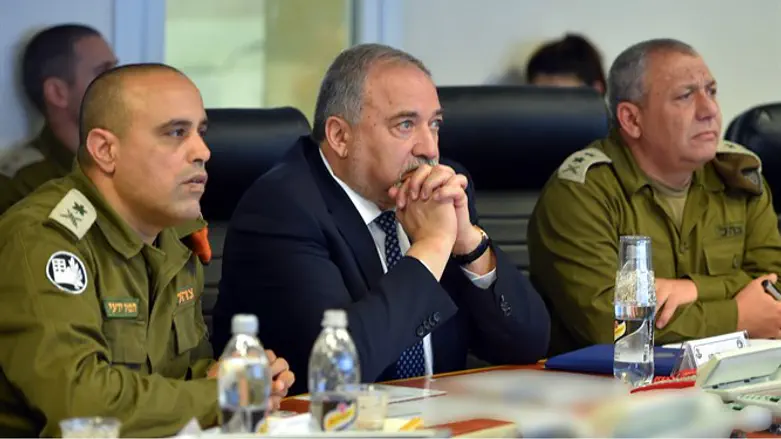
Defense Minister Avigdor Liberman (Yisrael Beytenu) spoke out Thursday morning in an interview with Army Radio about the bickering surrounding credit for the 2007 Israeli attack on the Syrian reactor that broke out immediately after the announcement.
Liberman was asked about his statement yesterday that he had regretted permitting the publication, explaining, "The fight over who gets credit [for the attack], when former officials spill all the state secrets to any media, is something that brings shame to the operation itself."
The Defense Minister emphasized that his criticism was not based on the censor's professional decision, which was justified in and of itself. "They didn't expect that the battle over credits could render people insane, no one imagined that the ego is so important to people that they are willing to wage a war of Gog and Magog."
Later, Liberman refused to "decide" between the versions of then Prime Minister Ehud Olmert and then Defense Minister Barak, "I won't enter into any disputes; it was a brilliant operation and the credit goes to the Prime Minister, to all the security branches, both to the army and to the people who carried out the operation. We must say what the Prime Minister at the time deserves; to make such a complex decision after the Second Lebanon War was not simple: I'm the only cabinet member who has since survived in the cabinet. What's important is the decision itself," Liberman claimed, who joined the cabinet after the Second Lebanon War.
"You don't see what was information disqualified for publication in the last few days," the Defense Minister explained. "It's only because of censorship that we've kept the deepest secrets. They're doing exceptional, unending work, if I take all these years into account. It's intolerable, and has seriously hurt the state's security with the most intimate details."
In response to a question about whether the reports and the battle over credit led to security damage, Liberman replied, "There was damage to state security. I spoke with several security commentators, and everyone believes red lines were crossed."