
Established in the Middle East approximately 4000 years ago, Judaism is one of the world’s oldest religions, and the oldest monotheistic religion. Its long history and rich culture have led to a diverse range of icons and symbols which, together, tell our story and unify our people.
The history and use of these icons are just as fascinating as the religion itself. Here’s a brief summary of some of the most famous Jewish emblems and what they stand for:
Shofars
The shofar plays a big role in many of the Bible’s – and Judaism’s – most important ceremonies. Its most obvious use today is the important part it plays in our Rosh Hashanah (Jewish New Year) celebrations: it’s so important that we are commanded to hear it being blown, and there are special blessings surrounding the ceremony.
Before this, horns played a crucial role in some of Jewish history’s biggest events. It was blown to announce war and celebrate triumph, accompanied the priests around the Temple, and famously helped Joshua bring Jericho’s unbreachable walls crashing to the ground.
The Talmud pays careful attention to what makes a shofar good enough quality to be considered kosher and acceptable for use. It must be from a goat, ram, or deer, and have no cracks or perforations. Today, a huge variety of kudu and ram’s horn shofars are available, so everyone can own their own piece of remarkable Judaica.

Pomegranates
Ruby red, deeply sweet, and juicily refreshing, pomegranates have a long history with the Middle East, Israel, and Judaism. In the book of Deuteronomy, they are listed as one of the seven species native to the land of Israel and special to God and the Jews.
They’re not just symbolic: pomegranates were the original Jewish décor.
They were first used decoratively in Biblical times. In Parshat Tetzaveh, instructions were given for creating the High Priest’s dress garments. The bottom of the priest’s robe was to be decorated with tiny silver bells and embroidered gold pomegranates, as a mark of holiness and honor.
The rubicund fruit’s popularity has never wavered. Today everything from Jewish jewelry and synagogue windows to challah covers and tallitot are decadently covered with shimmering representations of the emblematic fruit.
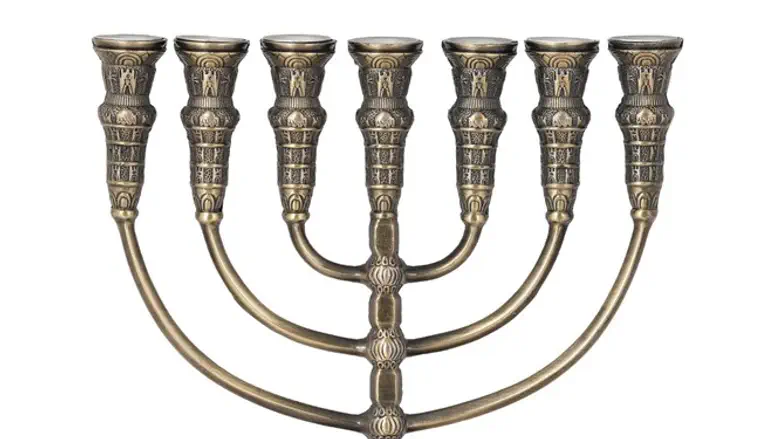
Seven-Branched Menorahs
The seven-branched menorah first appears in the book of Exodus, where Moses is commanded to create an intricately decorated gold candelabra from one solid piece of beaten gold. This elaborate piece of art was housed in the Tabernacle (Mishkan), the portable temple that accompanied the Jews on their trek across the desert, and later took pride of place in Jerusalem’s Temples.
Before the Star of David become popular, the seven-branched menorah was the symbol for Judaism. Aside from its well-documented use throughout Biblical literature, it was found on ancient seals and manuscripts from different historical eras and was the primary emblem for Judaism as late the 13th century, where it was discovered marked in stone in the ruins of an ancient synagogue.
Today, the seven-branched menorah can be found embroidered into synagogue Judaica (for example, on the curtains and cloths that cloak the aron hakodesh – Ark of the Covenant – and the bimah or podium from which prayers are read. You’ll also find it proudly standing in the homes of Evangelical and Messianic Christians who feel a close connection to their faith’s origins.

Stars of David
The Star of David has become the ubiquitous symbol for Judaism, and even takes pride of place on Israel’s flag. Interestingly, the infamous star didn’t start out as a Jewish symbol: known as a hexagram, it was a symbol for peace in ancient Hindu practice.
The Star’s first official use with in 1350s Prague, where the ruling Emperor prescribed the six-pointed star be combined with “Solomon’s Seal” on a red background as a marker for the Jewish community. However, it was used decoratively as early as a thousand years before this, as an engraved stone in northern Israel dating from the fourth century revealed.

Early Kabbalists also found great meaning in the iconic star, believing its shape to have immense significance. They believed that the two interlocking triangles which form the shape represent the interaction of the lower and upper realms of spiritual existence, and that the six directions in which the star points represent the totality of God’s reign and influence over the world.
Today, the Star of David is not just Israel’s emblem. It is used in home décor, appears throughout different Judaica items, and is exceptionally popular in Jewish jewelry.